
SpaceX fired all 33 engines on a Super Heavy at Starbase on Friday, 28 August, and called it a full-duration static fire for Flight 14. The company’s X post that afternoon, the one Mike Wall quoted for Space.com on 29 August, is the primary: “Full duration 33-engine static fire with the Super Heavy booster preparing for Flight 14.” Two videos sat on the post. The pad is in South Texas. The booster is Booster 21.
That is not a Falcon Heavy, and it is not Sunday’s Roman lift from 39A. This page is the booster on the Texas stand. The observatory that left Florida at 7:26 a.m. Eastern on 30 August is Liora Hale’s file. Harper Quinn’s is the 33-engine burn that has to happen before Starship tries to go around the planet.
Ship 41, the 52-metre upper stage for the same flight, had already done its engine work. Space.com noted the six-Raptor firing the week before. NASASpaceflight’s Flight 14 notebook put Ship 41 at Massey’s for a single-engine deorbit-burn demonstration and then a full-duration, about 60-second, six-engine static fire, delayed hours by methane-side tank-farm trouble and then completed. The ship and the booster are now a pair of completed hotfires waiting on a stack.
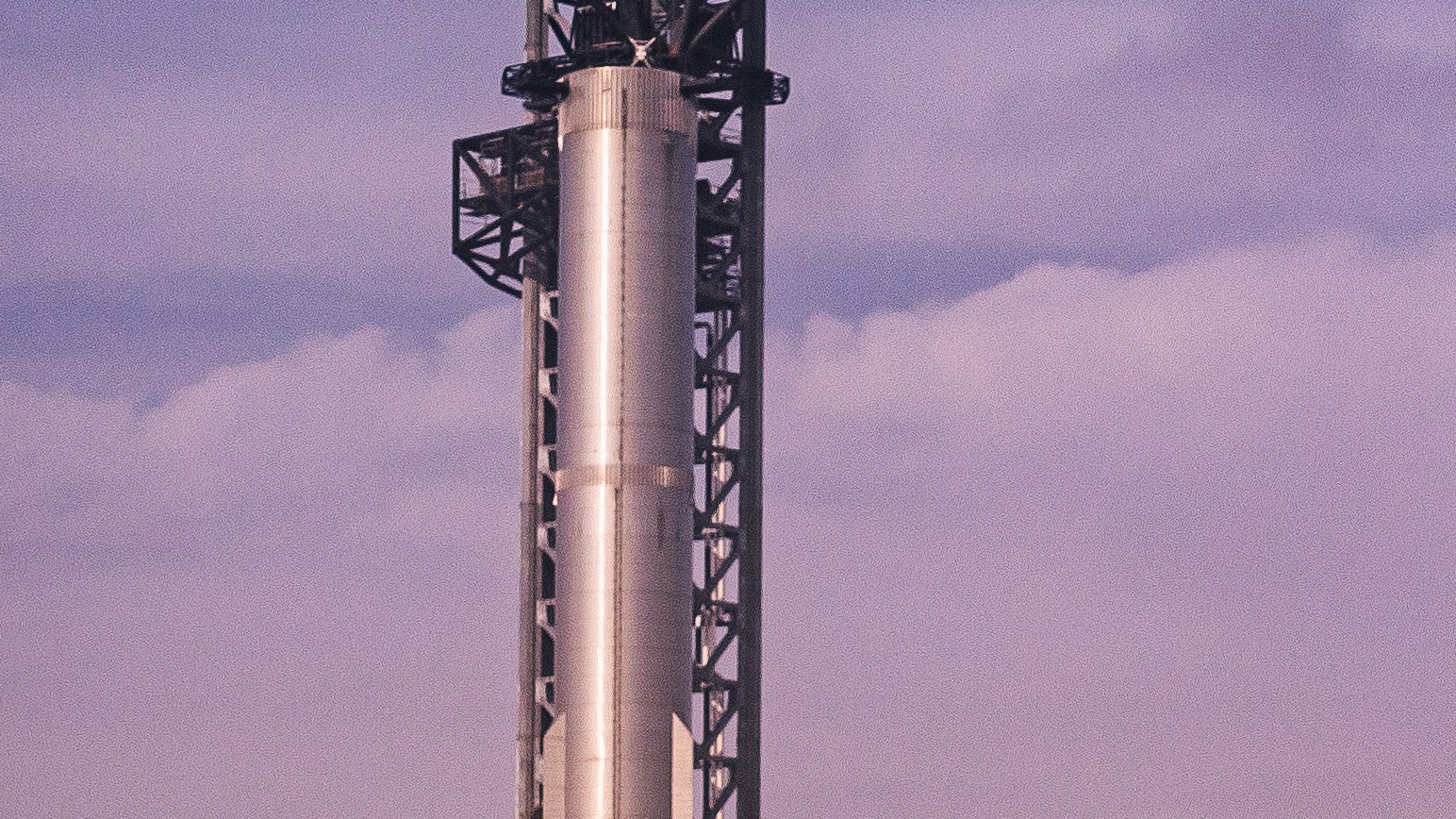
Booster 21 did not go straight from the high bay to a 33-engine day. NASASpaceflight had it still in Mega Bay 1 while Ship 41 finished at Massey’s. Secondary files dated 30 August put the booster’s cryogenic proof in mid-July, 18 to 20 July, then a wait, then a roll to Pad 2 on 25 August. Amy Doehring’s public note, quoted in Zona Integritas’ 28 August wrap, was “Booster 21 is on the move.” The static-fire window those same files gave ran 24 August through 5 September. Friday the 28th sat inside it.
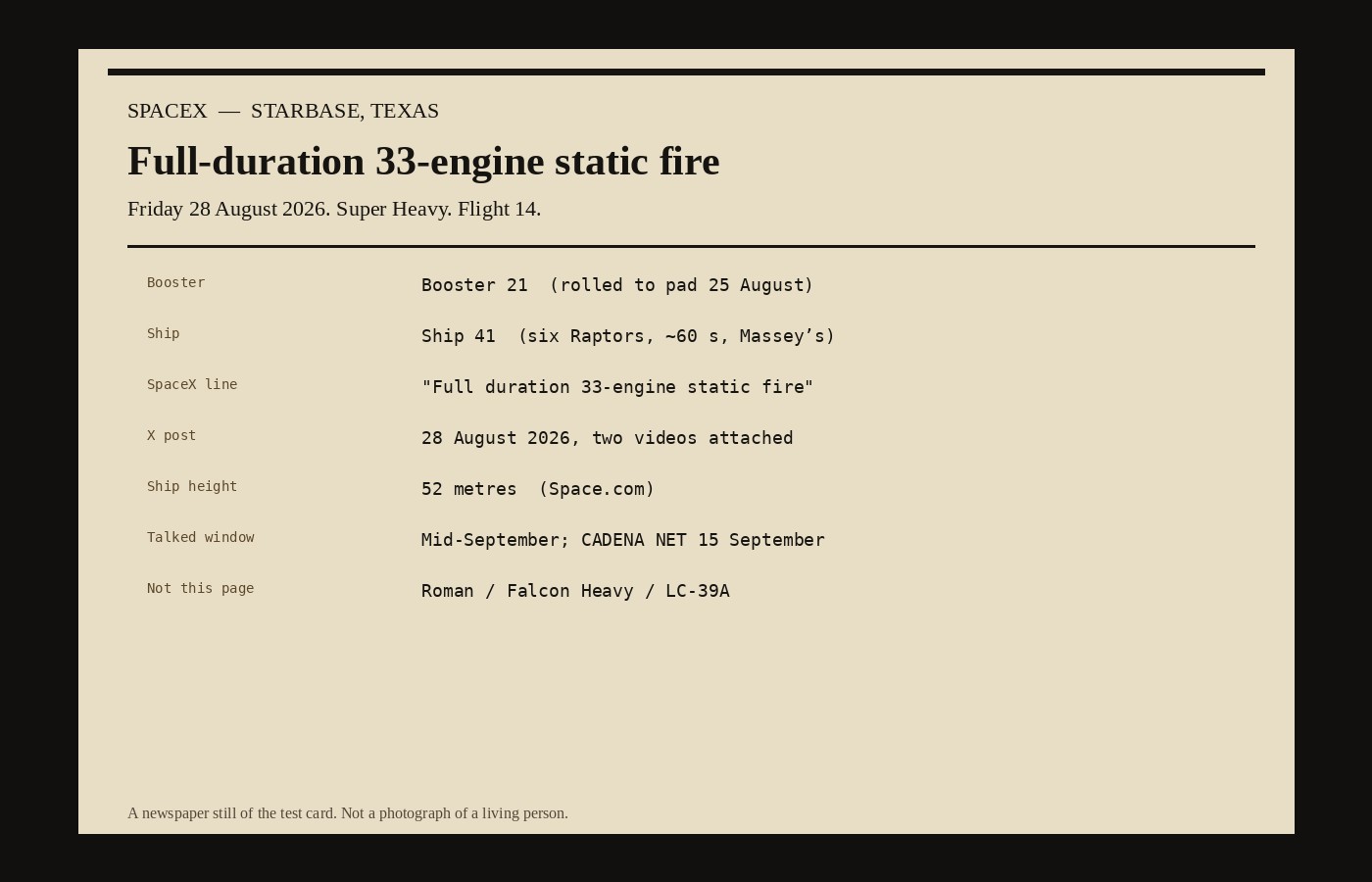
SpaceX’s own words are “full duration.” One later wrap said 15 seconds. This desk is not going to split a stopwatch the company did not publish. The primary is the company’s sentence and the two videos. Full duration, in this programme, is the length the flight needs from those 33 Raptors on the pad, held down, not a launch. If a later mission page prints a number of seconds, that number will replace the adjective. It has not, as of this file.
Flight 14 is being talked as Starship’s first orbital-class trip. Space.com’s 29 August piece said so, and said SpaceX is believed to be targeting mid-September. NASASpaceflight cited the CADENA space-operations presentation listing a no-earlier-than of 15 September, slipped from an earlier NET of 28 August. SpaceX itself, on the Friday post, did not print a clock. Treat mid-September as a working window, not a countdown. The FAA licence for the flight was still a live item in late-August roundups. Hardware that has now static-fired both stages is the part of that window this page can name without guessing a hold.
The payload talk on Flight 14 is Version 3 Starlink. Space.com said Ship would deploy a batch of operational V3 satellites if the trajectory holds. Flight 13, 24 July, put 20 V3s on a suborbital path; they came back in. An orbital Flight 14 is the difference between a demonstration dispenser and a constellation insert. KeepTrack’s 30 August X-report had the constellation at 12,881 launched, 11,102 in orbit, 11,087 operational. Those three numbers are a census sitting next to the test, not a launch manifest.
Recovery, on the late-August planning notes, is not a tower catch this time. LookToSpace, compiling the public remarks, had Booster 21 aimed at a Gulf splashdown rather than the chopsticks, and Ship 41 at an Indian Ocean splashdown after the trip around. Elon Musk, on 20 August on that same compilation, had deferred the first Mechazilla catch of a Ship. SpaceX has caught Super Heavy before. Catching the ship is a later flight until the company says otherwise. Pad 2 is the active orbital stand at Starbase for the rest of 2026 on those notes; Pad 1 is in a longer rebuild.
The 52-metre figure is Space.com’s conversion of the 171-foot ship. This newspaper uses the metre. Super Heavy under it is the stainless first stage with 33 Raptor 3 engines in the Block 3 stack. Flight 14 is being counted as the third Block 3 flight and the fourteenth integrated test. Those labels are the programme’s, not a fresh christening on Friday.
Ship 40 is the other hull, the one that flew Flight 13 and spent weeks in the Indian Ocean. Forte taking that hull off Christmas Island is already on this paper, Harper Quinn, 30 August in the morning book. It is not this test. Mixing a recovery of Ship 40 with a static fire of Booster 21 is how a desk gets two vehicles into one sentence they do not share. Flight 14 is Ship 41 on Booster 21. Ship 40 is coming home the long way.
NASA’s interest sits one layer out. Space.com recapped the Artemis bets: Ship as a crewed lunar lander, Artemis III to Earth orbit in mid-2027 on the current public plan, Artemis IV a landing in late 2028, Blue Origin’s Blue Moon still in the same conversation as a second lander. None of that launched on Friday. Friday was 33 engines, held, at Starbase. The lunar timetable needs this vehicle to start making orbital flights that look boring. Flight 14 is the attempt to start that boring.
What still has to happen, named without a date, is rollback, stacking, a wet dress if the company runs one, and a licence. NASASpaceflight had Ship 41 due back to Mega Bay 2 for payload work after Massey’s. Booster 21 has now done the thing it rolled out to do. A stack on Pad 2 is the photograph this page does not yet have. The photograph it does have is a Super Heavy on the tower, place not a face, a stand-in for Booster 21’s Friday because the company’s own stills from the burn are on X, not in the Commons tray this desk pulled.
The dates again, because the dates are the file. 18–20 July, cryo proof on the booster, per the 30 August secondary wrap. 18 August, Ship 41 to Massey’s. 25 August, Booster 21 to Pad 2. 28 August, full-duration 33-engine static fire, SpaceX’s post, Space.com the next day. 30 August, KeepTrack’s census and the Roman launch, which is not this vehicle. Mid-September, the working talk for Flight 14, CADENA’s NET 15 September. This Monday desk is the static fire, held, 33 engines, Texas. The Florida heavy that flew on Sunday can stay on the other page.
The paper
Comments
No notes on this story yet.
Sign in to comment