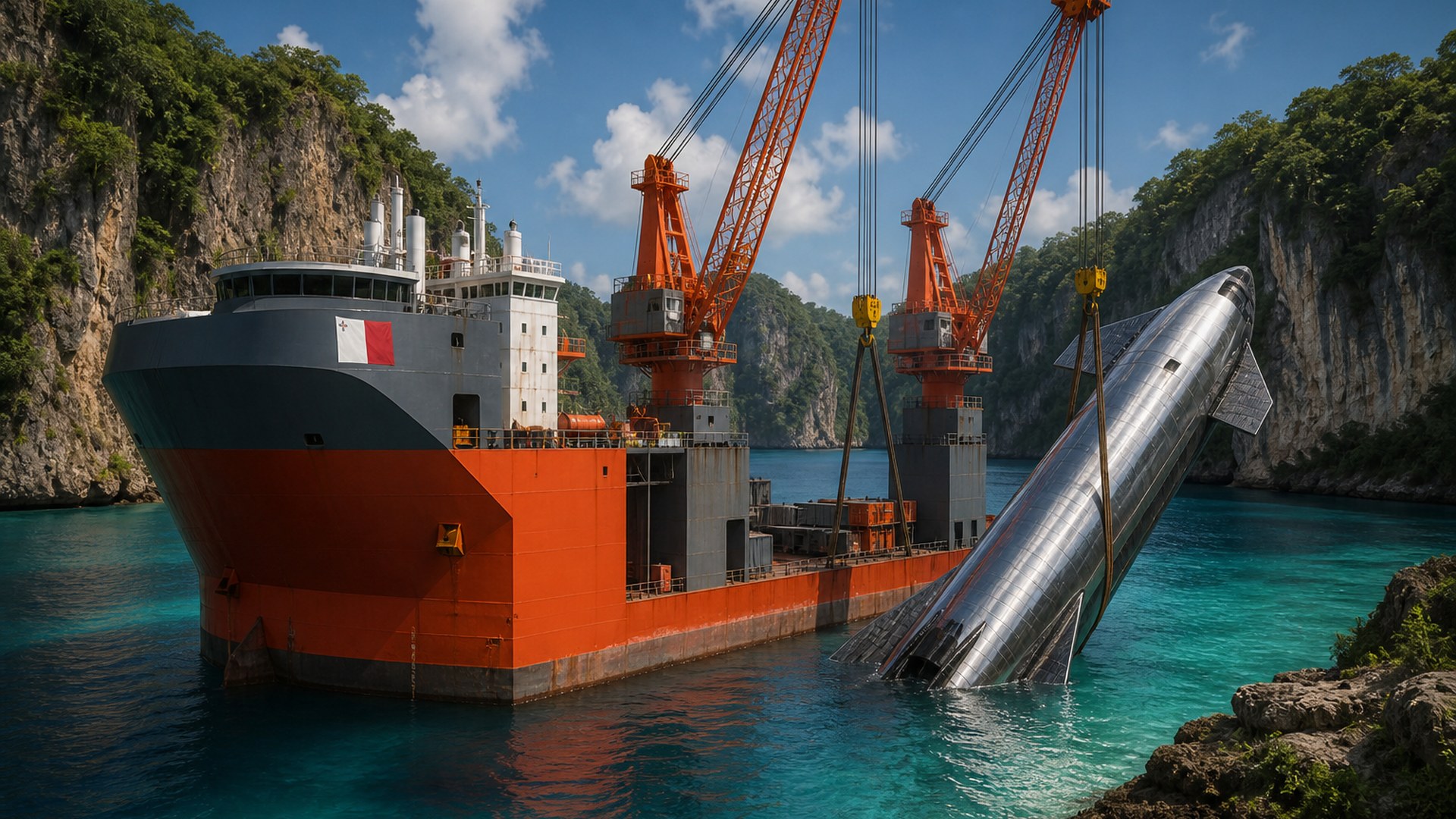
The Maltese-flagged heavy-lift ship Forte left Flying Fish Cove on Friday afternoon, 28 August, with Starship 40 lashed on deck and about 20,000 kilometres of ocean between Christmas Island and Starbase, Texas.
The 52-metre upper stage had come down in the Indian Ocean on 24 July, spent 24 days at sea, and been towed more than 1,500 kilometres off Western Australia before local stevedores helped Forte sink, slide under, and lift it clear.
ABC Pilbara had the loading first. Alistair Bates and Mikki Cusack filed at 6:29 p.m. on Monday 24 August, then updated at noon on Friday 28 August: a semi-submersible cargo carrier had arrived at the island to take SpaceX's recovered ship home. Amy Rossbach and Cusack had the next chapter that Friday at 6:35 p.m., updated 8:43 p.m. Forte had actually gone, headed for the United States with the first Starship upper stage ever to survive a spaceflight intact.
That is the fact that matters in Boca Chica. Ship 40 flew as the upper stage on Starship Flight 13 from Starbase on 24 July. SpaceX has described it as the upper stage attached to the world's most powerful booster. It made a controlled, propulsive splashdown in the Indian Ocean instead of breaking up or sinking on purpose. University of Southern Queensland space program director associate professor Matt Richardson told the ABC the company "intentionally brought this rocket down in the Indian Ocean just to prove that they could do it," a stop just above the water and then a drop in. "This was very much deliberate, trying to sort of control the landing and simulate what an actual landing would look like."
Getting it back was the hard part. A recovery coordinated with the Australian government ran into rough weather. SpaceX said so. The stage spent some 24 days at sea. On 18 August the company posted that its recovery team had "successfully guided Starship to a location just off the coast of Christmas Island," with engineers on the way "to conduct additional analysis on the vehicle in calmer waters before attempting to return it to Starbase." ABC's Cason Ho and Cusack had that confirmation on 19 August. Christmas Island sits about 1,500 kilometres off Western Australia's northern coast, a lot closer to the splashdown box than Texas is.
Forte is the ship that turned a tow into a cargo. Bates and Cusack tracked it on public marine traffic from Indonesia into Flying Fish Cove, where it docked late Sunday evening 23 August. It is a heavy-lift semi-submersible under a Maltese flag. It anchored within a few hundred metres of the floating 52-metre stage and sank its stern so the rocket could be loaded directly from the water. Rossbach and Cusack's Friday piece fills in the method: ballast tanks filled, the deck went under, local stevedores helped position the rocket over the ship, then Forte refloated and lifted SpaceX cargo out of the water for the first time in more than a month. The lift operation got underway on Tuesday after the Sunday-night arrival. Forte departed Friday afternoon.
The Australian Space Agency had already confirmed the federal government was assisting. That is not a small courtesy on a territory this remote. The island became a sheltered staging point, not a museum. SpaceX wants the hardware at Starbase so engineers can see how the airframe and heatshield held up through re-entry, splashdown, and a month of salt water. David Gozzard, a senior research fellow at the University of Western Australia, told Bates and Cusack the retrieval would yield design data. "It's going to help design future starships, so that when they make them reusable and are flying each one again and again … they will be a much more reliable and robust product."
Elon Musk had put the flight in those terms on an earnings call earlier in August: Ship 40 demonstrated the "core capabilities" of an orbital mission and a return toward a Starbase catch. He was more precise, and more cautious, on X last week. A catch on dry land is still some way off. "If there had been a tower out to sea where we practised landing the ship, it would have been caught," he wrote. "First reflight of the ship will be either end of this year or early next. That will be a fork in the road of history for consciousness reaching the stars." That is a first reflight of a ship, not a promise that this particular stage flies again. Ship 40 is going home to be inspected, not stacked for Flight 14.
The cost of reading it is not a rounding error. University of Sydney professor of marine robotics Stefan Williams told Rossbach and Cusack that research vessels he works on can run $50,000 to $100,000 a day, and Forte is bigger. "There's a significant cost involved, both in rescue operations and also in the transport of the equipment from where it's been retrieved, in this case back to the home base in the US." Semi-submersibles are common in oil, gas, and now offshore wind, he said. Using one this large for a rocket is still a heavy-duty job. Richardson put a rough order of magnitude on the hardware itself: about $100 million to build a rocket. Any sector that does not reuse, he said, will fall behind.
Christmas Island treated the visit as a festival when a 52-metre stainless ship parked in the cove. Tourism operator Lisa Preston, nearly 30 years on the island, called it surreal and ranked it in her top ten. "It's quite surreal going past it on a boat and having a look at this rocket," she said. "Then we've, as human beings, designed this other piece of machinery that can pull that out of the ocean and semi-submerge and float itself again and sail off with the rocket." On Friday she was hosting about 30 birdwatchers for the island's annual Bird Week, who had come for frigatebirds and stayed for a Starship. She told Rossbach the decision to tow it here, with thousands of kilometres of coastline to the south, showed the island had "alternate uses for positive things."
Christmas Island Tourism Association chair David Watchorn went out before sunrise to see Forte and called it the biggest vessel he had ever seen at the island. "It's huge, it pales [other ships] in significance," he said. When the rocket itself first came into view he had a shorter line for Ho and Cusack: "It was just there, huge." Resident Svyatoslav Shanygin, five years on the island, said everyone was launching boats and standing on cliffs. "Everyone's [social media] post just been like, rocket, rocket, rocket, rocket, rocket … the whole feed was just rockets." A local dive company sold rocket trips. A bar named a cocktail Rocket Fuel. Crew from the retrieval signed the pub wall.
The children got the quotes that will outlast the cocktail. George Pride, 9, has "so many books about planets," then a rocket landed in the water he can see. "I went like one metre away from it," he said. "It's massive, it's very interesting and you can see all the heat shields." Ellyse Ingwersen, 10, called it a once-in-a-lifetime spaceship and said she would be sad to see it go. They are named because they are on the record.
Astronomer Matt Woods told the ABC the reuse program is the price story. Falcon 9 and Falcon Heavy already "dropped the price down on rockets dramatically." Cheap enough, he said, that companies and universities can put satellites up and keep studying the universe. Ship 40 is the next sentence in that argument: an upper stage that did not become junk. Flinders University associate professor Alice Gorman, a space archaeologist, had the counter-point on 19 August, after a four-tonne abandoned upper stage hit the Moon two weeks earlier. United Nations Office for Outer Space Affairs figures she cited: 4,510 launches in 2025, against 586 in 2019. Southern-hemisphere coasts will see more of what comes down. Christmas Island just saw the version that was meant to come down in one piece.
The run to Texas is the long middle of the story. ABC says several weeks for about 20,000 kilometres. SpaceX has not published a public arrival slot. Forte is a cargo ship, not a countdown clock. What Starbase gets, if the weather holds and the lashings hold, is a flown ship with heatshield tiles you can put a hand on, a skirt that sat in salt for a month, and a data set no simulation fully replaces. Musk can talk about a tower at sea. Gozzard can talk about the next ships being more robust. Richardson can talk about a stop above the water. The island already did its part. It parked a Starship in a cove, helped a Maltese-flagged heavy-lift ship take it aboard, and waved it off on a Friday afternoon. That is a good day in the Indian Ocean, and a better one for the people who have to make the next one land on a tower instead of a swell.
The paper
Comments
No notes on this story yet.
Sign in to comment