
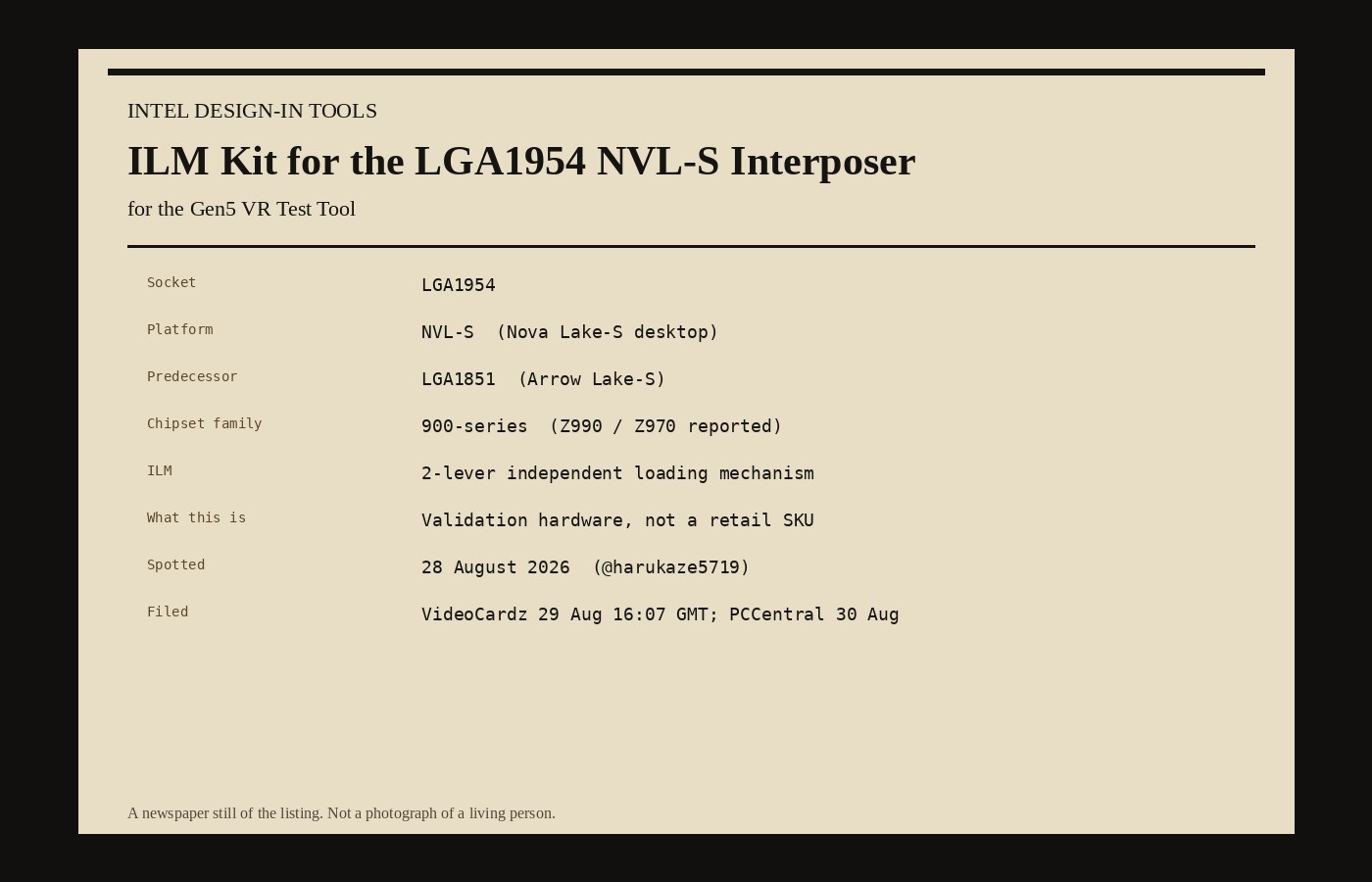
Intel put LGA1954 next to NVL-S on a page it operates. The object is not a keynote. It is a line in the Design-In Tools store: “ILM Kit for the LGA1954 NVL-S Interposer for the Gen5 VR Test Tool.”
The tweet that moved the listing was @harukaze5719 on 28 August. VideoCardz filed it at 16:07 GMT on 29 August under the heading that Intel had confirmed the socket for Nova Lake-S through an official test-tool listing. TechPowerUp dated the same confirmation Saturday, 29 August. PCCentral’s Bartosz Mazur put a 30 August 10:54 a.m. stamp on it. eTeknix and TopCPU followed on the 30th. The pairing of the two names on an Intel site is the news. A motherboard leak is not.
NVL-S is Intel’s shorthand for the Nova Lake desktop platform. LGA1954 is the socket. LGA1851 is the one it replaces. Arrow Lake-S lived on 1851. The next desktop does not.
The listing is validation hardware. VideoCardz was careful on that point, and the care is load-bearing. Design-In Tools is the catalogue Intel keeps for engineering and technical enablement. Some of it is gated to approved companies. A Gen5 VR test tool is a voltage-regulator and platform-validation kit. An independent loading mechanism kit for an interposer is the metal that holds a package onto a socket while someone measures power. It is not a boxed Core Ultra. It is not a 900-series retail board. It is Intel writing LGA1954 and NVL-S in the same product name on a site Intel runs.
That is why the week treated it as confirmation rather than as a launch. VideoCardz said LGA1954 itself was not new information. Shipping records had tied the socket to Nova Lake-S more than a year earlier. Photographs of a Nova Lake-S package showing the contact layout had already circulated. Corsair and Asetek had already listed LGA1954 compatibility on coolers. The difference, VideoCardz wrote, is the source. Not a shipping record. Not a cooler table. An Intel-operated website.
PCCentral’s 30 August file put the mechanical consequence in one line. Existing motherboards will not take the new processors. The socket is the upgrade path. LGA1954. Platform codename NVL-S. Predecessor LGA1851. Motherboard chipset family: 900-series. Those four rows are PCCentral’s table, dated 30 August, built from the same listing.
eTeknix, also working from the 28 August tweet, named a dual-lever retention mechanism, 2L-ILM, intended to spread pressure across the heat spreader. Arrow Lake’s generation had a well-documented habit of bending the IHS in the centre and hurting the thermal path. A two-lever ILM is a mechanical answer to that complaint. eTeknix attributed the 900-series pairing to Z990 and Z970 boards. Those chipset names are in the clip. They are not on the ILM kit’s own title. Keep the attribution.
TopCPU, Sunday 30 August, went further on the product family. The listing, that piece said, is the first time Intel has publicly confirmed the link between LGA1954 and Nova Lake-S. It put the processors in the Core Ultra 400 series, on 900-series boards, with a launch expected in the first quarter of 2027. TechPowerUp, a day earlier, had the same Q1 2027 expectation. Intel, in the listing, did not print a launch month. It printed a socket, a platform code, and a test tool. Expected is not announced. Q1 2027 is the desks’ consensus around that listing, not a slide from Intel’s event stage this week.
OC3D and others have, separately, circulated a staggered 2027 calendar: a 28-core DS part in late January to March, a 28-core K in March or April, 16-core and 8-core parts later in spring, a 52-core DS flagship from late May into September. Those rows are a leak calendar. They are not the Design-In Tools line. This page will not launder a leaker’s table into Intel’s confirmation. The confirmation is the socket name sitting next to NVL-S. Core counts, cache recipes, and a 52-core dual-compute-tile story remain in the rumour file until Intel puts them on a product page.
What a builder can take from this week, without waiting for a keynote, is the mechanical fact. The next Intel desktop wants a new motherboard. Cooler vendors are already cutting LGA1954 retention. The pin field is 1954 lands, not 1851. You do not mix them. You do not adapter them with a hopeful bracket from the last cycle. You buy the 900-series board when the board exists, or you stay on Arrow Lake.
AMD, in the same season, has been putting Zen 6 names on its own documents — Olympic Ridge and Medusa1 on AM5, Medusa1 and Medusa2 on FP10 — which is a different company’s paper and a different socket story. AM5 staying AM5 is the contrast, not the news of this file. Intel is moving the land grid. That is the sentence VideoCardz, TechPowerUp, PCCentral, eTeknix and TopCPU all filed between 28 and 30 August, and it is the sentence the listing actually supports.
A socket change is a tax. It is also how a vendor resets the power-delivery and mechanical envelope when the package outgrows the last hole. Nova Lake-S, on every public description of the architecture that is not this listing, is a chiplet desktop with more cores than Arrow Lake and a last-level-cache variant aimed at the same job AMD’s X3D parts have been winning. None of that is in the ILM kit’s title. Do not pretend it is. The kit says the hole is 1954 lands wide and that the platform code is NVL-S. Builders who were hoping LGA1851 would get one more generation now have Intel’s own string that it will not.
Corsair’s TITAN II ULTRA and Asetek’s listed LGA1954 kits are the supply chain moving before the CPU does. A cooler vendor does not wait for a launch keynote to cut a retention ring. They wait for a socket drawing. The drawing, this week, is effectively public because Intel sold an ILM kit under the socket’s name. If you already own an Arrow Lake tower, the honest calendar is: keep the 1851 board until a 900-series board is on a shelf you can buy, then move. There is no BIOS that turns 1851 into 1954. There is no interposer in that Design-In catalogue for a gamer. The interposer in the catalogue is for a voltage-regulator test. Builders who treat a validation SKU as a promise of December retail will be waiting on a quarter Intel has not printed on that page.
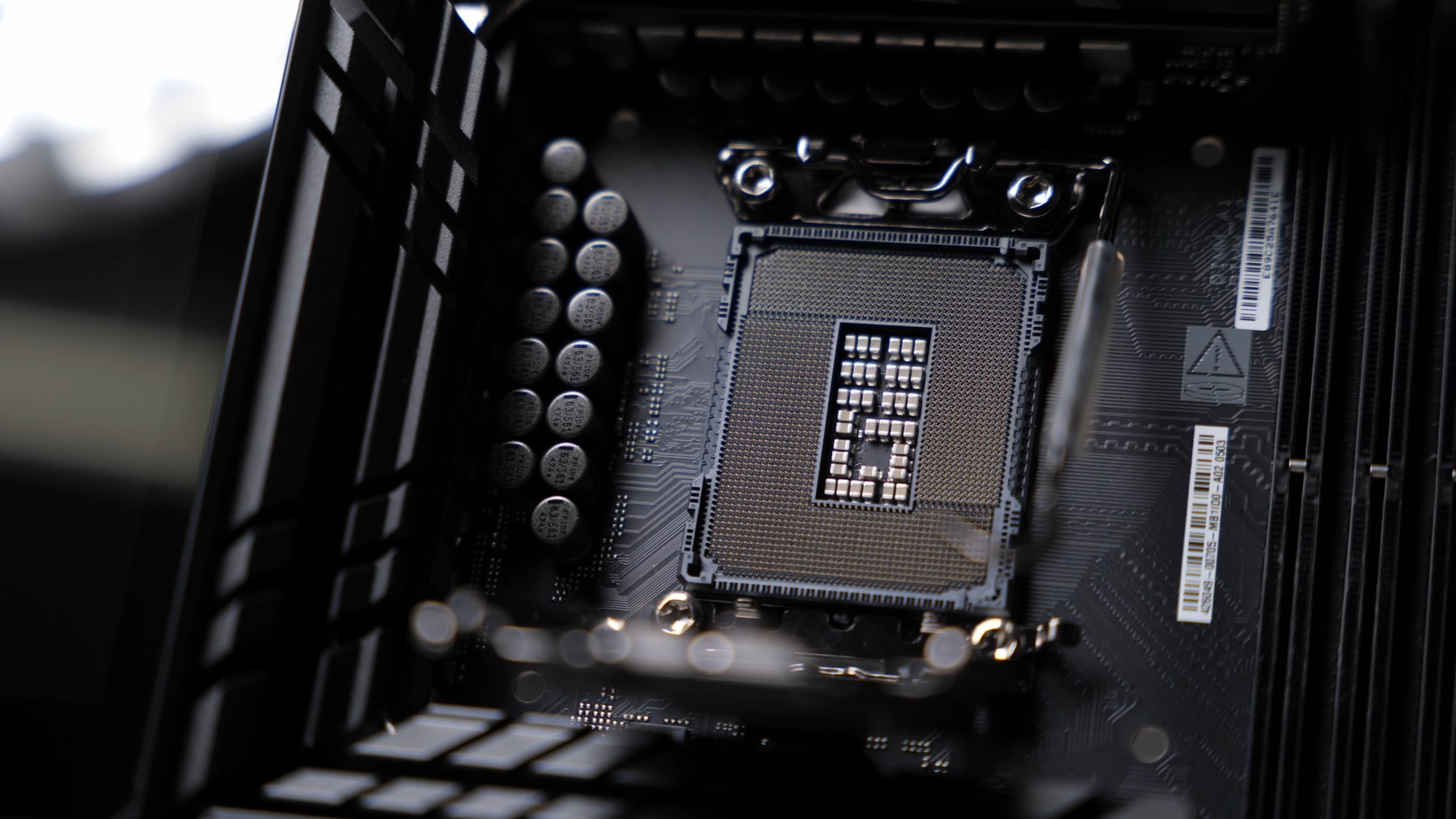
The hero photograph on this page is an empty LGA1851, the socket being replaced, because LGA1954 is not in retail cameras yet. The still is the listing. The date on the still is the week. 28 August for the tweet. 29 August for VideoCardz at 16:07 GMT and for TechPowerUp. 30 August for PCCentral and TopCPU. No living face. No invented SKU. No launch party. A test tool with the right two names on it, on a site Intel runs.
The paper
Comments
No notes on this story yet.
Sign in to comment