
NASA’s Starling swarm has shown it can find its own orbit without GPS. The demonstration is called FALCON. The agency posted the result on 17 August 2026 from Ames. ScienceDaily recirculated the same milestone on 26 August. The numbers are NASA’s.
FALCON stands for Fast Autonomous Lost-in-space Catalog-based Optical Navigation. It is a joint flight experiment with EraDrive, a Stanford spinout. Starling’s cameras and an onboard catalog did the work. The catalog holds about 20,000 known space objects.
17 August is the NASA small-satellite blog date. 26 August is the ScienceDaily recirculation. Starling launched in 2023 as a four-spacecraft CubeSat swarm in low Earth orbit. Ames Research Center in California’s Silicon Valley leads the mission. The Small Spacecraft and Distributed Systems program funds and manages it. Those are the institutional lines on NASA’s own page.
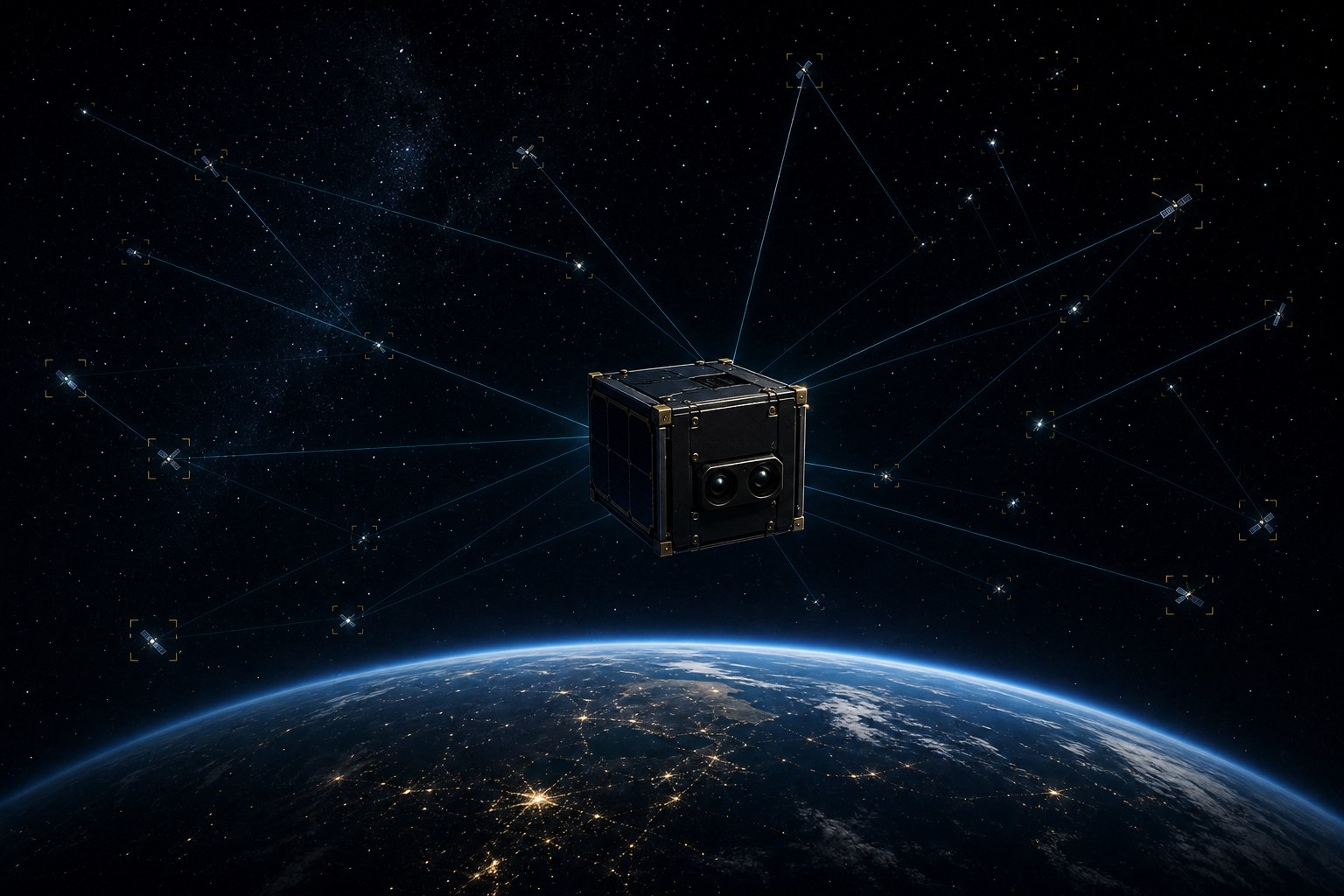
Traditional satellite navigation leans on GPS. GPS fades or vanishes around the Moon and in deep space. FALCON’s bet is simpler and harder at once: treat other spacecraft and orbital debris as moving landmarks. Match what the star-tracker cameras see against a public catalog. Use the verified objects as reference points. Write your own orbit from that geometry. NASA calls the self-orbit determination a first for spacecraft using optical cameras to navigate by relative position to other objects in space. That sentence is NASA’s. It is specific. Earlier probes have steered by stars. Earlier craft have flown without GPS. The novelty NASA names is this optical, catalog-matched, relative-object fix.
Roger Hunter is the program manager for Small Spacecraft and Distributed Systems at Ames. His quote on the 17 August post: “FALCON is yet another success for the Starling demonstration mission. The results from FALCON can have far-reaching implications for on-orbit space-traffic monitoring, collision avoidance, and alternative navigation.” He also said the number of firsts from Starling keeps growing. The quote stays on the page as his.
Two complementary tests ran on the same hardware. In the position, navigation, and timing experiments, FALCON matched camera observations of other spacecraft and debris to the Department of War’s publicly available catalog of known space objects. Verified matches became reference points for Starling’s own orbit. In separate catalog-update experiments, the team loaded the full catalog of roughly 20,000 objects and their predicted orbits onto the spacecraft. FALCON correlated those predictions with fresh optical sightings. Over three days, it improved the known orbits of more than 200 objects with no ground operator in the loop. Better onboard predictions than the ground stations supplied, on NASA’s own comparison. Three days. More than 200 objects. About 20,000 in the loaded catalog. Those are the counts.
EraDrive’s contribution is named Era-Core: flight software and embedded algorithms. Starling already carried star-tracker cameras, the ordinary instruments that pick bright objects to fix attitude. FALCON reused those cameras for navigation and situational awareness instead of adding a new optical stack. A University SmallSat Technology Partnerships project became a startup. Starling became the flight testbed. NASA’s blog frames that path as commercial innovation riding a public swarm. EraDrive is commercializing Era-Core and related hardware for broader use. The partnership line is on the record. The product name is Era-Core.
Later in 2026, NASA plans to extend the experiment so all four Starling spacecraft share tracking data and refine positions collectively. Space.com’s 17 August file says the three-year-old tech demo is extended until at least 2028. Collective navigation is the next flight question: whether one satellite’s moving landmarks become a practical network. That result is not on this page yet. The planned extension is. Four spacecraft. Shared tracking. Collective refine. 2028 is Space.com’s floor for the mission’s continued life, not a promise that FALCON finishes then.
What FALCON is for, in NASA’s own framing: lunar satellite swarms, distributed science missions, human exploration support. Coordinated GPS-free networks matter for surface operations on the Moon or Mars. Science missions need precise relative location when instruments look from several points at once. Space traffic management wants autonomous navigation and catalog updates that lean less on ground networks and catch collision risk earlier. Those three use cases are NASA’s list. Low Earth orbit is where Starling flew the demo. Cislunar and deep space are where the agency says the same idea is needed.
GPS is not obsolete in low Earth orbit tomorrow. FALCON has not flown at the Moon. The more than 200 refined orbits have not been shown as ingested into every ground catalog. EraDrive’s commercial line is not a finished product on every operator’s shelf. NASA demonstrated self-orbit determination and catalog refinement on Starling. The demonstration is the news. The lunar swarm is the destination sentence on the blog, not a flight that has already closed.
17 August 2026, NASA Ames small-satellite blog. FALCON on Starling. EraDrive Era-Core. Star-tracker cameras. Catalog of about 20,000 objects. Three days. More than 200 orbits improved without ground intervention. Self-orbit determination from optical relative landmarks, a first as NASA defines it. Four-spacecraft collective extension later this year. Mission led from Ames. Program funded under Small Spacecraft and Distributed Systems. ScienceDaily’s 26 August note repeats the three-day, 200-object line for a wider audience. Space.com’s same-day file adds the 2028 extension floor. Primary source for the milestone remains NASA’s 17 August post.
A navigation story is news when it has a date, a named system, and a count you can check. FALCON has all three. The date is 17 August. The name is Fast Autonomous Lost-in-space Catalog-based Optical Navigation. The counts are 20,000 in the catalog, more than 200 refined in three days, four CubeSats in the swarm. GPS is the thing the demo learned to do without. Moving landmarks are the method. Starling is the platform. Ames is the lead. EraDrive is the partner. Later this year the four share. Until that collective result posts, the news is the single-spacecraft first NASA already put on the public web.
The paper
Comments
No notes on this story yet.
Sign in to comment