
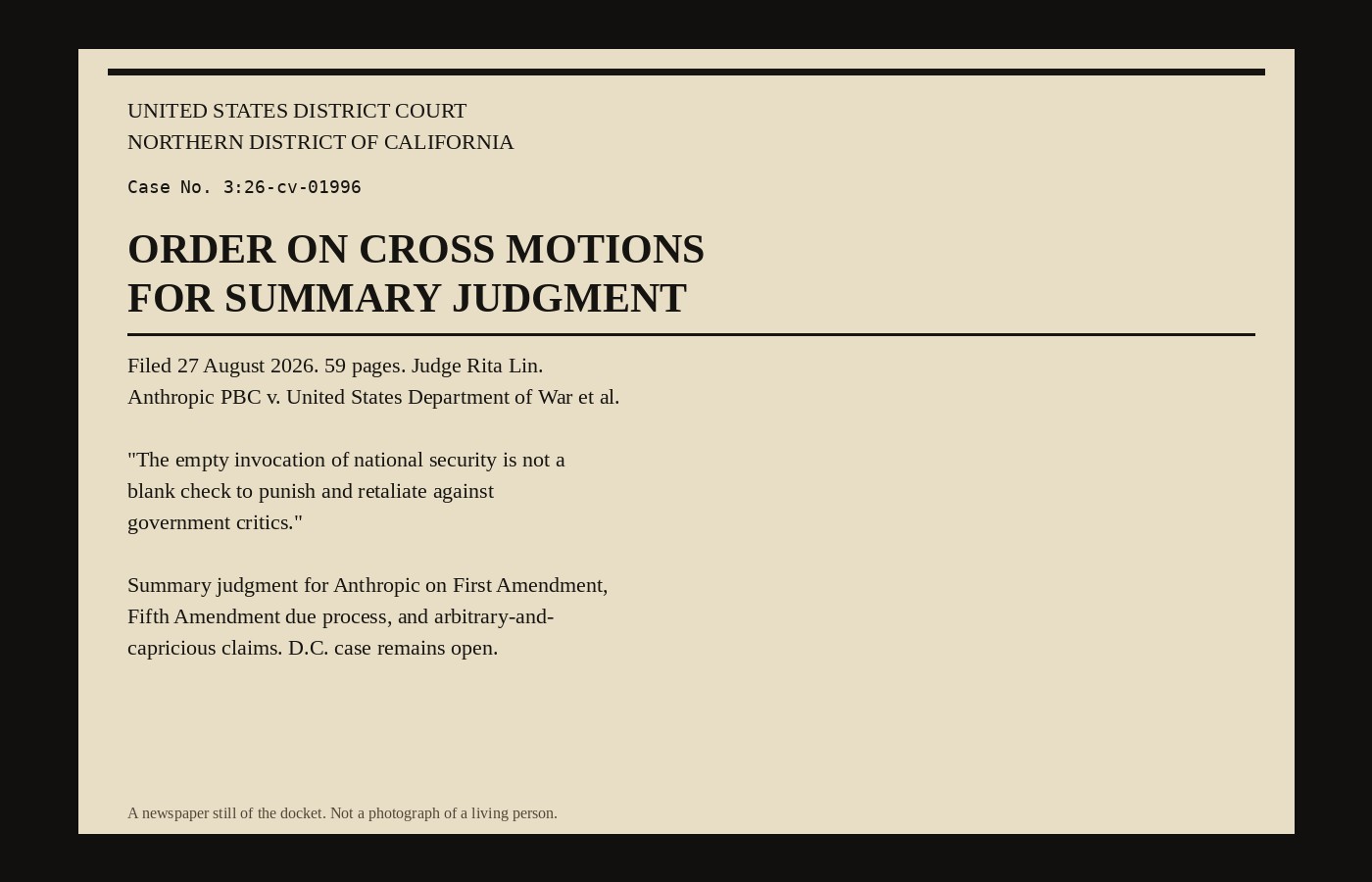
Judge Rita Lin vacated the Pentagon’s supply-chain risk label on Anthropic on Thursday evening, 27 August. The order is 59 pages. The court is the Northern District of California. The case number, on the Justia file, is 3:26-cv-01996.
Lin granted Anthropic summary judgment on the First Amendment claim and on the Fifth Amendment due-process claim. She found Secretary Pete Hegseth’s designation violated 10 U.S.C. § 3252 and was arbitrary and capricious. CNN’s Hadas Gold posted the ruling at 11:38 p.m. Eastern the same night. TechCrunch’s Rebecca Bellan filed at 5:46 a.m. Pacific on Friday, 28 August. WION’s Tarun Mishra carried it on Sunday, 30 August, at 18:38 IST. The paper of record on this desk is the order.
The line that will be clipped is in the order. “The empty invocation of national security is not a blank check to punish and retaliate against government critics.” That sentence is Lin’s. It is not this newspaper’s.
Anthropic filed on 9 March 2026. The complaint, as Lin recites it, alleged retaliation and viewpoint discrimination, a failure of pre-deprivation process, and an ultra vires presidential directive. Defendants certified an administrative record. The parties crossed motions for summary judgment. Lin granted Anthropic’s on the speech and process claims. She entered judgment for the government on the ultra vires separation-of-powers claim and on certain agency defendants who, she wrote, took no relevant action or only interim measures.
The designation is not a press release. It is the instrument the Pentagon uses to keep a vendor’s products out of military systems on the theory that those products might expose the systems to infiltration or sabotage. CNN noted that the label had previously been applied to companies seen as connected to foreign adversaries. Hegseth applied it to Anthropic in February. Contractors as well as the department itself were told not to use the products. Anthropic sued in March.
The dispute, on the public filings, is two refusals, not a walk-out. Anthropic would not let Claude be used for surveillance of Americans, or in fully autonomous weapons. TechCrunch put the same two lines on 28 August. CNN said the company argued the models were not reliable enough for those jobs. That is the company’s argument, attributed. This page does not retry the models.
It was not a refusal to sell to the government. Lin’s own sentence on vendor choice is the one the clips keep: “Though the Department of War is undisputedly free to select the AI vendor of its choice, the evidence demonstrates that the broad measures imposed on Anthropic were illegal and baseless.” The court used “Department of War.” CNN and TechCrunch used “Pentagon.” Both names sit on the same order.
Lin found the government’s “words and deeds confirm that the challenged actions were based on a desire to make a public example out of Anthropic for its ‘arrogance’ in criticizing the government.” TechCrunch quoted that. CNN added that the evidence did not show “any articulable basis to believe that Anthropic would actually sabotage its model.” FedScoop, filing the same order, had Lin concluding Anthropic was denied the notice the Fifth Amendment requires, and that the designation did not follow the statutory process.
The Hill, also on the Thursday order, had Lin writing that Dario Amodei’s public argument over safety restrictions was “consistent with a longstanding practice of public speech on AI safety.” The Department of Justice argued that speech inside contract negotiations is not protected. Lin called that position “unsupported.” Neither the Constitution nor the statute the defendants invoked, she wrote, lets them impose sweeping penalties “based principally on Anthropic’s critique of the Administration’s views.”
The contradictions inside the government’s own conduct are in the order, and TechCrunch named two. Hegseth had floated applying the Defense Production Act to Anthropic, “which would mean the company was essential to national security rather than a threat to it.” The department kept pursuing a contract. The government kept collaborating with Anthropic’s Mythos model on cybersecurity. Lin wrote that none of that is consistent with a genuine fear that Anthropic is a saboteur who would poison its software. She also wrote that Anthropic “undisputedly lacks” backdoor access to the technology once it is handed over.
In June, CNN noted, President Donald Trump told Axios he had previously viewed Anthropic as a national security threat and no longer believed it was. That interview is not the order. It is a dated clip sitting next to the order. The order is the news.
An Anthropic spokesperson told CNN, and then TechCrunch on Friday, that the company welcomed the ruling. “We remain focused on working productively with the government to harness AI for our national security so all Americans benefit from this technology.” The Pentagon, CNN wrote Thursday night, did not immediately respond. TechCrunch said it had reached out to the Department of Defense for comment.
There is a second case. Anthropic filed in San Francisco and in Washington. In April a D.C. appeals panel declined to shield the company from the designation’s consequences while it gathered evidence. FedScoop and TechCrunch both marked the D.C. suit as still open. Lin’s order is a merits ruling in the Northern District. It is not a Supreme Court. The government can appeal. The other circuit has already declined to help once, on interim relief, not on the merits. That caveat belongs on the same page as the quote about blank checks.
WION, on 30 August, treated the ruling as a commercial event as well as a constitutional one: Anthropic has filed confidentially for a public listing; annualised revenue, that piece said, reached roughly $65 billion by the end of July. An unresolved federal blacklisting is the sort of contingency a registration statement has to name. This desk is not an equity note. The figure is WION’s, dated Sunday. The load-bearing object is still the 27 August order.
What the order does not do is pick the Pentagon’s vendor. Lin said so. The department may buy from whom it likes. It may not, on this record, hang a supply-chain risk label on a laboratory because the laboratory criticised the uses it would not allow. Usage policies are how the frontier labs tell customers, including governments, what the weights will not do. A policy that cannot be held against the largest customer in the building is a brochure. Lin said the government cannot make that trade explicit with this instrument. Procurement decisions that never wear the label are a different file.
Watch three clocks. Whether the government appeals Lin’s order, and to which circuit. Whether the D.C. case reaches a merits holding that collides with hers. Whether other laboratories, having watched one company take the designation and then win on summary judgment, hold the same two lines in their next contract. The last of those is not a ruling. It is the industry reading a 59-page PDF over a weekend.
The dates are named. 9 March, the complaint. February, the designation. April, the D.C. panel’s refusal of interim relief. Thursday 27 August, 11:38 p.m. Eastern on CNN, the order. Friday 28 August, TechCrunch. Sunday 30 August, WION. This Monday file sits on those clips and on the Justia PDF. It does not sit on a hallway. It does not retry Mythos. It does not invent a face.
The paper
Comments
No notes on this story yet.
Sign in to comment