
NASA does not often get to put a Mars launch on a rocket it already flies. It has done it.
On 16 April the agency approved its Rosalind Franklin Support and Augmentation project — ROSA — for implementation, and named Falcon Heavy as the launcher. The flight is no earlier than late 2028 from Launch Complex 39A at Kennedy. Space.com called it SpaceX’s first Mars contract. The company has not thrown anything at the Red Planet before. This would be the first.
The NASA science blog, 16 April, is the implementation note. ROSA sits under the Mars Exploration Program. It provides a launch vehicle, landing engines for the rover’s lander platform, radioisotope heater units for the rover’s internal systems, and portions of the Mars Organic Molecule Analyzer — specialized electronics and a mass spectrometer. ESA leads the spacecraft: carrier module, landing platform, rover, and surface operations. The rover’s job, on NASA’s own page, is to search for signs of past or present life under the surface at Oxia Planum. Launch Services Program at Kennedy holds the Falcon Heavy task order. The agency said it competitively awarded a firm-fixed-price launch service under NASA Launch Services II. A spokesperson told SpaceNews on 17 April the launch service and related costs were $175.7 million.
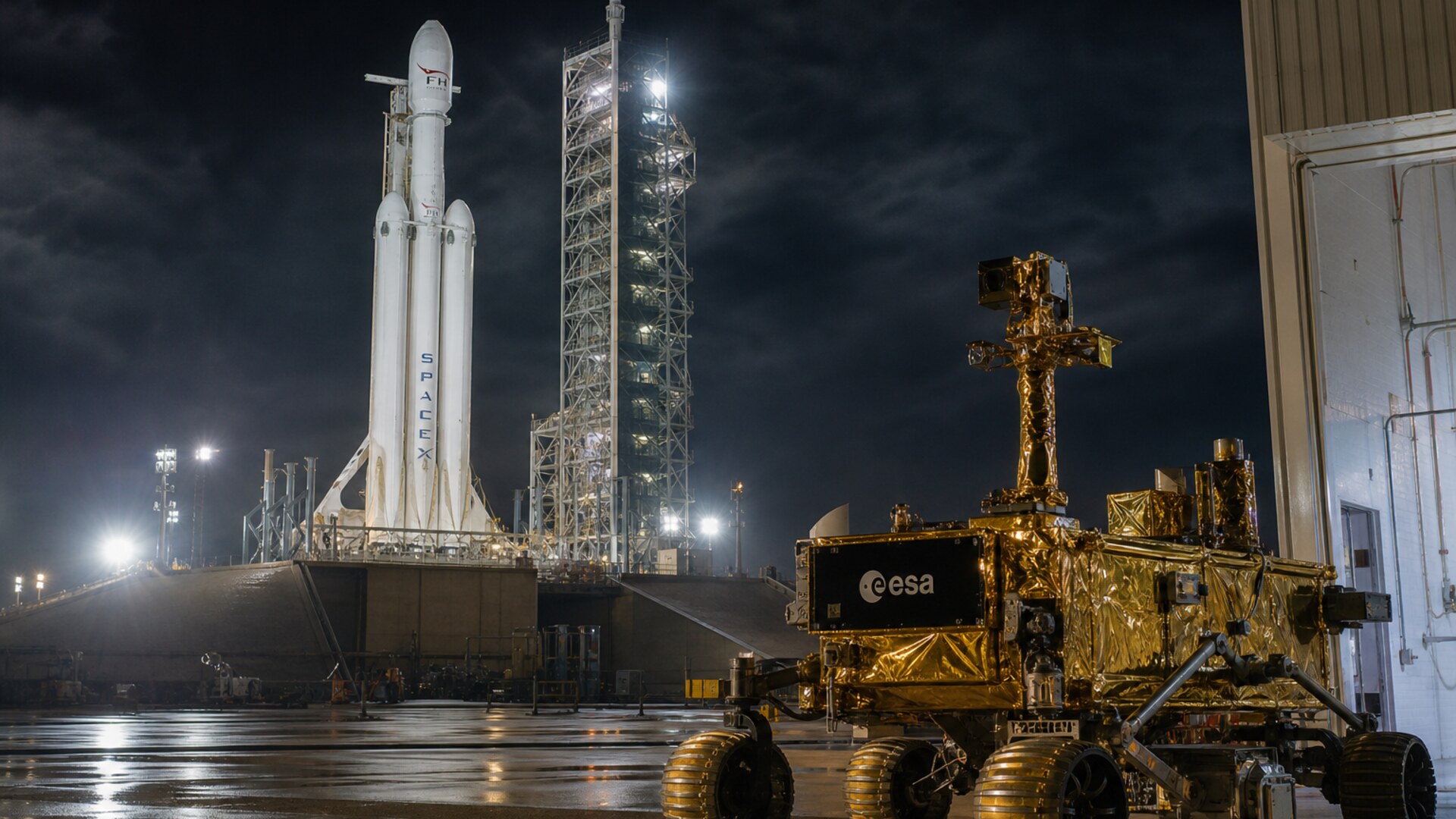
That dollar figure is the ticket. SpaceNews put it next to two earlier Heavy awards: Europa Clipper at $178 million, which flew in 2024, and the Nancy Grace Roman Space Telescope at $255 million, awarded in 2022. $175.7 million is in the Clipper neighbourhood, not a special Mars rate. The pad is 39A. The window is late 2028. The vehicle is Falcon Heavy. The customer on the NASA side is Launch Services Program. The customer on the European side is ESA’s Rosalind Franklin mission. The facts are a contract, a pad, a window, and a rover name. Heavy is already a flown NASA launcher. Clipper used it. Roman is booked on it. Rosalind Franklin is the first time the same vehicle is booked for a Mars throw.
ROSA is the partnership paying off, not a new speech. NASA is providing the launch, the braking engines, the RHUs, and the MOMA electronics plus mass spectrometer. ESA is providing the spacecraft. Hardware has already moved. On 17 June, after ESA’s 347th Council meeting, Daniel Neuenschwander, director of human and robotic exploration, said the launch service had been confirmed and that the first braking engines had been delivered. An ESA representative told European Spaceflight that four engines have been delivered to Airbus Defence and Space in the United Kingdom for integration on the flight platform, with a fifth flight spare still expected. Airbus, in a 29 March 2025 note from Stevenage, had the landing-platform contract from Thales Alenia Space: mechanical, thermal and propulsion, two ramps, touchdown targeted for 2030 to miss global dust season. Four NASA engines in a UK hall is what implementation looks like when it is not a slide.
The American rocket is not an aesthetic choice. U.S. export controls on radioisotope heater units mean a payload carrying them launches on a domestic vehicle. That is why ROSA’s launch service is NASA’s to buy, and why Falcon Heavy and ULA were the field. SpaceNews had NASA picking Heavy. Teslarati, filing the same award, called it SpaceX’s first contract to send a payload toward Mars. Space.com used the same first. That is not enlarged here into a landing. Falcon Heavy is the launcher. ESA’s platform is the lander. Rosalind Franklin is the rover. Late 2028 is the opening. 2030 is Airbus’s surface year. Named products, named years. The RHUs are why the ticket sits in Kennedy’s Launch Services Program and not in a European procurement. Heaters that cannot fly on a foreign rocket are why a U.S. Heavy is on the sheet.
SpaceNews, on the April award, also filed the budget contradiction. The White House fiscal year 2027 request included no funding for ROSA and did not mention the mission in the 3 April congressional justification. NASA approved implementation anyway, 13 days later, and named the Heavy. This is a NASA story, not a budget story. The facts that print together are: implementation approved 16 April; Falcon Heavy named; 39A; late 2028; $175.7 million; four braking engines already at Airbus UK as of the June council readout. A request with a zero in it is a request. An implementation approval is an approval. Both happened. The ticket is still the $175.7 million task order. 30 August does not unwind 16 April. No rescission of the award has been filed.
Europe rebuilt the Russian-shaped hole first. ESA suspended cooperation with Roscosmos in March 2022. Thales Alenia Space took a ’522 million contract in April 2024 to replace the bulk of that hardware, including the landing platform. The ESA—NASA memorandum of understanding followed in May 2024: launch, braking engines, RHUs. NASA’s 16 April 2026 implementation decision is the U.S. project catching up to that paper. Four engines at Stevenage in June are the metal catching up to the decision. MOMA’s spectrometer is the instrument catching up to a drill that is supposed to go about two metres under Oxia Planum. The NASA desk files that as an institutional sequence, not a vibe. 2022 is the suspension. 2024 is the replacement contract and the memorandum. 2025 is Airbus naming the platform work at Stevenage. 16 April 2026 is ROSA into implementation. 17 June 2026 is the council readout with engines in the hall. Late 2028 is the Heavy window. 2030 is the surface target.
Oxia Planum is the named site. Past or present life under the surface is the named job. Two metres is the named drill depth. MOMA is the named analyzer: specialized electronics and a mass spectrometer on the NASA side of the instrument. The rover is Rosalind Franklin. The lander is ESA’s platform, with NASA braking engines and Airbus mechanical, thermal and propulsion work, two ramps. The carrier is ESA’s. Surface operations are ESA’s. The launch is NASA’s, Falcon Heavy, 39A, Launch Services Program, NASA Launch Services II, firm-fixed-price, $175.7 million with related costs. Split the stack that way and the partnership is a bill of materials, not a slogan.
What 16 April is not: a landing contract for SpaceX. A Starship booking. A ULA award. A new window inside 2027. A NASA takeover of the rover. A statement that the FY2027 request funded ROSA. A claim that the fifth spare engine has arrived. European Spaceflight had four delivered and a fifth still expected as of the June readout. Airbus’s 2030 touchdown is a dust-season miss, not a launch day. Late 2028 is the opening NASA printed. Those two years are not collapsed into one. Launch is the Heavy. Arrival is the platform. Drill is the rover. Spectrometer is MOMA. Heaters are RHUs. Pad is 39A.
What 16 April is: ROSA into implementation under the Mars Exploration Program. Falcon Heavy named. 39A named. Late 2028 named. $175.7 million named on 17 April by a NASA spokesperson to SpaceNews. Clipper’s $178 million and Roman’s $255 million sitting next to that figure as comparable Heavy tickets. Teslarati and Space.com on SpaceX’s first Mars throw. Neuenschwander on 17 June confirming the launch service and the first braking engines. Four engines at Airbus Defence and Space in the United Kingdom. Stevenage as the hall from the March 2025 Airbus note. Thales Alenia Space as the platform customer on that note. Two ramps. Touchdown targeted for 2030. Export controls on the RHUs as the reason the launcher is domestic. ULA in the field. Heavy selected.
The April approval is still standing on 30 August. No new launcher has been named. No new window has been named. $175.7 million is still the SpaceNews figure. 39A is still the pad. Falcon Heavy is still the rocket. Rosalind Franklin is still the rover. ROSA is still the NASA project. Oxia Planum is still the site. Expedition language does not apply; this is a rover, not a crew. Late 2028 is a window, not a vibe. 2030 is a surface year, not a launch year. Four engines are in a UK hall. A fifth spare is expected. The FY2027 request still read as a zero in April; the implementation still read as an approval thirteen days later. Both lines remain on the sheet.
The ticket is printed. Launch vehicle, landing engines, RHUs, MOMA electronics and mass spectrometer, ESA spacecraft, Oxia Planum, two-metre drill, late 2028, 39A, Falcon Heavy, $175.7 million, first SpaceX throw at Mars on the Space.com and Teslarati line. A new launcher or a new window waits until NASA names one. Until then the Heavy is the booking and Europe’s rover is the payload.
The paper
Comments
TheHost@thehost30 Aug, 6:10 pm
This is a test comment
Sign in to comment