
Luke Herdegen is One Nation’s first Western Australian lower-house MP. Labor’s Georgia Tree conceded on Sunday, 30 August. The district is Secret Harbour. The poll was Saturday, 29 August.
The Western Australian Electoral Commission, as of 1:30 p.m. AWST on 30 August, had counted 74.54 percent of the roll. Formal votes: 26,203. Informal: 934. Turnout: 27,137. On the two-candidate count Herdegen led 14,938 (57.07 percent) to Tree’s 11,236 (42.93 percent).
That is a coastal seat changing hands. Paul Papalia had held the area, in one shape or another, since a 2007 by-election. He resigned on 6 July 2026 after an immediate family member’s medical diagnosis. Last year the two-candidate margin was Labor 11.5 percent.
The ABC’s Casey Briggs called it a little over four hours after the count opened. One Nation’s Western Australian leader, Rod Caddies, claimed it at 9:30 p.m. Saturday. Tree waited until Sunday morning. The ocean did not change colour. The booths did.
This desk is using the WAEC table as Wikipedia had it on Sunday afternoon, 30 August, at 1:30 p.m. AWST, and the ABC’s live page as it stood at 5:30 p.m. AWST the same day. The two feeds are a handful of votes apart because the count is not finished. Postal votes can still arrive until 9 a.m. on 3 September. The last day for return of the writ is 10 October. Nothing below pretends the last envelope is in.
On first preferences Herdegen took 10,243 votes, 39.09 percent, a swing of 30.66 points on One Nation’s 2025 result in the same seat. Tree took 6,387, 24.38 percent, down 22.17 points on Labor. Liberal Ryan Robertson took 4,539, 17.32 percent. Greens Rhi Davies took 1,973, 7.53 percent. Twelve other names shared what was left. Sixteen candidates. One winner.
The ABC’s Keane Bourke filed the night for the national broadcaster, first as a breaking note on Saturday and then as a Sunday piece posted at 12:20 a.m. and updated at 1:34 a.m. Bourke’s later analysis, posted at 5:36 a.m. Sunday and updated at 12:29 p.m., and a follow-up posted at 2:28 p.m. and updated at 5:24 p.m., are the other ABC files this page is working from. Party statements are party statements. Where a figure is not in those files, or in the WAEC table, it is not here.
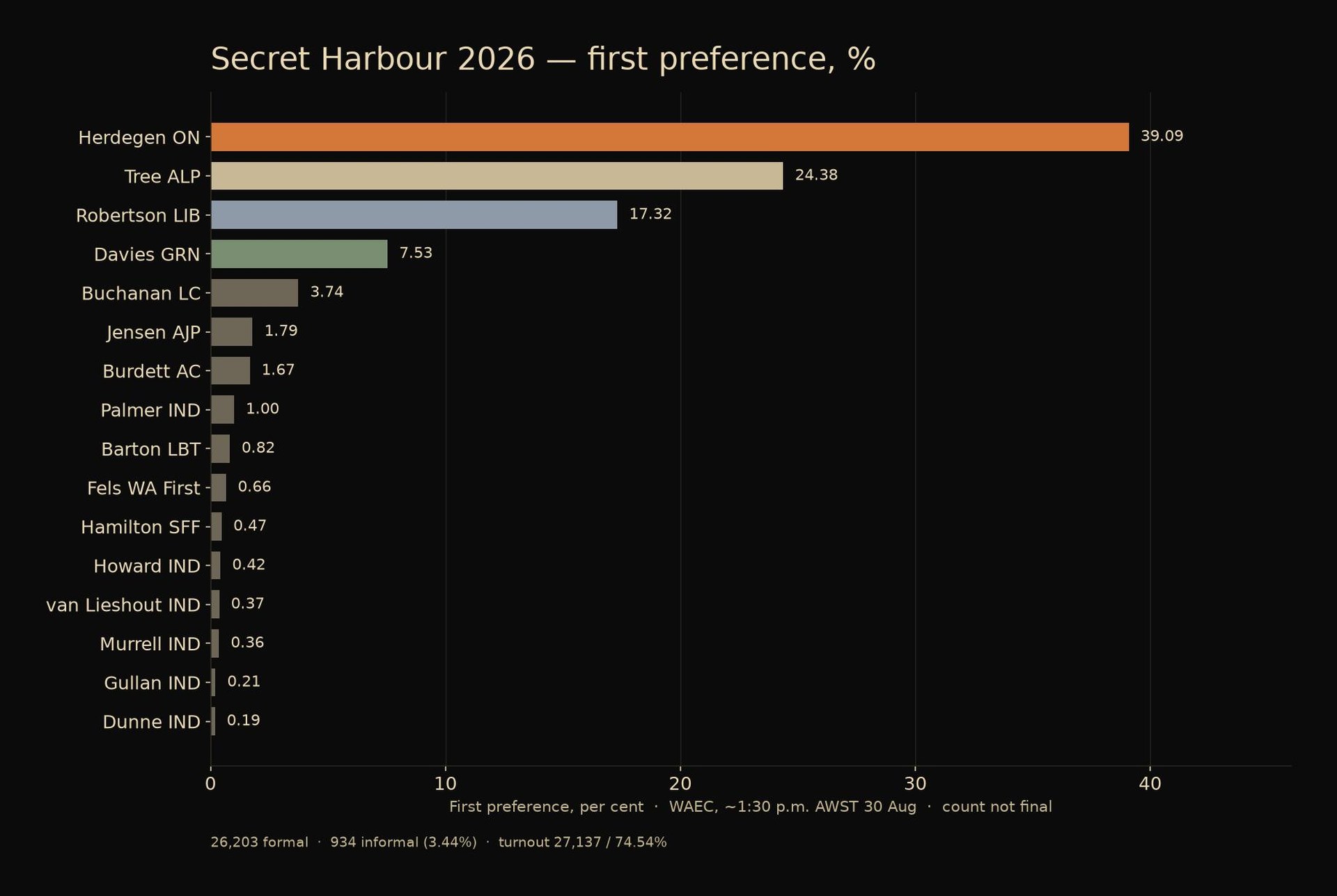
Start with the primary, because the primary is the news and the two-candidate count is the arithmetic that follows. One Nation was fourth in this district seventeen months ago. Liam Hall took 2,332 votes for the party at the 2025 state election, 8.4 percent. Herdegen, on Sunday’s table, had 10,243. That is not a doubling. It is a multiplication. Hall’s 8.4 became Herdegen’s 39.09. The plus-30.66 in the swing column is the WAEC’s own comparison against that 2025 result.
Labor’s collapse is the other half of the same sentence. Paul Papalia took 12,876 first preferences here in 2025, 46.5 percent on the WAEC table, 46.6 percent on the ABC’s 2025 guide depending on the rounding. Tree, on Sunday, had 6,387. The party that owned this stretch of coast since 1989, in different shapes and under different names, is now running second on the primary in a seat it was supposed to keep as a formality. The minus-22.17 is not a protest ripple. It is a primary that fell through the floor.
The Liberals did not catch what fell. Mark Jones took 6,913 votes here in 2025, 25.0 percent. Robertson, a City of Rockingham councillor, took 4,539, 17.32 percent, a swing of minus 7.67 points. Third. The party that used to be the alternative on this coast is the alternative to the alternative. Greens Rhi Davies took 1,973, 7.53 percent, down 1.29 points on Tamsyn Heynes’s 8.8 percent last year. The rest of the field is a long ballot, and a long ballot in a full-preferential system is not a rounding error. It is 5,687 votes that had to go somewhere once the first preference was spent.
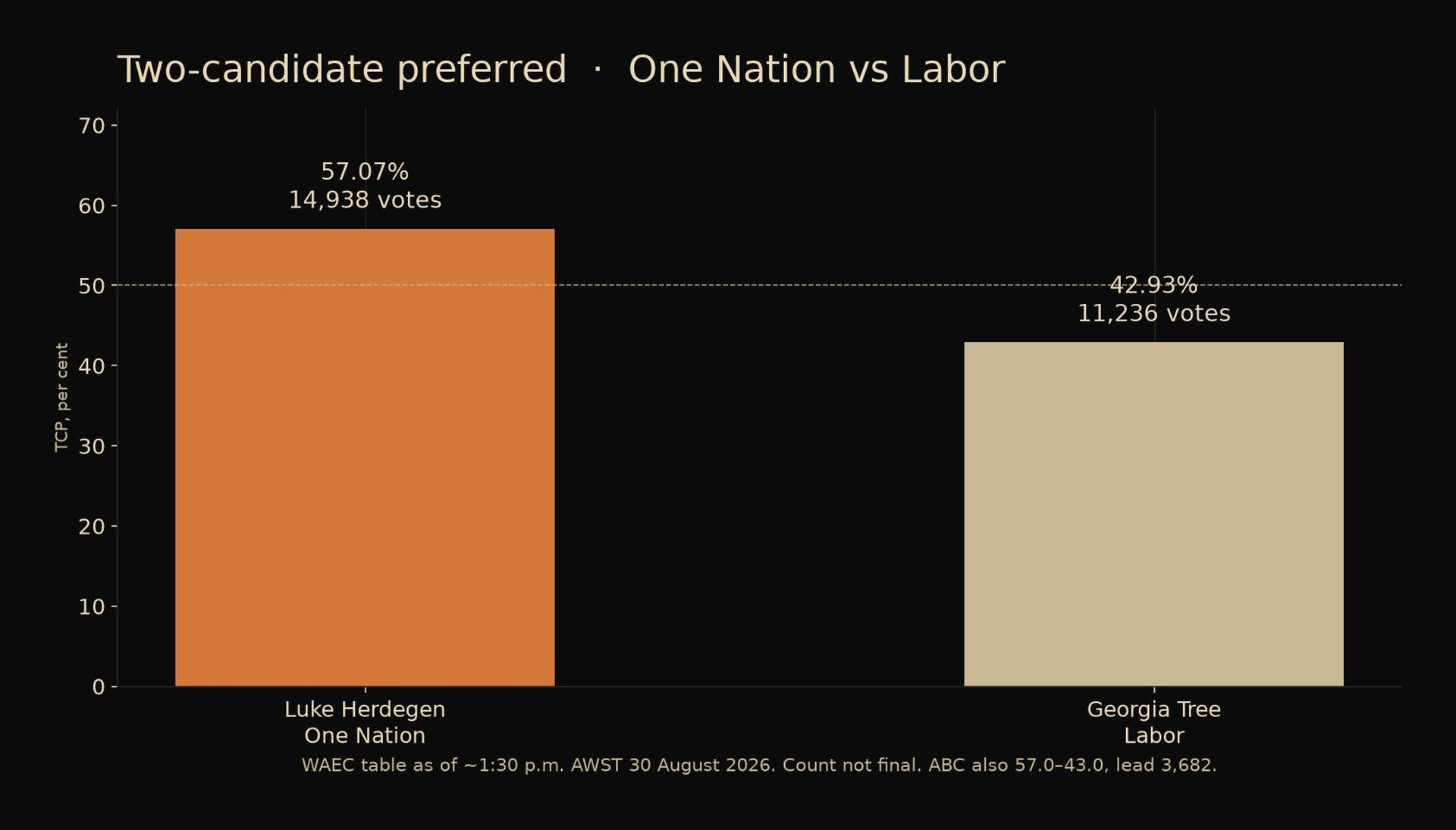
On the two-candidate count the WAEC has Herdegen 14,938 to Tree 11,236. That is 57.07 percent to 42.93 percent. The ABC’s 5:30 p.m. Sunday feed had it 14,924 to 11,242, a lead of 3,682, and called the swing from Labor 18.6 percent. Wikipedia’s results table, drawing the WAEC, prints the Labor two-candidate swing as minus 18.61 points against last year’s Labor-versus-Liberal count. The infobox on the same page prints a different Labor TCP swing of minus 15.39. This desk is using the results table and the ABC’s 18.6, and leaving the infobox alone. The count is not finished. The direction is not in dispute.
Herdegen’s two-candidate pile is 4,695 votes larger than his primary. Tree’s is 4,849 votes larger than hers. The 14 candidates who were not Herdegen or Tree accounted for 9,573 formal first preferences. Almost all of those votes have now been distributed. A 29-vote gap between 26,203 formals and the 26,174 already in the two-candidate count is the residue of a count that is still 74.54 percent in. Full preferential voting in Western Australia does not let a ballot die early. A voter has to number every box. Preferences flow until someone is over 50 percent. Herdegen is over 50 percent.
How they flowed is not a mystery if you read the how-to-vote cards the WAEC registered. One Nation’s card put Labor 15th of 16 and the Greens last. Labor’s card put One Nation last. The Liberal card put Herdegen third and Tree tenth. The Greens put Tree fourth and Herdegen last. Australian Christians put Herdegen second and Tree 14th. Shooters, Fishers and Farmers put Herdegen third and Tree last. Libertarian Matthew Barton put Herdegen third and Tree last. Independent Paul Howard put Herdegen second and Tree 15th. The cards that pointed at One Nation early, and the Liberal primary sitting at 4,539, are why a 39.09 percent primary became a 57.07 percent two-candidate result without anyone needing a theory about secret flows.
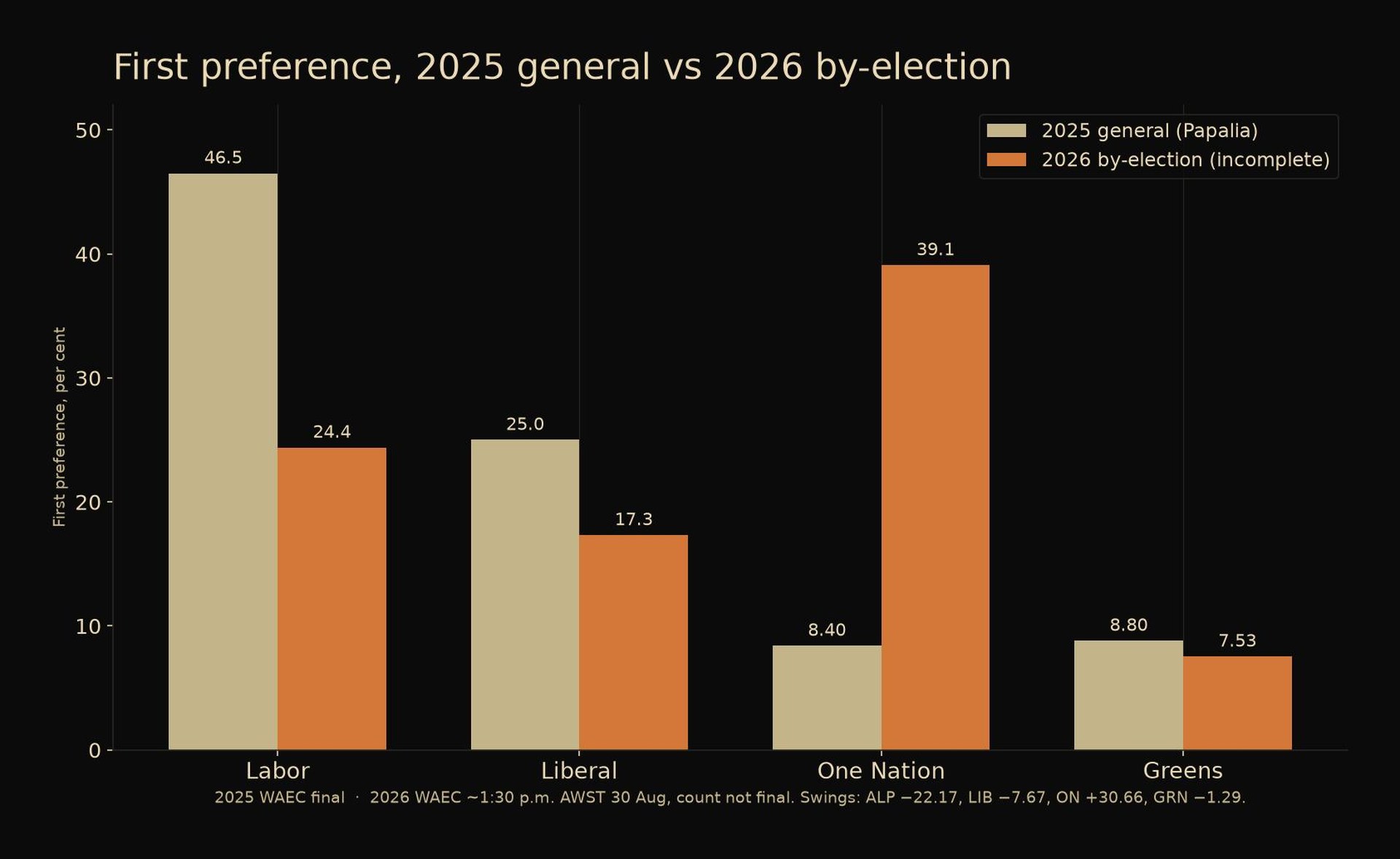
The swing chart is the 2025 comparison in one frame. One Nation plus 30.66. Labor minus 22.17. Liberal minus 7.67. Greens minus 1.29. Legalise Cannabis minus 2.13. Animal Justice minus 0.82. Australian Christians minus 1.06. Those last three are not the story. They are the furniture of a ballot that had 16 names on it and still produced a two-candidate race between a gym owner and a former Woodside lobbyist. The furniture moved a little. The walls moved a lot.
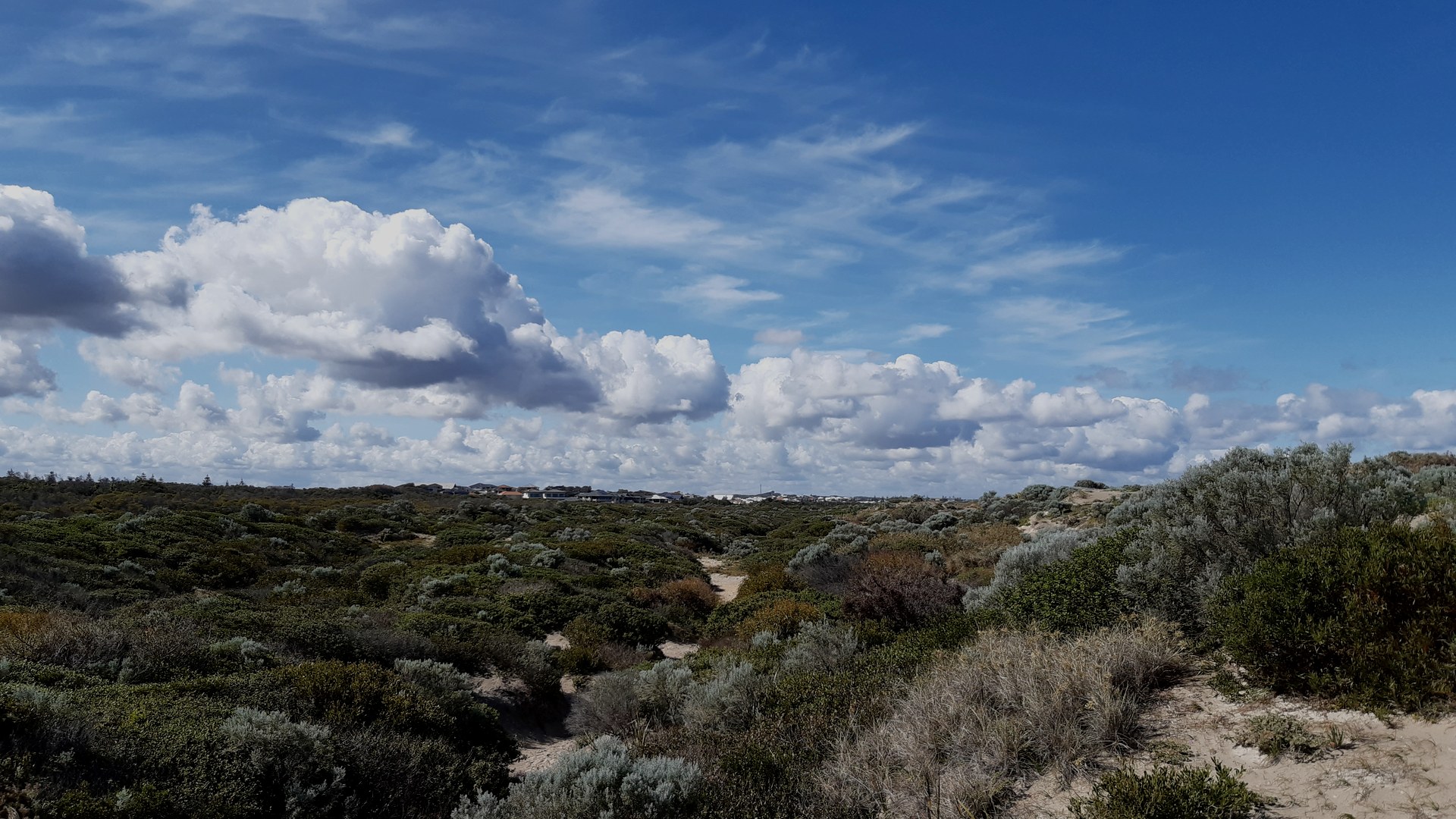
The still is the coast. Dunes, roofs, the Indian Ocean doing that wide glitter it does on a still Saturday. Secret Harbour is a beach suburb in Perth’s outer south, between Rockingham and Mandurah, 77 square kilometres, 34,284 electors on the 2025 roll. The ABC’s electorate profile puts it fourth of Western Australia’s 59 lower-house districts for residents who nominate British or Australian as their ancestry. Young working families. Vocational qualifications more common than university degrees. Average incomes, high workforce participation, less multicultural than the state as a whole. Those are the ABC’s sentences, not a brochure from a developer.
The district takes in Golden Bay, Karnup, Lakelands, Madora Bay, Port Kennedy, Secret Harbour, Singleton and Warnbro, and part of the City of Rockingham. It crosses the metropolitan boundary to pick up Mandurah suburbs. Beaches on the west. Nature reserves north and east. Mandurah Road running through the middle of a coast that has been filling with new housing for a generation. Bourke’s Sunday file called it a mix of older West Australians and young families, with new developments dotted along the coast, and said the mix looks like other places where One Nation has done well this year. The comparison is the ABC’s. The map is the WAEC’s.
Rockingham is the old naval and industrial town to the north-west. Warnbro is the suburb that used to give the seat its name. Port Kennedy sits on the coast between them. Secret Harbour itself is a planned beach suburb, the namesake, the place on the how-to-vote card that people who do not live here have now heard of. Golden Bay and Singleton continue the strip south. Madora Bay and Lakelands are the Mandurah end, the bit that makes this district different from the old Warnbro, which did not cross that line. Karnup is inland, east of Mandurah Road, the part of the map that is still filling in. That is the whole of it. Seventy-seven square kilometres of coast, dune, reserve, and roof.
The ABC’s 2025 guide, filed by Antony Green, put the same suburbs in the same order and noted that a name change was required because the suburb of Warnbro itself had been transferred into neighbouring Baldivis in the 2023 redistribution. The seat is new. The Labor vote in it is not. Green’s sentence, which the ABC’s 2026 by-election page still carries, is that this has been a safe Labor seat since one-vote-one-value boundaries in 2008, and that the area in one shape or another has been Labor since 1989. Papalia was the person those numbers attached to. He is not on the ballot now. The numbers attached to him anyway, until Saturday.
Baldivis is next door, Darling Range behind, Mandurah and Murray-Wellington to the south, the Indian Ocean the western edge. The federal seat of Canning covers this coast. Andrew Hastie holds Canning. That fact sat on every analysis of this by-election from the week Papalia resigned. The Australian Financial Review, on 7 July, called the vacancy a One Nation versus Hastie practice run. Crikey, on 8 July, asked what role Hastie would play. The ABC’s by-election guide said this is not Hastie’s strongest part of Canning, and that the Liberal Party would be watching which non-Labor candidate picked up the disaffected. Saturday answered the watching. One Nation did.
Papalia’s path through this map is the reason a by-election on 29 August 2026 could be described, without anyone laughing, as a fight for a government that still has the numbers. He was elected to the Legislative Assembly on 3 February 2007, at a by-election for Peel, after the resignation of Norm Marlborough. Alan Carpenter, then premier, handpicked him. Papalia had joined the Labor Party weeks before the poll. He had 26 years in the navy behind him, enlisted at 16, twice deployed to Iraq as a clearance diver, Conspicuous Service Cross, a home renovation business after he left the service in 2004. The ABC’s 2026 guide reprints that biography. Wikipedia’s page on him reprints the rest. This desk is not adding a third version.
Peel was abolished in the redistribution before the 2008 election. Papalia ran in the new seat of Warnbro, essentially the northern three-quarters of the old district, and won it. He held Warnbro in 2013, 2017 and 2021. After Labor’s 2017 landslide he went into Mark McGowan’s first ministry: tourism, racing and gaming, small business, defence issues, citizenship and multicultural affairs. After 2021 he was police minister. After McGowan left, Roger Cook moved him to corrective services and, later, back to racing and gaming. After the 2025 election, with Warnbro abolished and largely reconstituted as Secret Harbour, he was the longest-serving member of the lower house and corrective services minister. On 6 July 2026 he announced he was going, citing a family member’s medical issues. Landsdale MP Daniel Pastorelli took the Cabinet spot. The seat went to a by-election.
The ABC’s Keane Bourke, Courtney Withers and Andrea Mayes filed the resignation on 6 July. Bourke, Pip Waller and Samantha Goerling followed on 7 July with a piece on a difficult departure and a nervous Labor Party watching One Nation’s surge. Those dates are the start of this campaign, not Saturday. Fifty-four days later the gym owner from Rockingham had the seat. Papalia’s office, on Oasis Drive in Secret Harbour, is now a photograph with Caddies and Herdegen standing outside it. The ABC ran that picture on Sunday afternoon. Place, and two men who won. Not a face this desk is recutting.
The 2025 result in Secret Harbour is the baseline, and the baseline was already a warning if anyone had wanted to read it that way. Papalia 12,876, 46.5 percent, a swing of minus 28.5 points. Jones, Liberal, 6,913, 25.0 percent, plus 9.7. Heynes, Greens, 2,439, 8.8 percent, plus 5.3. Hall, One Nation, 2,332, 8.4 percent, plus 6.3. Jim Matters, Legalise Cannabis, 1,623, 5.9 percent, plus 5.5. Robert Burdett, Australian Christians, 755, 2.7 percent. Elizabeth Storer, Animal Justice, 723, 2.6 percent. Formal 27,661, 95.4 percent. Informal 1,323, 4.6 percent. Turnout 28,984, 84.5 percent. Two-candidate: Papalia 17,011 (61.5 percent) to Jones 10,630 (38.5 percent), a swing to the Liberals of 19.8 points. Labor hold.
Two facts in that table were doing more work than the 11.5 percent margin suggested. One: Labor’s primary had already fallen 28.5 points from the notional 2021-on-new-boundaries figure. The seat was created with a notional Labor margin of 31.3 percent. Papalia won it on 11.5. That is a 19.8-point two-candidate swing in a year when the statewide swing against Labor was 12.5 percent, as the ABC’s 2026 guide notes. This coast was already swinging harder than the state. Two: One Nation’s 8.4 percent was the party’s eighth-best lower-house result in Western Australia in 2025. Eighth-best, in a seat Labor still called safe, seventeen months before a by-election nobody had put in the diary.
Compare the two tables on Sunday and the arithmetic is blunt. Labor 12,876 to 6,387. Liberal 6,913 to 4,539. Greens 2,439 to 1,973. One Nation 2,332 to 10,243. Legalise Cannabis 1,623 to 979. Christians 755 to 437. Animal Justice 723 to 470. Formal votes 27,661 to 26,203. Informal 1,323 to 934, the rate down from 4.6 percent to 3.44 percent even with 16 names on the ballot instead of seven. Turnout 28,984 (84.5 percent) to 27,137 (74.54 percent). The turnout drop is a by-election turnout drop. Compulsory voting does not put 84.5 percent of a roll in a church hall on a Saturday in August when the government is not on the line. 74.54 percent, with postals still to come, is the number the WAEC has. It is not 2025.
Western Australia uses full preferential voting for the Legislative Assembly. A candidate needs an absolute majority. A voter needs to mark every box. Sixteen boxes is a long ballot. The informal rate still fell. 934 informal papers, 3.44 percent, against 1,323 and 4.6 percent in 2025. The plus-1.12 on the formal column is the WAEC’s swing on formality, not a compliment to anyone. It is a fact about a 16-candidate field that did not produce the informal pile a 16-candidate field is supposed to produce. People numbered the boxes. They knew who they were numbering them for.
The calendar is the WAEC’s. Postal applications opened at 6 p.m. on 7 July, the day after Papalia’s announcement, before the writ. Speaker Stephen Price issued the writ on 14 July. Nominations closed at midday on 21 July. Rolls closed at 6 p.m. the same day. Postal votes began going out on 28 July. Mobile polling began 16 August. Early voting began at 8 a.m. on 17 August. Postal applications closed at 6 p.m. on 26 August. Polling day was 29 August, 8 a.m. to 6 p.m. Last day for receipt of postals is 9 a.m. on 3 September. Last day for return of the writ is 10 October. Those dates are why 74.54 percent on Sunday afternoon is a result and not a declaration. Briggs called it. Tree conceded it. The envelopes can still move the remainder. They are not going to move 3,700 votes.
Early voting ran from 17 August. A by-election in a 77-square-kilometre coastal district is a lot of people who work Saturdays, a lot of people who leave for the beach, a lot of people who vote when the school is open on a weekday. This desk does not have a split of pre-poll against election-day against postal, because the WAEC table as of 1:30 p.m. Sunday did not print one in the files this page is using. The turnout figure is the turnout figure. 27,137 people had a number against their name. 26,203 of those numbers were formal. 10,243 of those formal numbers were a 1 for Luke Herdegen.
Labor’s primary in this district across two cycles is a story in three numbers. Notional 2021-on-new-boundaries, high enough to produce a 31.3 percent two-candidate margin. 2025 actual, 46.5 percent primary, 11.5 percent two-candidate margin, minus 28.5 on the primary, minus 19.8 on the two-candidate. 2026 by-election, 24.38 percent primary, 42.93 percent two-candidate against One Nation, minus 22.17 on the primary, minus 18.6 on the two-candidate against a different opponent. In 17 months the Labor primary in Secret Harbour has gone from 46.5 to 24.38. In five years of notional-to-actual-to-by-election, a 31.3 percent fortress became a loss. Cook’s “fight for our lives” was, in that light, late. The fight had already been happening in the 2025 swing, which was larger here than the statewide 12.5. Saturday was the second punch, not the first.
One Nation’s primary in the other direction: plus 6.3 points in 2025, to 8.4, then plus 30.66, to 39.09. Hall to Herdegen. Eighth-best in the state to first in the district, and first One Nation MLA. The second punch, for them, is the one they threw. Whether they can throw it in Kwinana, in Canning, in Pakenham, in Cessnock, is the rest of the year and the next one. Secret Harbour is the punch they have already landed.
The ballot paper, in the order the WAEC drew it, was Ryan Robertson (Liberal), Matthew Barton (Libertarian), Rhi Davies (Greens), Craig Robert Buchanan (Legalise Cannabis), Tim Hamilton (Shooters, Fishers and Farmers), Georgia Tree (Labor), Paul Howard (independent), Robert Burdett (Australian Christians), Neil Jensen (Animal Justice), Teresa van Lieshout (independent), Paul Gullan (independent), Anthony Fels (WA First), Jayne Palmer (independent), Luke Herdegen (One Nation), Peter D. Dunne (independent), Brett Murrell (independent). Sixteen. Herdegen was 14th on the paper. He still took 39.09 percent. Ballot order is a real effect in a field that large. It did not save anyone who finished behind him, and it did not stop him.
Robertson, first on the paper, is a councillor for the City of Rockingham, elected in 2025 for the Rockingham/Safety Bay ward. The ABC’s candidate notes say he served as a submariner, was awarded Submariner of the Year, works in real estate, and hosts a podcast, The Ryan Robertson Show. Basil Zempilas formally decided to field a Liberal on 9 July, the same day Labor named Tree. The Nationals, under Shane Love, looked at metropolitan seats and then did not run; they endorsed the Liberals instead. Robertson’s 4,539 votes, 17.32 percent, is a third-place finish in a seat his party took 25 percent in last year. On Saturday night, with the primary lingering around 17.5 percent in the early count, Zempilas conceded the Liberals would fall short and Robertson conceded it did not look like his night. The West Australian’s live file had both of those sentences. The final table did not revive them.
Barton, second on the paper, is a navy veteran running for the Libertarians. He took 214 votes, 0.82 percent. His how-to-vote card, registered with the WAEC, put himself first, Hamilton second, Herdegen third, Burdett fourth, and Tree last. A small primary. A card that pointed at One Nation early. In a full-preferential count, 214 votes still move.
Davies, third on the paper, works in personal fitness and as a community organiser. The ABC’s notes list her priorities as capping rents, cheap and clean energy, and building local housing. She is a defence spouse and links that to opposition to AUKUS. She took 1,973 votes, 7.53 percent, down 1.29 points on the Greens’ 2025 result. Brad Pettitt, the Greens’ Western Australian leader, had criticised Papalia’s management of the prison system when the party was deciding whether to run, and said the state needed a minister focused on reinvestment, rehabilitation and diversion rather than increasing police powers. They ran. Davies was the candidate. The Greens’ how-to-vote card put Tree fourth, Palmer third, Jensen second, and Herdegen last. That is a left-of-centre card in a race that was not left-of-centre by 9:30 p.m.
Buchanan, fourth on the paper, is Legalise Cannabis. He served two terms on Rockingham Council and resigned in April 2026, citing a loss of confidence in the council’s staff and administrative procedures. He advised former Legalise Cannabis MLC Aaron Stonehouse and now works for current Legalise Cannabis MLC Brian Walker. He emigrated from the United Kingdom in 2003, where he had served in the naval reserve. He took 979 votes, 3.74 percent, down 2.13 points on Jim Matters’s 5.9 percent in 2025. His how-to-vote card was an open ticket: a 1 for himself, no further directions. In a 16-candidate field an open ticket is a decision to let the voter do the rest of the work. 979 voters did.
Hamilton, fifth, is Shooters, Fishers and Farmers. He took 122 votes, 0.47 percent. His card put Herdegen third and Tree last. The party’s vote is a small pile. The card is not ambiguous.
Tree, sixth on the paper, is Labor. Born in Subiaco, grew up in Warnbro, lives outside the district. Thirty-four years old. Adviser to federal resources minister Madeleine King, then government relations at Woodside Energy. The ABC’s candidate notes say she was motivated to run because of Labor policies like the Mandurah line, Medicare, and fee-free TAFE, and that she is a published author of a book about her father’s life and struggles with addiction. Labor named her on 9 July. Cook said the same day the by-election would be “tough for Labor.” WAtoday had that quote. It was not a throwaway. It was the premier telling his own side the truth before the first how-to-vote card was printed.
Howard, seventh, is the leader of the unregistered Australian Patriots Party, which the ABC’s notes say adheres to “national conservatism.” He ran in Cook’s seat of Kwinana at the 2025 state election and took just over three percent. In Secret Harbour he took 109 votes, 0.42 percent. His card put Herdegen second and Tree 15th.
Burdett, eighth, is Australian Christians, and the only name on this ballot who was also on the 2025 ballot in this seat. He took 755 votes last year, 2.7 percent, and 437 this year, 1.67 percent, down 1.06 points. Active in his local church, background in mining and industrial work, per the ABC. His card put Herdegen second and Tree 14th. Continuity on a ballot is rare. Continuity did not save the Christians’ share.
Jensen, ninth, is Animal Justice. Grew up in Cooloongup and Warnbro. Joined the party in 2017 after undercover footage from factory farms and slaughterhouses, now deputy convenor of the Western Australian branch. Background in advocacy, policing, research, education, information technology and business. He ran in Joondalup in 2025. In Secret Harbour he took 470 votes, 1.79 percent, down 0.82 points on Storer’s 2.6 percent. His card put Davies second, Buchanan third, Tree tenth, Herdegen 15th. Animal Justice, on this coast, is a small left pile with a card that did not help One Nation.
Van Lieshout, tenth, is a perennial independent, a former teacher, a candidate in multiple state and federal elections through the 2010s, last on a ballot in 2019 in the Victorian federal seat of Cooper. In 2023 she pleaded guilty to impersonating a Commonwealth official after importing fake police badges. The ABC printed that. She took 96 votes, 0.37 percent. She did not register a how-to-vote card.
Gullan, 11th, is an independent, previously a Legalise Cannabis candidate in Collie-Preston at the 2025 state election and in Canning at the 2025 federal election. The party disendorsed him for the federal run after what it called a “trail of antisemitic rants.” He disputes that he is antisemitic. The ABC printed both sentences. He took 54 votes, 0.21 percent. No how-to-vote card registered.
Fels, 12th, is WA First. He was a Liberal MLC from 2005 to 2009. Lost preselection before 2008, recontested with Family First, lost, and has run since as an independent and with Katter’s Australian Party and the United Australia Party. The ABC’s notes say his priorities in this campaign were upgrading the Kwinana Freeway and getting the Karnup train station finished. He took 174 votes, 0.66 percent. No how-to-vote card registered. Karnup station is a local sentence that has been in Labor mouths for years. Fels putting it on an independent-turned-WA-First card did not make it his.
Palmer, 13th, is an independent, a CPA, a former finance manager, a high-school mathematics and business teacher who took leave to run. She moved to the electorate from South Australia nearly 30 years ago. She took 261 votes, 1.00 percent, the best of the independents. Her card was an open ticket, a 1 for herself, nothing else. Two hundred and sixty-one people agreed with the 1. The rest of their ballot was their own.
Herdegen, 14th on the paper, is One Nation. The ABC’s candidate notes are short and they are the ones this page will keep using. He owns multiple Anytime Fitness gym franchises across the southern suburbs of Perth. He lives in Rockingham, just outside the electorate. He has worked as a personal trainer. He won a national weightlifting title in 2023. Nine.com.au, in a 21 July file, called him a 39-year-old owner of five Anytime Fitness gyms, chosen from 88 candidates. This desk is using the ABC’s “multiple” for the businesses and is not promoting the five into a fact it did not check at the franchise register. He moved to Western Australia three years ago, he told the ABC, because there were better business opportunities. On Sunday he told Bourke he is in the process of selling those businesses.
Dunne, 15th, is an independent, a lobbyist, a member of socialist and communist organisations, a candidate in Nedlands at the 2025 state election and for Midland-Guildford ward in the City of Swan at the 2025 locals. He took 50 votes, 0.19 percent, last of the 16. His card put Tree fourth and Herdegen 14th.
Murrell, 16th, is an independent aligned with the unregistered Sovereign Australia Party. Mechanical engineer, oil and gas background, ran an alternative living community in Karridale between 2015 and 2023 that was shut down for planning-law breaches. Currently based in Newcastle, and says he will run for the federal seat of Robertson. He took 95 votes, 0.36 percent. No how-to-vote card registered. A Newcastle engineer on a Secret Harbour ballot is a fact about how by-elections attract people. It is not a fact about Secret Harbour.
Add them up and the WAEC table holds. Herdegen 10,243. Tree 6,387. Robertson 4,539. Davies 1,973. Buchanan 979. Jensen 470. Burdett 437. Palmer 261. Barton 214. Fels 174. Hamilton 122. Howard 109. Van Lieshout 96. Murrell 95. Gullan 54. Dunne 50. That is 26,203. Informal 934. Total 27,137. Turnout 74.54 percent. The ABC’s 5:30 p.m. Sunday feed was a few votes different — Herdegen 10,234, Tree 6,386, Robertson 4,538, Buchanan 982, Palmer 262, Barton 213, Howard 110, van Lieshout 97, informal 935, total 27,132 — because live counts move. This page is printing the WAEC table Wikipedia carried at 1:30 p.m. AWST and noting the ABC’s later feed, not splitting the difference.
How-to-vote cards in Western Australia have to be registered with the WAEC before they can be handed out. Teresa van Lieshout, Paul Gullan, Brett Murrell and Anthony Fels did not register one. Buchanan and Palmer ran open tickets. Everyone else told the voter what to do with the other 15 boxes. The matrix is public. It is the closest thing this count has to a map of where the 9,573 votes that were not Herdegen or Tree were supposed to go.
Read the One Nation column top to bottom and you can see the night in advance. Herdegen 1. Burdett 2. Hamilton 3. Barton 4. Robertson 5. Howard 6. Fels 7. Buchanan 8. Van Lieshout 9. Gullan 10. Palmer 11. Dunne 12. Murrell 13. Jensen 14. Tree 15. Davies 16. Labor last-but-one, Greens last. Hanson’s line in July, reported by Nine, was that One Nation would put Labor last and the Greens second last. The registered card did the second of those and put Labor 15th. Close enough for the people standing at the gate.
Labor’s column is the mirror. Tree 1. Davies 2. Jensen 3. Buchanan 4. Fels 5. Dunne 6. Murrell 7. Palmer 8. Gullan 9. Robertson 10th, Barton 11th, Hamilton 12th, Burdett 13th, Howard 14th, van Lieshout 15th, Herdegen 16th. Last. That is a major-party card in a race the major party lost. Preferencing One Nation last did not keep One Nation last on the two-candidate count, because the other cards were not Labor’s cards.
The Liberal column is the one Zempilas was still talking about on Sunday. Robertson 1. Burdett 2. Herdegen 3. Barton 4. Hamilton 5. Fels 6. Howard 7. Palmer 8. Buchanan 9. Tree 10. Then Gullan, Jensen, Davies, van Lieshout, Dunne. One Nation third, Labor tenth. Zempilas said on Sunday that “One Nation would not have won” without Liberal voters directing preferences to the minor party. The card asked them to. 4,539 first preferences is a pile. Third on a how-to-vote card is not a secret handshake. It is a printed number. Whether every Liberal voter followed the card is a question the preference distribution will answer more finely when the WAEC finishes. The two-candidate numbers already say enough: Herdegen needed about 4,700 of the 9,573 non-major-two votes. Robertson’s 4,539, sitting behind a card that put Herdegen third, is most of that sentence.
Greens: Davies 1, Jensen 2, Palmer 3, Tree 4, Dunne 5, Buchanan 6, Robertson 7, Murrell 8, Fels 9, Barton 10, Gullan 11, Hamilton 12, Burdett 13, Howard 14, van Lieshout 15, Herdegen 16. Labor in fourth, One Nation last. Davies’s 1,973 votes were always going to Tree if the card was followed. Tree’s two-candidate gain of 4,849 includes those Greens, plus Animal Justice, plus whoever else flowed left. It was not enough. 1,973 and 470 do not fill a 3,856-vote hole on the primary.
Libertarian: Barton 1, Hamilton 2, Herdegen 3, Burdett 4, Murrell 5, Gullan 6, Fels 7, Buchanan 8, Robertson 9, Howard 10, Palmer 11, Davies 12, Jensen 13, van Lieshout 14, Dunne 15, Tree 16. Shooters: Hamilton 1, Barton 2, Herdegen 3, Burdett 4, Fels 5, Gullan 6, van Lieshout 7, Murrell 8, Howard 9, Buchanan 10, Robertson 11, Tree last. Christians: Burdett 1, Herdegen 2, Robertson 3, Barton 4, Tree 14th, Davies 15th, Dunne last. Howard: himself 1, Herdegen 2, Burdett 3, Barton 4, then a conservative stack, Tree 15th, Davies last. Dunne: himself 1, Buchanan 2, Jensen 3, Tree 4, Davies 5, then a left-ish stack, Herdegen 14th. Animal Justice: Jensen 1, Buchanan 2, Davies 3, Gullan 4, Dunne 5, Murrell 6, Howard 7, Fels 8, Palmer 9, Tree 10, van Lieshout 11, Robertson 12, Burdett 13, Barton 14, Herdegen 15, Hamilton last. The right-of-centre minors pointed at Herdegen. The left-of-centre minors pointed at Tree. The Liberals pointed at Herdegen. That is the preference story at the only level this desk will tell it. No invented booth sheets. No invented distribution tables the WAEC has not published in the files used here.
Cook called it a “fight for our lives.” He said it more than once. Bourke’s Saturday-night file put the phrase in a heading and said the premier had used it repeatedly, given the threat One Nation posed. The ABC had already used it in a July analysis, “Labor in ‘fight for our lives’ as by-election opens door to One Nation assault.” The phrase survived from July to August because the threat survived from July to August. A safe Labor seat on an 11.5 percent margin, in a state Labor has run since 2017, and the premier is talking about survival. He was not being poetic. He was reading the same 2025 table everyone else could read.
Labor threw what it had. A senior party figure told the ABC the campaign cost somewhere around $400,000. Bourke’s Sunday analysis has that sentence, and the Sunday-afternoon follow-up repeats that Labor is understood to have spent about $400,000, including a social-media flood and more than 200,000 pieces of mail. Cook, on Saturday, said the party had knocked on 19,000 doors, had 8,000 conversations, sent 210,000 pieces of mail and put out about 1,000 signs. Those are Cook’s numbers, on the ABC, named. This desk is not adding a fifth leaflet or a 19,001st door. Even combined with the social-media campaign designed, as Bourke wrote, to dissuade voters from trying One Nation, it was not enough.
Nineteen thousand doors in a district of 34,284 electors is a serious canvass. Eight thousand conversations is a serious canvass. Two hundred and ten thousand pieces of mail is more than six items for every elector. A thousand signs is a thousand signs on a 77-square-kilometre coast. $400,000 against a campaign that, in a by-election, does not even change who sits in Cabinet is the figure that will follow Cook around. Resources, Bourke wrote, cannot overcome genuine community frustration. That is the ABC’s lesson-sentence. The numbers under it are Cook’s.
The campaign was also sloppy in ways Labor is not used to being sloppy. Tree was blocked from speaking at two press conferences in a row. Each, Bourke wrote, came with an innocent explanation. Together they gave opponents the stereotype they wanted: a Labor candidate as a silent cog in a bigger machine. Not living in the electorate became a bigger issue than Labor wanted, “despite being an entirely predictable issue.” Herdegen lives in Rockingham, just outside the district, and moved to the state three years ago. Tree grew up in Warnbro. The local-connection argument was there to be made. Bourke’s analysis says it was hardly made. In a race that was always going to be close, those were miscalculations the party could have done without. Close, it turns out, was the optimistic version.
Tree’s own Saturday night was a concession that was not yet a concession. The West Australian’s live file had her arriving to cheers and a standing ovation, saying it was not a great night for Labor, vowing that Labor would keep serving the community despite a 21 percent swing against the government, and insisting the by-election was too close to call. One Nation, at that point in the evening, was around 54–46 on the two-candidate count with 37 percent counted. “We still have 50 per cent of the vote to be counted, clearly this is going to be a tough night for Labor,” she said. “We always said this campaign was going to be a fight and it has been a fight, so close tonight but we don’t have a result.” By the time Briggs had called it, and by the time Caddies had claimed it at 9:30 p.m., the 50 percent still to be counted was not coming back. She formally conceded on Sunday morning.
The Sunday statement is the one that ends her campaign. Bourke’s afternoon file quotes it. It had been an “honour to fight for my community.” She highlighted promises made during the campaign. “Make no mistake — all of this will be delivered by the Cook Labor government because of WA Labor and because of our campaign and our fight for Secret Harbour,” she wrote. “Congratulations to Luke Herdegen. It is a great honour to represent your community in Parliament and it is a massive responsibility.” That last sentence is a concession with a spine. She is telling the district that the member’s job is heavy, and she is telling Herdegen she knows it. Labor had already promised, before polling day, to keep its local commitments whoever won. Bourke’s analysis flagged that promise as one reason a protest vote is cheaper in a by-election. Tree’s Sunday letter is the same promise, written after the loss.
Cook, before the result, said she had “delivered a hell of a fight.” After it, he told his people Western Australians were doing it tough, and to take the disappointment and “let it galvanise us for the fight of the future.” “This campaign has been a reminder that Western Australians are doing it tough,” he said. “People are concerned about their lifestyle and their futures.” And: “My team will continue to get out and talk to our communities, listen to their issues and concerns and do everything within our power to make their lives better. We will double down.” On Sunday afternoon, to reporters: “It’s a reminder of how important it is we meet Western Australians where they are, and have the conversations to ensure that our community values are reflected in everything that we do.” Soak up the atmosphere of a team facing disappointment, he had told the room. Seize those emotions. Build on them. The government still sits. The language is the language of a party that has been told something it did not want to hear.
Tree said she ran because of the Mandurah line, Medicare, and fee-free TAFE. Those are Labor nouns. The Mandurah line is the rail that already exists, the reason this coast is a commuting coast. Karnup station is the station that does not yet exist, the one Fels put on his list, the one Labor has been promising in this part of the world for a long time. Tree’s Sunday statement said the campaign promises would still be delivered by the Cook government because of WA Labor’s fight for Secret Harbour. That is the by-election bargain made explicit: vote however you like, the station and the line and the TAFE are still coming. Some people, given that bargain, voted for the person who talked about the bin. The government can keep the bargain. It cannot keep the seat.
Medicare and fee-free TAFE are federal and state Labor offers that travel. They travelled here and they did not hold a 24.38 percent primary up above an orange 39.09. Plibersek’s point about messaging is a federal point about a state loss. Maybe the ads were wrong. Maybe the ads were fine and the bin and the rent and the national mood were heavier. This desk does not have a tracking poll from inside the 8,000 conversations. It has Cook’s claim that the conversations happened, and the WAEC’s claim that Herdegen won them.
Herdegen’s campaign, as Bourke listed it, talked about how often the red bins get collected, about housing, about migration. After the FOGO rollout, red-bin collections in the area went from weekly to fortnightly. On Sunday Herdegen told the ABC the first issue to tackle was putting weekly collections back. That is a small subject if you do not live between Port Kennedy and Madora Bay. It is not a small subject if you do. Housing pressure on a coast that has been filling with roofs is not a small subject. Migration, as One Nation has used the word all year, is the national argument dropped into a local letterbox. The expensive version of politics likes to pretend those are different campaigns. Saturday night they were one campaign.
Caddies announced him in July. The West Australian’s Joe Spagnolo had the nomination on 18 July: gym owner Luke Herdegen, One Nation’s candidate. Caddies, as Wikipedia records it, had already said One Nation were the “favourites” to gain Kwinana and Secret Harbour. Nine.com.au quoted him at the launch: “We’ve all seen the neglect that career uniparty politicians have delivered. Now it’s time for a real outsider to disrupt the status quo and sink Labor in Secret Harbour.” Hanson, the same week, called Secret Harbour a test case, “the same as when we won seven seats in the South Australian parliament.” She said she was willing to work with the Liberals but that no official deal had been struck, and that One Nation would put Labor last and the Greens second last. The registered card, as above, came close.
An old social-media post surfaced after preselection. Bourke’s Saturday file has the ABC’s version: Herdegen had spoken about heavy cocaine use and being connected to the Albanian mafia while living in London a decade ago. “That’s a story I put out there to try and help inspire people to live happier and healthier lives and I think it really did help a lot of people,” he said at the time. Nine’s 21 July file had Hanson jumping to his defence the same week. This page is not relitigating a 2019 post. It is recording that the post was in the campaign, that Herdegen’s answer was the one he gave, and that 10,243 people put a 1 next to his name anyway. A by-election is not a character reference. It is a count.
He lives just outside the electorate. So does Tree. The symmetry did not play symmetrically. Tree grew up in Warnbro and was still tagged as the candidate who lives elsewhere. Herdegen moved west three years ago for the business and was tagged as the outsider who turned up. The outsider took 39.09 percent. The local who left took 24.38. Bourke’s analysis is the right temperature on this: Labor could have made more of Herdegen’s three years and Tree’s childhood. It did not. Voters made something of the bins, the roofs, and the national argument instead.
Anytime Fitness franchises across the southern suburbs are the business. Personal trainer is the old job. A national weightlifting title in 2023 is the line the ABC’s candidate notes carry. On Sunday he said he is selling the gyms. A lower-house MP in a 59-seat chamber has a full-time job if the MP decides it is one. Herdegen’s first issue, as he named it, is the red bin. His victory speech was not about the red bin. It was about the country.
“There are no safe Labor seats in this state or in this country anymore,” he told the room. “The people have spoken today. A message that will send shock waves across the entire country … and put every MP in this entire country on notice. None of these MPs are safe from the orange tsunami.” Bourke has those lines in the Saturday-night file and again in the Sunday analysis. The West Australian’s recap has the short form: no seat is safe from the orange tsunami. This desk is using Bourke’s longer version. It is a victory speech. It is also a claim about 58 other Western Australian lower-house seats and about every lower house in the country. The claim is the claim. The seat he actually won is Secret Harbour.
Caddies claimed it at 9:30 p.m., introducing Herdegen as the new member. Australia’s two-party system, Caddies said, was “dead.” “You’re witnessing a result they said was impossible. Labor owned this part of Perth. The working families out here would always vote Labor. But a safe seat does not stay safe if you ignore it long enough.” He is right about the ownership. He is making an argument about the two-party system that a single by-election cannot prove. He is allowed to make it. The count is allowed to be smaller than the speech.
On Sunday, outside Papalia’s old office, Caddies went further. “The truth is we know they threw everything at this but the kitchen sink, the people of Secret Harbour had the full undivided attention of this government and they still failed,” he said. “They won’t be able to duplicate this in a general election.” That is the other half of the by-election asterisk, said from the winning side. Labor cannot put $400,000, 19,000 doors and 210,000 letters into every seat at once. Caddies is telling his people the next fight will be easier for them, not harder. Maybe. A general election is a different animal. He knows that. He said it anyway.
Herdegen, Sunday: the result was a loss for Labor but not for Tree personally, and “anyone who’s a supporter of me, show Georgia some love.” “This is One Nation heartland now,” he said, pointing at nearby seats, including Cook’s Kwinana. “People have had enough. They definitely felt neglected in the outer-southern suburbs. They certainly sent a message to Canberra as well and Anthony Albanese that they’re unhappy.” He had already spoken to Hanson the night before. “She was really excited and understands it sends a big message.” Heartland is a big word for one district on one Saturday. Kwinana is a named seat. Cook holds it. Caddies had already put Kwinana next to Secret Harbour in July when he called One Nation the favourites for both. Saturday was one of those two. The other is still on the map.
Hanson, on News24, put the night in the language her party has been using all year. People, she said, were turning to One Nation for hope. “They’re wanting someone who’s really going to listen to them and really go out and fight for them to change the direction this country is going in. And I give them my solemn oath I’m trying to get the right people on the floor of parliament to do that for the Australian people, to give them back our country that’s been stripped away from us every which way.” Bourke has that quote in the Saturday file, with One Nation supporters watching her on a screen as they celebrated. The solemn oath is hers. The floor of parliament, as of Sunday, has one new Western Australian lower-house MP in orange.
Barnaby Joyce, federal One Nation, told the ABC the win showed Hanson deserved credit for changing the nature of politics. “We’re going to continue to make sure that we improve so that we gain the respect of the people of Western Australia, the people of Victoria … people of New South Wales and the people of Australia.” Victoria is 28 November. New South Wales is watching. Joyce named both, on the record, the day after Secret Harbour. He is not a man who accidentally puts state names in a sentence.
Albanese, speaking at Labor’s state conference in Brisbane, did not directly address the loss. He warned of “hard-right populists … peddling politics that is dangerous, divisive and downright dishonest.” “Parties like One Nation have no serious answers to problems which are there; their own divisions and disagreements are now showing through,” he told the room. “The best way to defeat this coalition of chaos is to give Australians real hope for the better future for their country, for their families and, of course, for themselves, to stay positive, to be the party with the ideas that will make people’s lives better.” Bourke’s Sunday-afternoon file has those lines next to the concession. The prime minister was in Brisbane. The count was in Secret Harbour. The warning was aimed at both.
Tanya Plibersek, on Insiders, said messaging was part of the problem and that “it is important that all of us have a good look at the results here and think about what more we need to do.” That is a federal frontbencher treating a Western Australian by-election as a national memo. It is also the least she could say. The memo is 18.6 points.
The Liberal Party finished third and then argued with itself. Zempilas had said a One Nation win would be a win for the Liberals, because it would show Labor bleeding. Hastie told him that was accepting defeat. Hastie’s seat of Canning overlaps this coast. One Nation now has a local MP inside the most useful part of that map. Bourke’s Saturday file flagged that Canning is expected to be targeted by One Nation at the next federal election. Hanson’s public line, as Bourke’s analysis had it, appeared to play down targeting Hastie specifically. There is no secret, the same analysis said, that it is a seat they would like and is now easier to get.
Zempilas on Sunday rejected the idea his party had run a weak campaign. “The game has changed,” he said. “And if the game has changed, that means the way you win the game has also changed. And as I say, my job as WA Liberal leader is to put the WA Liberal team in the best position for electoral success.” The game-has-changed sentence is doing a lot of work. Third place, minus 7.67 points on the primary, a how-to-vote card that put One Nation third, and a claim that One Nation would not have won without Liberal preferences: that is a leader arguing that finishing third was a kind of usefulness. Hastie does not agree. Outgoing federal Liberal senator Jonno Duniam, on News24, said he shared Hastie’s feelings. “We shouldn’t be talking about being open-minded to work with particular other parties or anything like that,” Duniam said. “We should be asking people to vote for us.” “Not a good outcome for my party, and it’s one that we need to look hard at and rectify.”
Hastie, on Sunday afternoon, emailed supporters asking for donations to hit a target of $186,000 in September, fearing Labor could win Canning because of divided support. “But I’m not interested in making excuses. I’m only interested in winning and delivering the changes you and I believe Australia needs,” he wrote. Bourke printed the figure and the line. $186,000 is a September target in a federal seat that now has an One Nation MLA in its southern suburbs. Divided support is the polite name for what Saturday did to the non-Labor side of Canning. Hastie has been nervous about this coast for a reason. The nervousness now has a member’s name on it.
Robertson is the Liberal who had to stand in the middle of that argument. Councillor, submariner, real estate, a podcast. First on the ballot paper. 17.32 percent. His concession on Saturday night, as The West Australian had it, was that it did not look like his night. It was not. The Liberal primary in a seat the party took 25 percent in 17 months ago is now 17.32. Zempilas can call that a preference lever. Robertson has to live with the 17.32. The Liberal Party in Western Australia has been trying to climb out of the 2021 hole ever since the hole opened. Secret Harbour was supposed to be a place where anti-Labor feeling showed up as a Liberal vote. It showed up as an One Nation vote. That is the also-ran paragraph Bourke wrote, and it is the also-ran paragraph this page is keeping.
One Nation’s election-night room started within 15 minutes of polls closing, before a single vote had been reported. Bourke was there. The DJ went to the victory playlist when the early numbers trickled. Queen’s We Are The Champions, then Tina Turner’s The Best. “It’s a bit early for this,” one attendee said. At that stage it was too early to call. For a party that took 8.4 percent here last year, more than a third of the primary would have been victory enough. Within a few hours it was more than that. Labor heartland had turned orange. The ABC’s call came a little over four hours after counting began, 10:30 p.m. local in Wikipedia’s telling, which is 4.5 hours after the 6 p.m. close. Caddies had already claimed it at 9:30. Briggs made it a result. Labor had not yet conceded. The call still stood in the morning. Tree’s statement made it formal.
Voters the ABC spoke to before polling day talked about a desire for change and a frustration with local, state and federal governments. That is Bourke’s sentence, not a vox pop this desk invented. The campaign, as the Sunday-afternoon file listed it, ran from red bins through to the popularity of Albanese and Hanson. Local, state, federal, all on the same card. A by-election is supposed to be about a local member. This one was about a national mood with a local bin schedule attached. Both can be true. Saturday suggests both were.
A by-election is a weather balloon, not a census. Governments do not fall when a safe seat goes on a Saturday in August. The Western Australian Legislative Assembly has 59 seats. One of them changed hands. Labor still has the numbers in Stirling Gardens. Cook still lives in the premier’s office. Pastorelli is in Cabinet where Papalia was. The government of the day does not change no matter the outcome, which is the sentence Labor will take some heart from, as Bourke wrote, because by-elections often produce results that do not translate to general elections. Voters can send a message without changing the premier. Labor had already promised to keep its local commitments whoever won. That makes a protest cheaper. It also makes the protest louder, because the voter can have the bins argument and the orange argument on the same ballot without losing the Mandurah line.
What a by-election does not change: the 2025 state election result, the size of Cook’s majority, the ministry list beyond the one replacement already made, the federal parliament, the Victorian parliament, the New South Wales parliament. What it does change: who takes the Secret Harbour seat in the Assembly, who has an office on Oasis Drive, who gets the questions about fortnightly red bins, who has a local platform on this stretch of Canning, who can put “MLA” after a One Nation name in Western Australia for the first time. Herdegen is that name. The party has had upper-house moments and federal moments. It had not had a Western Australian lower-house MP. It has one as of Saturday, conceded on Sunday, still subject to the last postals, not subject to any serious doubt.
Fifty-nine seats. A majority is 30. Labor’s 2021 landslide was 53 of 59. The 2025 election cut that back; Papalia still won Secret Harbour on 11.5 percent. One seat in 59 is 1.7 percent of the chamber. It is not a governing number. It is a noise number, a morale number, a targeting number. Caddies pointing at Kwinana is the targeting number. Hanson talking about shock waves is the morale number. Cook talking about a fight for our lives, in July, for a seat that cannot unmake him, is the noise number as Labor heard it. All three numbers are real. None of them is 30.
The other limit is the asterisk every by-election carries. Turnout 74.54 percent against 84.5 percent in 2025. A 16-candidate field. A local bin fight. A national party using a vacancy. An opposition that finished third and then claimed the preferences as a kind of win. A government that spent around $400,000 on a contest that could not change the government. Bourke’s analysis is the adult version: time will tell what One Nation’s Western Australian victory will mean. The party began celebrating before a vote was reported because almost any result in this heartland was going to be claimable. Then the result was better than claimable. Then the caveats arrived in the same piece: by-elections do strange things; red bins loom larger; promised local spend regardless of winner makes experiment cheaper; Victoria and New South Wales will not be Secret Harbour. Print the caveats. Print the 57.07 percent too.
Victoria goes to the polls on 28 November 2026. That date is in the Electoral Act. The Victorian Electoral Commission prints it: last Saturday in November, every four years. All 88 Legislative Assembly seats and all 40 Legislative Council seats. Labor under Ben Carroll seeking a fourth term. Coalition under Jess Wilson. One Nation under Warren Pickering, who will contest Pakenham, and who told reporters in August that the party intends to govern and wants “a November to remember.” Hanson has said the party will field candidates in every Victorian lower-house seat. On Saturday night, 29 August, about 1,000 One Nation supporters were in Marnoo, in western Victoria, hearing Pickering, Hanson and Joyce preview an energy policy. The formal launch is Monday 31 August at Yallourn. That event is a different file. It sat on the same Saturday as Secret Harbour. Joyce, on Sunday, named Victoria in the respect sentence. He was not wandering.
New South Wales is not in the field this year. The next New South Wales state election is 27 March 2027. On Friday, 28 August, Hanson named former NSW investment commissioner Mike Newman as One Nation’s New South Wales leader, to contest Labor-held Cessnock in the Hunter. Newman told the ABC he wants the state more like Texas and Florida. That is also a different file. It is 48 hours older than Secret Harbour’s polling day. A Hunter announcement on Friday, a Western Australian by-election on Saturday, a Marnoo reserve on Saturday night, a concession in Secret Harbour on Sunday morning. The week is a national week for a party that used to be a protest share. NSW watching is not a metaphor. The New South Wales operation was staffed on Friday. The Western Australian operation won on Saturday.
South Australia is the comparison Hanson reached for in July: seven seats in the South Australian parliament, a test case, Secret Harbour the next one. This desk is not rerunning the South Australian election. It is recording that Hanson used it as the frame when Herdegen was announced, and that Herdegen then won. Test cases that pass stop being tests. They become precedent, at least in the mouth of the person who named the test. Whether Victorian voters in November treat Secret Harbour as precedent is a question for November. Whether Cessnock voters in 2027 do is a question for 2027. Saturday is already on the record.
Federal implications sat on this race from the day Papalia resigned. Canning. Hastie. Outer-suburban Labor strongholds in other capitals, as the ABC’s guide asked: how seriously does Labor need to guard them? For the Liberals: is the One Nation threat spreading from regional and rural areas into the cities? Secret Harbour is outer metropolitan, beachside, young families, British and Australian ancestry, vocational not university. It is not a wheat belt. It is not a regional city. It is Perth’s southern suburbs, and it just elected an One Nation MLA. Albanese’s Brisbane speech about hard-right populists is a federal speech because the federal party can see the same suburbs in Sydney and Melbourne and Brisbane. Plibersek’s Insiders line is the same sighting. Guard the outer suburbs, or do not, but do not pretend this coast is unreadable from the east.
The informal rate is the quiet number. 3.44 percent, 934 papers, down 1.12 points, in a field of 16, under full preferential voting that requires every box filled. The usual story about a long ballot is that informal rises. Here it fell. People who turned up numbered the paper. The people who did not turn up are in the turnout column, not the informal column. 74.54 percent turnout is low against 2025’s 84.5, and normal against the way by-elections behave when the government is not on the line. The WAEC will add postals until 3 September. Turnout can move. The informal rate can move a little. The winner will not.
Booths are how a district this size actually votes: school halls, community centres, the early-vote centres that opened on 17 August, the mobile teams that started on 16 August, the postals that left from 28 July. The ABC’s results page has a polling-place table. This desk is not reprinting booth-by-booth figures that were still moving on Sunday afternoon, and is not inventing a booth that “flipped” without a final WAEC sheet. The district-wide numbers are enough to say the coast moved. Port Kennedy, Secret Harbour, Golden Bay, Singleton, Madora Bay, Lakelands, Karnup, Warnbro: those names are the district. The 10,243 first preferences came out of them. A later file can do the booths when the WAEC stops moving the decimal.
What 74.54 percent counted means in practice: more than a quarter of the roll is not in the table yet, but a large share of that remainder is people who will not vote, because 100 percent turnout does not happen. The 2025 turnout was 84.5 percent. If this by-election lands near that, there are still several thousand votes to come, mostly postals and the last declaration envelopes. Herdegen’s two-candidate lead on Sunday’s WAEC table is 3,702 votes (14,938 minus 11,236). The ABC’s 5:30 p.m. lead was 3,682. Briggs called it on Saturday night. Tree conceded on Sunday morning. Caddies claimed it at 9:30 p.m. Saturday. A lead of that size, with preferences already distributed on the counted pile, does not reverse on postals unless the uncounted pile is a different electorate. It is not. It is the rest of Secret Harbour.
WA Labor has looked immovable for nearly a decade. McGowan’s 2017 win, the 2021 wipe-out, Cook inheriting a majority that still looked like a majority after 2025. Bourke’s Saturday file said the result is a significant blow for a party that has been dominant in the state for nearly a decade, even if the government does not change. That is the right size. Dominant is a reputation. Saturday night it looked optional. Optional is also a reputation. Both can attach to the same Cabinet.
Cook’s personal position is a different sentence from Labor’s. He holds Kwinana, next door in the way that matters on a map and in Caddies’s mouth. He called Secret Harbour a fight for our lives when it could not unseat him. He now has a One Nation MLA on his southern shoulder and a federal Coalition MP in Canning who is raising money because the non-Labor vote split. Double down, Cook said. Meet Western Australians where they are. The $400,000, the 19,000 doors, the 210,000 letters, the thousand signs: that was meeting them. They still voted for the gym owner. The next version of meeting them will have to be something other than a bigger mail-out, or it will be the same night in a different suburb.
Papalia’s departure was not a scandal. It was a family medical diagnosis, announced on 6 July, a minister walking away from corrective services and from a seat he had held in three names since 2007. Labor did not lose this seat because Papalia was Marlborough. Labor lost it in the vacancy Marlborough’s old geography produced, 19 years later, under a different premier, against a different minor party. The 2007 Peel by-election was supposed to be a risk because of Marlborough; Carpenter’s answer was a navy diver who had just joined the party. The 2026 Secret Harbour by-election was supposed to be a risk because of One Nation; Cook’s answer was a 34-year-old former King adviser who had done government relations at Woodside. The navy diver won. The adviser did not. The geometry of the coast is the same geometry. The year is not.
Corrective services, police, the firearms rollout, prisons: those are Papalia’s last portfolios, and they sat in the background of this campaign without this desk having a WAEC column for them. Pettitt criticised the prison system when the Greens were deciding to run. The rest is other files. Tree did not become the candidate of a prisons debate. She became the candidate of a Labor machine that spent around $400,000 and still came second. Herdegen did not become the candidate of a prisons debate. He became the candidate of bins, housing, migration, and a national orange brand. The background is background. The count is the count.
Commentators framed the by-election, Wikipedia notes, as a test of One Nation’s rising support in national opinion polls. This paper has already printed the winter samples in other files. This file is not a poll dump. It is a by-election dump. The point of mentioning the frame is that Secret Harbour was never only Secret Harbour, not from 6 July, not from Caddies calling it a favourite, not from Hanson calling it a test case, not from the AFR calling it a Hastie practice run. A 39.09 percent primary in a Labor coastal seat is now a real result those polls have to sit next to. Polls are samples. 10,243 first preferences are not.
One Nation’s Western Australian lower-house history until Saturday was a history of not winning. Hall’s 8.4 percent in 2025 was eighth-best in the state and still fourth in the district. The party’s state leader is Caddies, not Herdegen. Herdegen is the first MLA. That distinction will matter in Stirling Gardens, where a party leader who is not in the Assembly will be speaking for a member who is. It will matter in the party, where a gym owner who won a seat will have a different kind of authority from a state leader who did not. This desk is not forecasting a fight. It is noting the new fact: there is now an One Nation member of the Western Australian Legislative Assembly, and his name is Luke Herdegen, and his district is Secret Harbour.
Weekly red-bin collection is a council schedule, not a state Act. FOGO bins, food organics and garden organics, are the reason the red lid went to fortnightly. Herdegen named weekly collection as the first issue. A new MLA can write to a council, stand in a parliament, and make a noise. He cannot, by himself, put a truck in a driveway. The point of naming the bin is not that One Nation now runs the City of Rockingham’s waste calendar. The point is that the winning campaign thought the bin was worth naming, and that the losing campaign’s 19,000 doors did not make the bin go away. Housing is a state argument. Migration is a federal one. The bin is the local one. Saturday braided all three.
Housing on this coast is the visible fact from the road. New roofs. Young families. The ABC’s demographic notes are the ones to keep: working families, vocational qualifications, average incomes, high participation, British and Australian ancestry. A seat like that, in 2025, still returned Papalia on 11.5 percent. A seat like that, in 2026, returned Herdegen on 57.07 percent two-candidate. The roofs did not change between March 2025 and August 2026. The member did. The party system, if Caddies is to be believed, did. The roofs are still there. They now have a different person to ring about the truck.
The Liberal primary, 25.0 to 17.32, is the sadder graph if you are Zempilas, and the useful graph if you are Caddies. Minus 7.67 points, third place, and a preference card that still put Herdegen third. Zempilas’s Sunday argument is that those Liberal preferences were the win. Hastie’s argument is that asking people to vote for someone else is how you stop being the alternative. Duniam said ask people to vote for us. Robertson asked people to vote for Robertson, then for Burdett, then for Herdegen. 4,539 did the first of those. Enough of them did the third, or did something like it, that Herdegen’s two-candidate number cleared 50. The Liberal Party can spend the next month deciding whether that was clever. The count is not waiting.
The Western Australian Legislative Assembly sits in Parliament House on Harvest Terrace, Stirling Gardens, Perth. Fifty-nine members. Herdegen will be one of them when the writ is returned, by 10 October at the latest, in practice as soon as the WAEC is done. He will be the first One Nation member of that chamber. There will be a maiden speech. There will be a first question. There will be a first day when the red-bin MLA is on his feet about something that is not a red bin. None of that is Saturday. Saturday was the count.
Caddies will not have a lower-house seat of his own unless he wins one later. Hanson will not have a state seat. Joyce will not. Pickering is running in Pakenham in November. Newman is running in Cessnock in 2027. Herdegen is the one who has already been elected. That is a strange distribution of power for a party that runs on a federal leader’s voice. It is also a simple one: the only One Nation MLA in Western Australia is the man who took Secret Harbour. The voice in the chamber will be his.
Labor’s caucus on Monday is one short of what it was on Friday, in the only sense that matters for a seat count, and unchanged in the sense that matters for a majority. Cook will still have the numbers to pass a bill. He will not have Papalia, and he will not have Tree. He will have a hole on the map where an 11.5 percent margin used to be, and a neighbour in orange. Galvanise, he said. Double down. The words are the right words for a leader who cannot call an early election every time a coast turns. He will have to govern next to the hole.
Timeline, named, because named dates are the job. 6 July 2026: Papalia resigns. 7 July: postal applications open; ABC files the nervous-Labor piece. 9 July: Labor names Tree; Liberals decide to run; Cook says it will be tough. 14 July: writ issued. 18 July: Spagnolo files Herdegen’s nomination. 21 July: nominations close, rolls close; Nine files the social-media post and Hanson’s defence. 28 July: postals begin to go out. 16 August: mobile polling. 17 August: early voting. 26 August: postal applications close. 28 August: Hanson names Newman in New South Wales. 29 August: polling day, 8 a.m. to 6 p.m.; One Nation’s room opens by 6:15; Caddies claims it at 9:30 p.m.; Briggs calls it around 10:30 p.m.; Herdegen makes the orange-tsunami speech; Cook says Tree delivered a hell of a fight; Hanson is on News24; a thousand people are in Marnoo. 30 August: Bourke’s first write-up at 12:20 a.m., updated 1:34 a.m.; analysis at 5:36 a.m.; Tree concedes Sunday morning; Hastie emails about $186,000 Sunday afternoon; Bourke’s follow-up at 2:28 p.m., updated 5:24 p.m.; WAEC table at 1:30 p.m. AWST, 74.54 percent; ABC live page at 5:30 p.m. AWST, still 74.5 percent. That is the week. That is the result.
Sunday morning’s concession is the legal-and-political end of Labor’s hold on this geography, pending postals that will not save it. Sunday afternoon’s photographs are Caddies and Herdegen outside the old office, Cook promising to listen, Hastie asking for money, Plibersek on the replay of Insiders, Albanese’s Brisbane lines being dropped into the Western Australian file. A by-election that was supposed to be a formality took 54 days and then took the seat. The formality was the misread. 2025’s 19.8-point swing was the tell. Saturday was the tell, answered.
Sixteen names on the ballot. A gym owner from Rockingham. A former Woodside lobbyist who grew up in Warnbro. A Liberal councillor who used to be a submariner. A Green who works in personal fitness. Twelve others, from Legalise Cannabis to a Newcastle engineer. 26,203 formal votes. 10,243 of them a 1 for Herdegen. 14,938 of them, after preferences, still Herdegen. Tree 6,387 and 11,236. Robertson 4,539 and out. The first One Nation MLA in Western Australia. Labor’s first loss of this coast since the names on the map were Peel, then Warnbro, then Secret Harbour.
The ocean off Secret Harbour is the same Indian Ocean it was on Friday. The district is 77 square kilometres of beach, reserve, and new roof. Papalia’s name comes off the member’s list. Herdegen’s goes on. Cook still has the majority. Victoria still has 28 November. New South Wales still has 2027. Hastie still has Canning, and a September donation target, and a new neighbour. Hanson still has a solemn oath. Caddies still has a line about the two-party system being dead. None of those sentences needed Saturday to be spoken. Saturday gave them a number. 57.07 percent. 39.09 percent on the primary. Plus 30.66. Minus 22.17. An 11.5 percent Labor margin, gone.
This count is not 100 percent. 74.54 percent as of 1:30 p.m. AWST on 30 August. Postals until 3 September. Writ by 10 October. Briggs called it. Tree conceded it. Herdegen is the member. One Nation takes Secret Harbour. The rest of the country can decide, in its own time, whether it takes the message. The coast already did.
The paper
Comments
No notes on this story yet.
Sign in to comment