
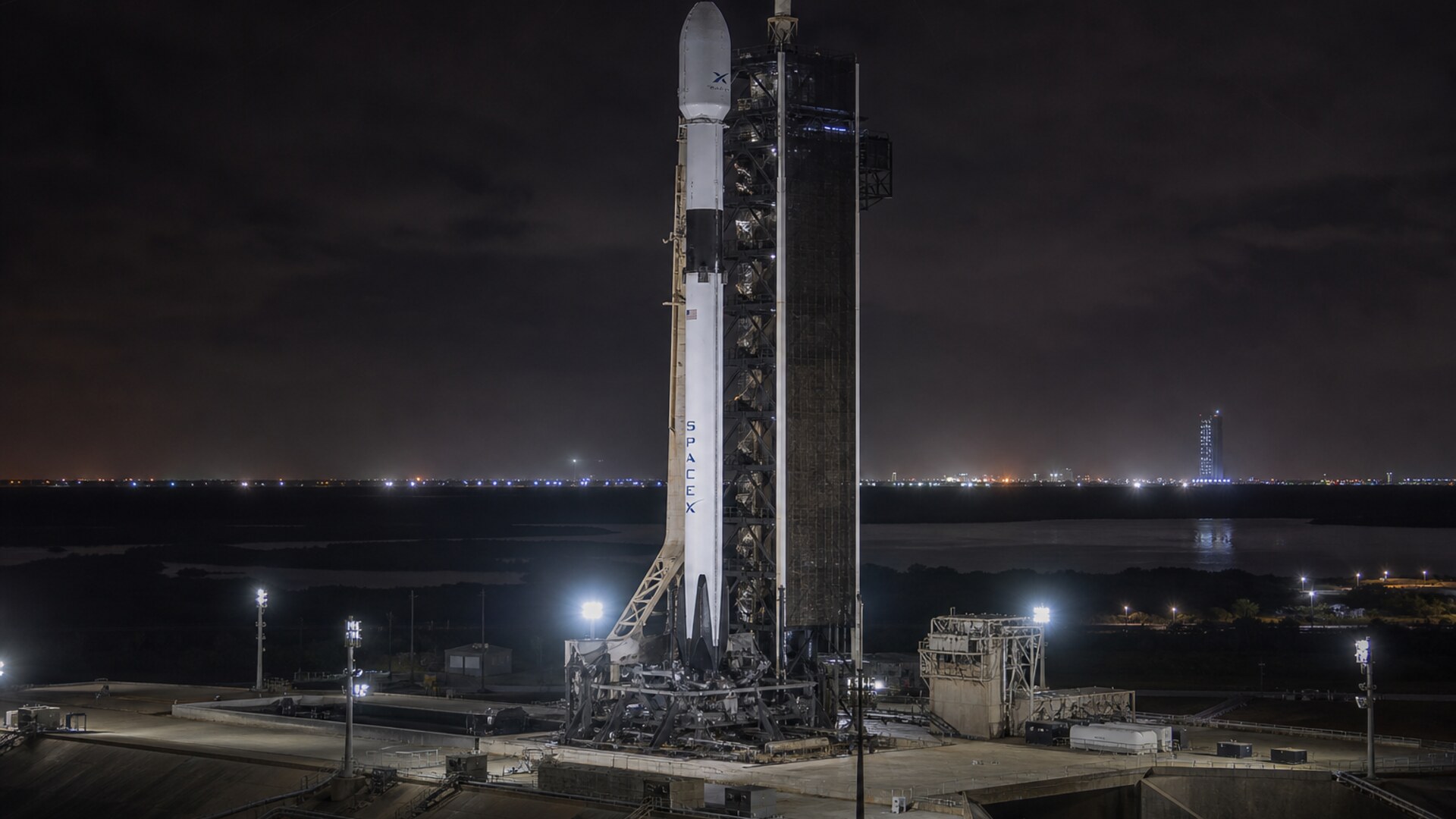
Pad 40 did its last planned Starlink at dawn, and then it stayed dressed.
A Falcon 9 left Space Launch Complex 40 at 5:33 a.m. Eastern on Tuesday, 25 August, with 29 Starlink satellites. The first stage was B1067, the fleet leader, on its 37th flight. SpaceX’s own mission page said so. Kiko Dontchev, vice president of launch, called it the last planned Falcon 9 Starlink from Florida, and said the next Starlink missions out of the state will fly on Starship. Vandenberg keeps the Falcon 9 Starlink work.
SpaceX’s mission page put the time at 5:33 a.m. ET from SLC-40 at Cape Canaveral Space Force Station. Twenty-nine Starlink satellites to low Earth orbit. B1067 on its 37th flight. After separation the first stage landed on the droneship A Shortfall of Gravitas in the Atlantic. Space.com, the same morning, called it the 100th Falcon 9 launch of 2026 and the record 37th for that booster. NextSpaceflight logged the mission as Starlink Group 10-49. Those are pad numbers. Those are pad numbers. A dawn launch, a droneship recovery, a named group. The constellation work left Florida on a Falcon 9 and is not scheduled to come back on one.
B1067’s card is why Dontchev put a double exclamation on fleet-leading. Previously CRS-22, Crew-3, Turksat 5B, Crew-4, CRS-25, Eutelsat HOTBIRD 13G, SES O3B mPOWER-A, PSN SATRIA, Telkomsat Merah Putih 2, Galileo, Koreasat-6A, and 26 Starlink missions. The booster entered service in June 2021. Thirty-seven flights later it was still the fleet leader. Space.com had six Falcon 9 boosters at 30 flights or more, with B1067 in front. Crew and cargo sit on that list next to the Starlink pile. The same serial number has taken people to the station and has taken the constellation to orbit. On 25 August it took the last planned Florida Starlink and came home on a barge.
Dontchev’s caption was the policy. “This morning’s SpaceX mission from pad 40 was the last planned Falcon 9 Starlink launch from Florida (and it launched on the fleet-leading booster!!), marking the end of an era for these launches on the East Coast,” Aerospace Global News quoted. “From here on, Starlink missions out of Florida will fly on Starship. The West Coast team will continue regularly launching Starlink from Vandenberg.” The Space Coast Rocket had the shorter version from his post: last planned Falcon 9 Starlink from the state; West Coast keeps the regular Falcon cadence. Florida Starlink becomes a Starship job. That is a vehicle change, not a pad funeral. Last planned is the phrase that matters. Planned is a schedule word. The pad is not being closed. The customer stack is being moved to another rocket.
The 25 August load was 29 Starlink satellites, a v2-mini batch on NextSpaceflight’s card, deployed about 61.5 minutes after liftoff on Space.com’s clock, 7:18 a.m. EDT on the company’s own confirmation as The Space Coast Rocket had it. Dawn on the pad. Mid-morning on the birds. A droneship in the Atlantic for the booster. For a pad correspondent that is a completed turnaround even if this particular booster’s next assignment is not posted. Group 10-49 is the mission name. Twenty-nine is the count. v2-mini is the batch class. Those three numbers are the payload. Starship is the next Florida vehicle for the same constellation. Vandenberg is the next Falcon 9 vehicle for the same constellation. Two coasts, two rockets, one product.
Florida Today, watching B1067 come back into Port Canaveral on Thursday, 27 August, said the same thing in coast language. The booster that left at 5:33 a.m. Tuesday was back at the port for a short stay before teams returned it to Kennedy for refurbishment. Two days from Atlantic to the port. Falcon 9 will still fly from Launch Complex 40 — including NASA’s Crew-13, then still on a September target — and 39A is being prepared for Starship and the occasional Heavy. As of earlier this year, Florida Today said, the rocket has only lifted off from 40 as teams ready 39A. A slip later in the week moved Crew-13 off 12 September after a Dragon oxidizer leak. The pad assignment did not move. Crew still belongs to 40. Starlink, from Florida, does not. The leak is a capsule story. The mount is still a crew mount.
SpaceNews, the same Tuesday, had SpaceX building one Starship pad at 39A and two at SLC-37. The Space Coast Rocket, citing the FAA, had a 30 January final environmental impact statement and record of decision for Starship launches and landings at 39A, covering as many as 44 Starship and Super Heavy launches a year from that pad. Gigabay is going up at Kennedy, on Roberts Road. NASASpaceFlight, in July, had the structural steel finished there, cladding and roof nearly done, two smaller doors in, the large rollout doors still in work, and SLC-37A’s mount and tower modules stacking. The coast is not going quiet. It is changing what it is loud for. Forty keeps Falcon 9. Thirty-nine A is being dressed for Starship and, when needed, Heavy. Thirty-seven is the other Starship pair. Roberts Road is the factory going up behind the pads.
Vandenberg is the other half of Dontchev’s sentence. The West Coast team will continue regularly launching Starlink from Vandenberg. Falcon 9 Starlink does not end on 25 August. It ends as a Florida product. California keeps the cadence that used to live on both coasts. Florida keeps the crew, the NASA stacks, and the customer missions that still fit a Falcon fairing. Starship takes the Florida constellation work because the birds are being sized for that bay. The handoff is a vehicle sentence, not a geography sentence. The state still launches. The pad still launches. The satellite that left at dawn is the last of a planned class from that mount.
Forty does not get undressed for a constellation change. It gets the next customer stack. Dragon still rolls there. Crew-13 is still a Pad 40 stack even after NASA slipped the 12 September target on 29 August. Heavy and Starship are being built for other mounts — 39A, and 37 behind it. The last planned Starlink left on time. The booster came home on Thursday. The mount is still a mount. A pad that can fly crew and cargo and, until Tuesday, the constellation, is a pad that stays in paint. The Starlink era on that concrete is the era that closed at 5:33 a.m. The crew era on that concrete did not close. NASA still prints SLC-40 on the Crew-13 ticket.
What 25 August is not: a retirement of SLC-40. A last Falcon 9 from Florida. A last Starlink from SpaceX. A last flight of B1067. A statement that Vandenberg is taking crew. A statement that 39A is already flying Starship. The FAA paper in January is a permission structure for 39A, as many as 44 a year, not a launch. Gigabay in July had steel and cladding and doors still in work. SLC-37A had mount and tower modules stacking. Those are construction facts. The flight fact is Group 10-49, 29 satellites, B1067 on 37, A Shortfall of Gravitas, 100th Falcon 9 of 2026. The policy fact is Dontchev: Florida Starlink on Starship from here; Vandenberg for the Falcon cadence.
What 25 August is: 5:33 a.m. Eastern, SLC-40, 29 Starlink, a v2-mini batch, Group 10-49, B1067 on flight 37, fleet leader since June 2021, droneship A Shortfall of Gravitas, deploy about 61.5 minutes later, company confirmation at 7:18 a.m. EDT, 100th Falcon 9 of the year, port return on 27 August, then Kennedy for refurbishment. Dontchev on the record. Vandenberg for the Falcon 9 birds. Starship for Florida’s next ones. Crew-13 still a Pad 40 stack. Gigabay going up on Roberts Road. 39A and SLC-37 for the bigger vehicle. As many as 44 Starship and Super Heavy launches a year from 39A on the January FAA paper. That is the Tuesday. The pad stayed dressed.
The last planned Florida Starlink is a completed turnaround. Liftoff, landing, port, hangar. The next Florida Starlink is a different rocket on a different mount. The next Falcon 9 Starlink is a West Coast job. The next Falcon 9 from Pad 40 is a customer stack, and the named one still on the sheet is crew. Starship’s first Florida Starlink is a later sentence, when it leaves 39A or 37. Until then the caption on 40 is the one Dontchev wrote and the one the booster proved: last planned, fleet-leading, on time, home on Thursday. The constellation changed vehicles. The pad did not close.
The paper
Comments
No notes on this story yet.
Sign in to comment