
Hackaday filed Berkeley Humanoid Lite on 30 August. Donald Papp’s headline was “Low(er)-Cost Humanoid Robot Leverages DIY Actuators.” The useful object on that page is not a finished person-shaped product. It is a 3D-printed cycloidal joint you can make on a desktop printer before you decide whether you want a robot at all.
The paper is “Demonstrating Berkeley Humanoid Lite: An Open-source, Accessible, and Customizable 3D-printed Humanoid Robot,” by Yufeng Chi, Qiayuan Liao, Junfeng Long, Xiaoyu Huang, Sophia Shao, Borivoje Nikolic, Zhongyu Li and Koushil Sreenath at the University of California, Berkeley. The site is lite.berkeley-humanoid.org. The hardware bill, on the US table in that paper, is $4,312. The abstract’s round number is under $5,000. Both are named. The robot on that bill is 0.8 metres tall and 16 kilograms.
Do not print a humanoid first. Print one 6512 actuator. The US bill for that joint is $188. The China table is $157. If that joint does not turn, nothing you bolt to it later will walk.
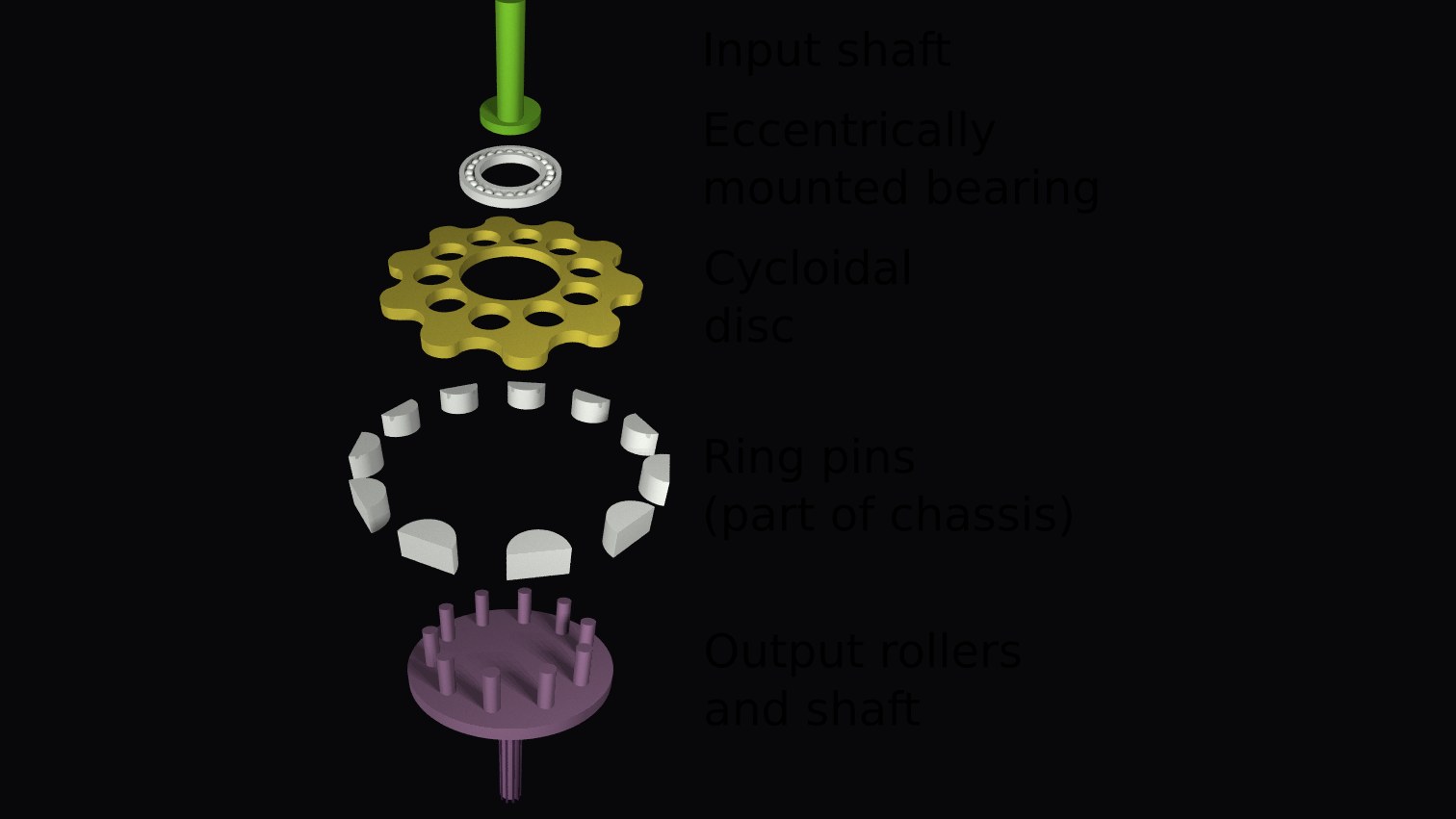
A cycloidal reducer is a compact gear. An eccentric input turns a lobed disk against a ring of rollers. Pins on the output carrier pick up the disk’s slow walk around that ring. Load is shared across many teeth instead of two. Roozing and Roozing’s 2022 and 2024 papers, which Berkeley cites, are why the lab picked cycloidal over planetary for FDM plastic: the form forgives a desktop printer’s resolution in a way a fine sun-and-planet set does not.

The 6512 is sized by a 6811ZZ ball bearing. The motor is an M6C12 150 KV BLDC drone motor from MAD Components, $129 on the US table. The driver is an ST B-G431B-ESC1, $19, stocked at Mouser and Digikey. The encoder is an AS5600, $3. Bearings $23. Fasteners $5. Printed parts $4. Cables and connectors $5. That is Table I in the paper, dollars rounded. The 5010, Table II, is the smaller sibling at $136 US: a 5010 BLDC at $84, the same driver and encoder, $18 of bearings. A full robot on Table III is ten 6512s ($1,880), twelve 5010s ($1,632), an Intel N95 mini PC ($129), four USB-CAN adapters ($68), two USB hubs ($36), a BNO085 IMU ($13), a 6S 4000 mAh LiPo ($70), two grippers ($72), aluminium extrusions ($39), $200 of printed structure, and miscellaneous metal and electronics. Total $4,312 US, $3,236 on the China table.
Every non-standard structural part is specified to fit a 200 millimetre × 200 millimetre × 200 millimetre build volume. PLA. The paper names Bambu Lab PLA Basic and Hatchbox as the two recommended spools on the gitbook BOM page. FDM, not resin, not a mill. Through-screws and a brass hex standoff in the input shaft are there because layer lines are a cleavage plane. The standoff is how torque gets from the motor into the cycloidal disks without asking plastic to take the whole shear.
The shop sequence is the gitbook page “Building the Actuator,” not a hallway recipe. First the encoder. The AS5600 as sold is not in the right configuration. The lab’s page says to swap a few resistors on the board, then solder VCC, GND, SDA and SCL on the corresponding pads. There is a video on that page. Follow the page. This newspaper is not a substitute for the pads.
Second the magnet. Hot-glue it to the rotor shaft. Use the magnet that comes with the encoder. The gitbook’s note is load-bearing: those magnets are charged along the radial axis. A hardware-store disc magnet is charged along the cylinder axis and will not talk to the AS5600. On the 5010 the magnet sits under a clip. On the M6C12 a screw at the end of the shaft holds the stack. Same magnet job.
Third the print and the stack. Housing, cycloidal disks, input shaft, output shaft. MakerWorld has a 6512 project (model 1220823) and a 5010 project (model 1279205). Onshape links sit on the gitbook releases page. Assemble to the lab’s video, YouTube CHPVXL-SsSo on that same page. Do not invent a fastener order here. The exploded view is in Figure 4 of the paper.
Fourth the solder. Encoder, motor, B-G431B-ESC1. The gitbook warns that the CAN pads on the ESC are fragile and will lift off the FR4 if you tug. Flux helps. Power is 14 AWG stranded silicone, about 2.1 square millimetres: white or red for positive, black for ground. CAN is 30 AWG, about 0.05 square millimetres: yellow for CAN-H and SDA, green for CAN-L and SCL. That colour code is the lab’s. Keep it so the next person on the bench does not swap a bus for a battery.
Test at 24 volts, the same rail the paper used. The lab ran a dynamometer: actuator under test in torque control, a second actuator as a damper in velocity control, two load cells, an electrical-power board. Mechanical efficiency of the gearbox sat around 90 percent across most of the map, falling at high torque and speed with heat. Transmission stiffness on a 6512, output locked, torque ramped to 20 newton-metres and back, linear fit between 4 and 10 newton-metres, was about 319 newton-metres per radian. Roozing’s PA-CF cycloidal, which they cite, was about 1,468. PLA is not carbon-filled nylon. That difference is the material, attributed.
Durability is the question every printed gearbox gets. The lab lifted a 0.5 kilogram pendulum on a 0.5 metre arm from −45 degrees to +90 degrees at 0.5 hertz for 60 hours. Efficiency dipped and recovered. Backlash rose and stayed inside what they called acceptable. Six 6512s printed on two different printers tracked torque within ±0.5 newton-metres. Fresh-print backlash, six samples, maximum 0.0229 radians, standard deviation 0.0042. A five-degree-of-freedom arm of those actuators, 100 repeats to four targets, end-effector scatter 3.433 millimetres standard deviation on SteamVR tracking.
Hackaday’s commenter someNerd, 30 August at 7:20 a.m., wrote “188$ per actuator according to their bom. No torque / lifecycle ratings.” The $188 is Table I. The lifecycle rating the comment wanted is the 60-hour pendulum, which is a lab hours figure, not a catalogue MTBF. The paper is honest about a missing thermal study on long running. Read that limitation before you order twenty-two motors.
Communication on the assembled robot is 1 megabit CAN 2.0, four buses, 250 hertz to the actuators and the IMU, policy at 25 hertz on the N95. Each bus can address up to 64 devices. That is why the same joint becomes a quadruped or a mobile base in Figure 6. You do not need that for the first afternoon. You need one 6512 that turns on 24 volts, holds a position, and does not strip a printed disk. Papp’s 30 August point stands: even if you never build the humanoid, the actuator is the part worth stealing for some other machine.
Print one. Weigh the filament. Pay the $188. Flex the joint. Then, and only then, open Table III.
The paper
Comments
No notes on this story yet.
Sign in to comment