
The Nancy Grace Roman Space Telescope left Launch Complex 39A at 7:26 a.m. Eastern on Sunday, 30 August. A SpaceX Falcon Heavy did the lifting. NASA’s Kennedy Space Center, Florida. The time was not a window any more. It was the clock on the event.
Seven minutes later, the ground team at Goddard Space Flight Center in Greenbelt, Maryland, had telemetry. Thirty-one minutes into the flight the observatory separated from the rocket. An hour and twenty-three minutes after liftoff, the solar panels and the lower instrument sun shade were out. About seventy minutes after launch, the Deep Space Network took the link at Canberra. Roman is flying.
NASA Headquarters released the news under 26-071, Jennifer M. Dooren, 30 August. Fourth NASA primary mission on a Falcon Heavy. Formal launch readiness was May 2027. Sunday was August 2026. About nine months early, on a rocket that did the job.
The minutes are the file. NASA’s Goddard mission blog, updated the same morning, put numbers on them. Communications through a Tracking and Data Relay Satellite at 7:33 a.m. Eastern. Separation from Falcon Heavy’s second stage at 7:57 a.m. Eastern. That is thirty-one minutes after 7:26, which is also the figure in the Headquarters release. SpaceX’s Roman mission page had listed the deploy as T+31 minutes 31 seconds, marked as a countdown time. The blog is the flown time.
After the side cores came off the centre, the two boosters came home to the Cape for refurbishment. SpaceX’s mission page named the landing pads: Landing Zones 2 and 40 at Cape Canaveral Space Force Station. The same page listed the heritage. First flight and third flight. Previous work: GOES-U, and Viasat-3 F3. Fairing separation had been in the table at T+4 minutes 15 seconds. NASA’s release did not reprint the landing-zone names. It did say the boosters returned safely to the launch site. Two sources, one morning.
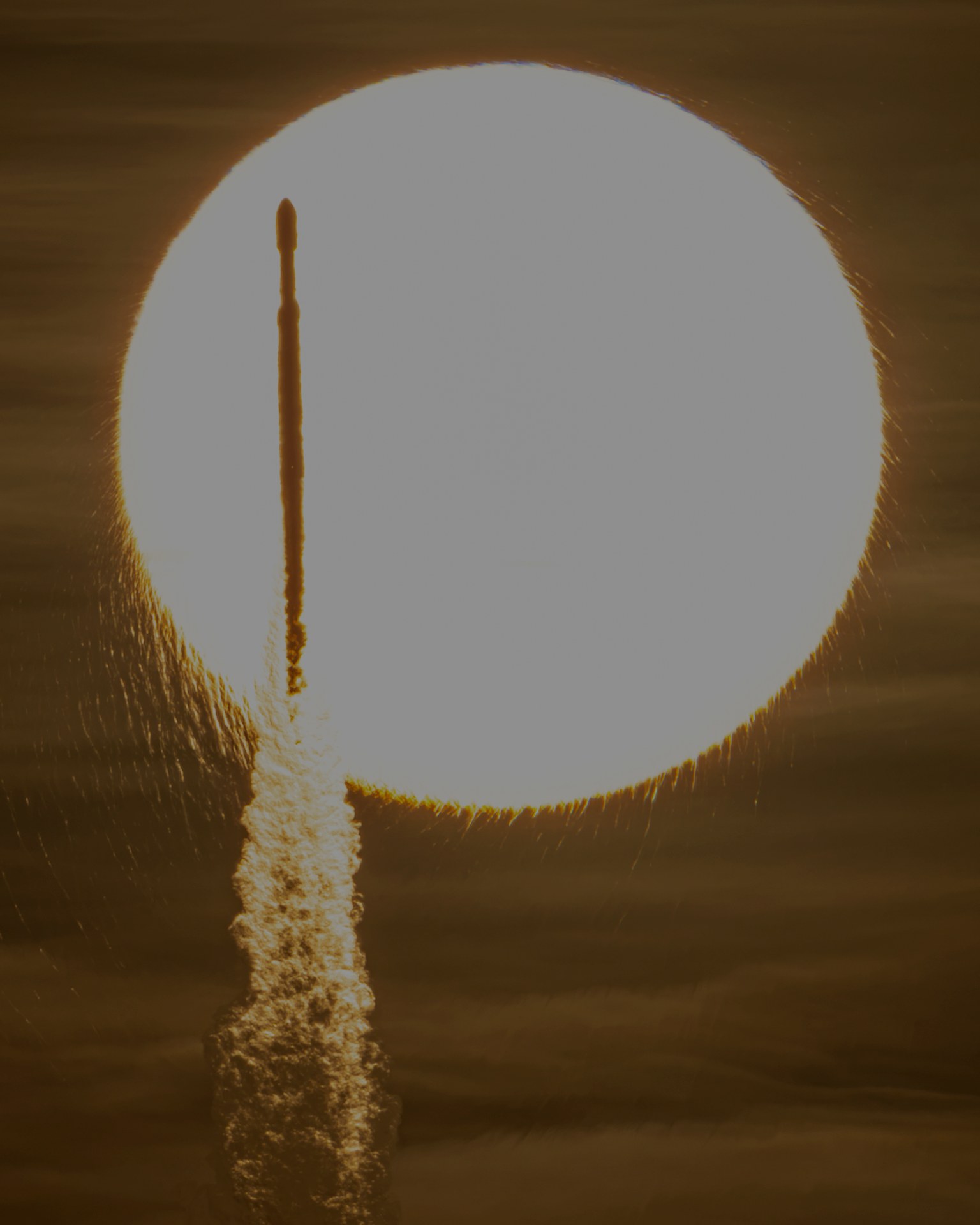
The photograph NASA put on the release is the one on this page. Falcon Heavy, Roman on the nose, transiting the Sun, LC-39A, 30 August. Credit NASA/John Kraus. Photograph NHQ20260830_admin_0001. No crew. The rocket is the object in the frame.
During launch and early orbit, Roman used the Near Space Network’s ground stations and relay satellites for tracking, telemetry and command. About seventy minutes after launch, the Deep Space Network took over and began the long job of walking the observatory toward the second Sun-Earth Lagrange point. First station: the Canberra Deep Space Communication Complex in Australia. About six hours later, the Madrid Deep Space Communication Complex in Spain. Then Goldstone in California. NASA wrote that chain so the contact would be continuous. Goddard’s blog added the later science-data path: when Roman starts sending the high-rate science stream, the Near Space Network carries that load, the Deep Space Network keeps the tracking, and ESA and JAXA add downlink through New Norcia in Australia and Misasa in Japan.
The solar work came next. NASA Headquarters: solar panels and the lower instrument sun shade deployed one hour and twenty-three minutes after launch. Goddard’s blog, written just after separation, had described the hardware that was about to move. The Solar Array Sun Shield is power and a thermal shield in one. After separation, four outer panels swing out to make a six-panel array. The Headquarters confirmation is the flown result. The blog is the mechanism.
The next few days are a short list, also from 26-071. High-gain antenna. A visor-like deployable aperture cover. The first of two mid-course corrections. The Coronagraph Instrument powers on. A few weeks into the cruise, the Wide Field Instrument activates. Then calibrations, for the rest of a three-month commissioning period. NASA expects the first images in early 2027.
The destination is a quasi-halo orbit around Sun-Earth L2, about 1.5 million kilometres from Earth. Three months on the way. The Headquarters release and the Goddard blog both put Roman on that road the morning it left.
The object that flew
NASA’s Roman FAQ is the tape measure. The observatory is about 12.7 metres long — NASA’s comparison is a semi-trailer — and more than 4.4 metres wide once it is fully deployed. Primary mirror 2.4 metres, the same diameter as Hubble’s, about 80 percent lighter. NASA’s Office of Inspector General, in report IG-24-014, put a mass on that glass: 186 kilograms. Hubble’s primary is the same width and more than four times the weight.
Two instruments. The Wide Field Instrument is the survey camera. The Coronagraph Instrument is the technology demonstration. That pairing is the whole payload.
The FAQ still lists the camera as 288 megapixels. NASA’s launch release and the March 2026 WFI technical sheet, version 1.4, call it a 300-megapixel infrared camera. This desk is filing the instrument page and the launch release. Eighteen Teledyne H4RG-10 detectors, each 4096 by 4096 pixels, each about the size of a saltine cracker, per 26-071. Pixel pitch 10 micrometres. Sampling 0.11 arcseconds per pixel. The focal plane, excluding the gaps between detectors, is 0.8 by 0.4 degrees, 0.281 square degrees. That field is about 200 times Hubble’s WFC3-IR camera, with better sensitivity and comparable spatial resolution. NASA’s public Wide Field Instrument page makes the comparison another way. Each Roman image is bigger than the apparent size of a full Moon. Hubble’s infrared frames with WFC3 are about 200 times smaller. Hubble’s widest exposures with the Advanced Camera for Surveys are nearly 100 times smaller.
NASA’s Scientific Visualization Studio, sequence 12308, did the arithmetic with actual footprints. Hubble needed 432 pointings of Wide Field Camera 3 to cover roughly the area Roman covers with two. Same class of resolution. Different number of times you have to repoint. That is why a 0.281-square-degree field is not a crop. It is the observing plan.
Survey speed is a different number. Do not stack it on the field of view and call them the same fact. NASA’s launch release says Roman is designed to survey the universe a thousand times faster than Hubble. The WFI page says that in five years Roman will image more than 50 times as much sky as Hubble covered in its first 30 years, at up to 1,000 times Hubble’s survey speed, at similar sensitivity and infrared resolution. The March 2026 technical sheet is more specific still. At a 55-second integration, Roman can cover about 8 contiguous square degrees per hour in one spectral element. Slew-and-settle already eats a little more time than the exposure. Faster than that, the sheet says, is not worth the sensitivity you give away.
The camera is a Cold Sensing Module on the instrument carrier, plus a Warm Electronics Module in a spacecraft-bus bay. Light hits an element wheel before the detectors: eight imaging filters from 0.48 to 2.3 micrometres, plus a prism and a grism for slitless spectroscopy. The overview table on the technical page gives the dispersers as 0.75 to 1.93 micrometres. The same page’s spectroscopy section splits them. Grism G150, 1.00 to 1.93 micrometres, resolving power around 600. Prism P127, 0.75 to 1.80 micrometres, resolving power around 100. Detectors sit at 89.5 K, passively cooled by external radiators. Image stability: 1.0 nanometre RMS wave-front error in 180 seconds. Guiding is interleaved with the science reads. An Alignment Compensation Mechanism under the focal plane handles fine focus. An internal relative calibration system, LEDs into a sphere onto diffusers, is there to keep linearity honest for five years of supernova photometry.
The filters have names, because they will be in every proposal. F062, F087, F106, F129, F158, F184, F213, and the wide F146. One-hour point-source depths, 5-sigma, at twice minimum zodiacal light, run from magnitude 27.97 in F062 to 25.64 in F213. A 57-second point-source frame is about 24.8 to 23.1, same filters. Those figures are the June 2024 sensitivity table on the technical page. They are not first-light promises. They are the performance the instrument was built to.
The bandpasses themselves are in the same sheet. F062 runs 0.48 to 0.76 micrometres. F087, 0.76 to 0.98. F106, 0.93 to 1.19. F129, 1.13 to 1.45. F158, 1.38 to 1.77. F184, 1.68 to 2.00. F213, 1.95 to 2.30. The wide F146 is 0.93 to 2.00, a single element that swallows most of the camera’s near-infrared range. Simulated point-spread-function full widths at half maximum, for a K0V star on a detector near the middle of the field, go from 0.058 arcseconds in F062 to 0.169 arcseconds in F213. Eight milliarcseconds of Gaussian pointing jitter are already in those numbers. The element wheel also carries a dark and diffuser masks so the camera can take internal flats and darks without waiting on the sky.
Zodiacal light sets the floor. At high Galactic latitude the sheet uses about 1.5 times the minimum. In the bulge, 2.5 to 7 times. Internal thermal background is negligible in the blue filters and 4.38 counts per pixel per second in F213. That is why F213 is the shallowest one-hour point-source limit on the table. The camera was not designed to pretend every filter is equal. It was designed so cosmologists can pick the band and know the noise.
Thermal-vacuum test two, TVAC2, put the flight focal plane at the 89.5 K plateau. Median total noise across the array, 5.58 electrons. Median dark, 0.018 electrons per second, which the sheet warns is internal thermal background more than a true dark floor. Median quantum efficiency 0.888 between 900 and 2,200 nanometres. Across all 18 detectors, 98.26 percent of pixels met requirements. Sensor control unit 4, serial 21115, is the exception the sheet flags: an extended region of persistence pulls that detector’s operable fraction down to 84.75 percent. The rest sit in the high nineties. The array still works as an array. That is the point of publishing the table.
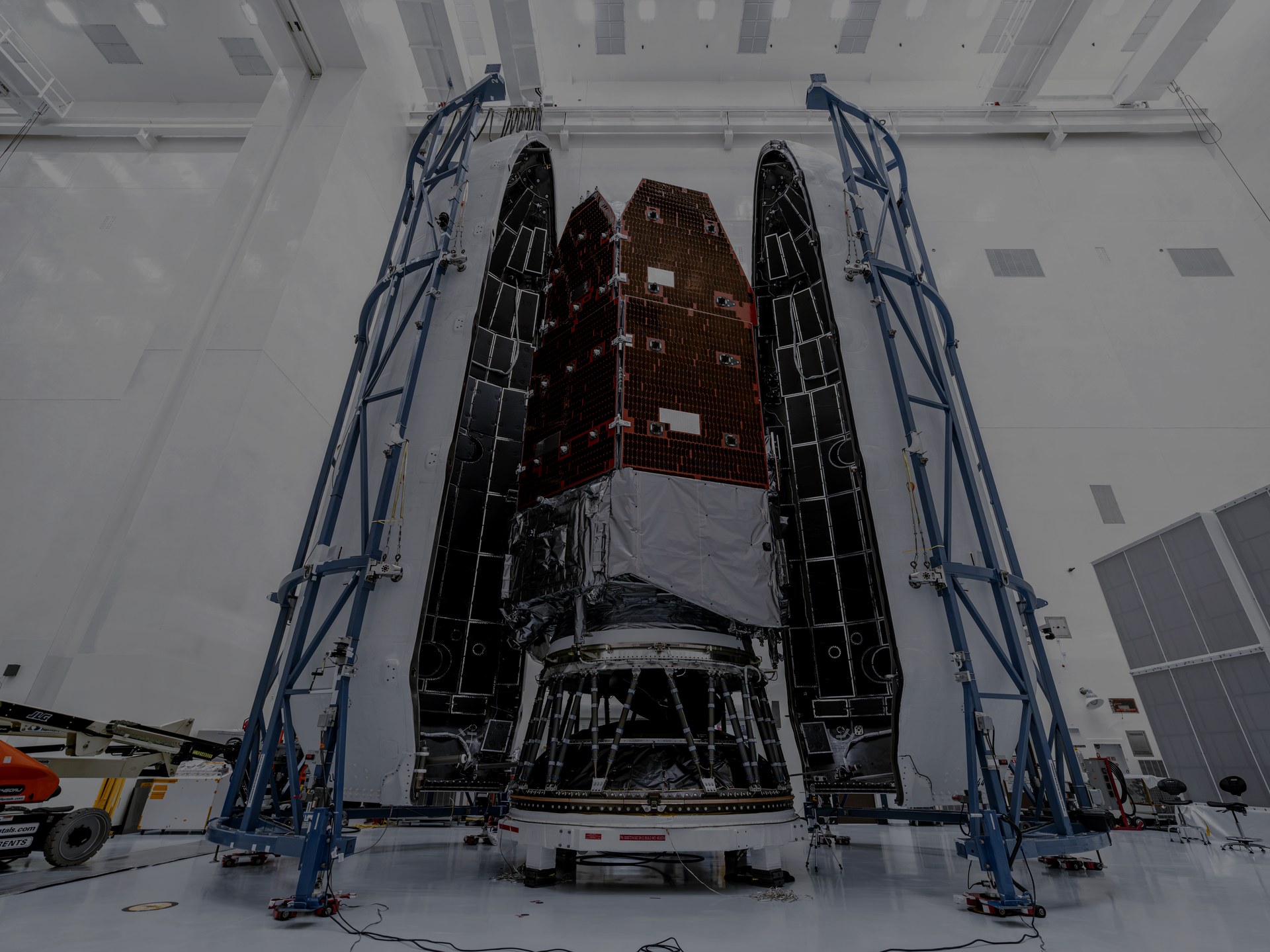
Friday, 21 August, Payload Hazardous Servicing Facility at Kennedy: teams closed the observatory into the Falcon Heavy fairing. NASA’s Sydney Rohde photographed the work. The still on this page is KSC-20260821-PH-SER01_0001. Observatory vertical, fairing halves open like a clamshell, acoustic blankets on the inside, solar-array faces on the bus. No portraits. Encapsulation is the last time the machine is in air on purpose.
Why the field is the mission
Roman is not Hubble with a wider crop tool. Hubble points. Roman sweeps. NASA’s FAQ is blunt about the science case: dark energy, dark matter, exoplanets, and a wide run of infrared astrophysics, including the outer solar system. More than a billion galaxies. Type Ia supernovae as tracers of accelerated expansion. Weak lensing and galaxy clustering as a map of how matter sits. A stare at the galactic bulge for planets in wide orbits, more than a thousand of them by microlensing, and more than 100,000 transits in the same campaign. Three planet methods on one observatory: microlensing, transits, and direct imaging with the coronagraph.
The observing time is not a guest-observer scramble. NASA’s Core Community Surveys page is the ledger. In the first five years the Wide Field Instrument’s time is mostly three community-defined surveys, plus General Astrophysics Surveys that take about a quarter of the clock. All of the data is public at once. No proprietary period. One hundred percent of observing time is community directed, per the FAQ.
The Roman Observations Time Allocation Committee delivered recommendations in April 2025. Co-chairs: Gail Zasowski, University of Utah, and Saurabh Jha, Rutgers. Thirteen scientists. The committee took the three survey-definition reports and told the project what to fly.
High-Latitude Wide-Area Survey, the cosmology map. NASA’s survey page: more than 5,000 square degrees, about 12 percent of the sky, in just under a year and a half. Three tiers. A main imaging-and-spectroscopy piece of about 2,500 square degrees in multiple filters plus the grism. A wider single-filter piece that more than doubles the area, laid out so ground telescopes in both hemispheres can overlap it. A smaller, deeper piece for faint distant galaxies. The CCS page’s Medium tier is 2,400 square degrees in Y, J and H with grism spectroscopy. The Wide tier adds 2,700 square degrees in H. ROTAC gave this survey the nominal allocation, 520 days, about 17 months. Galaxy clustering and weak gravitational lensing are the two main cosmological tools. Hundreds of millions of faint galaxies, positions and shapes. Spectroscopy for distances and for the expansion rate in different eras. NASA’s page puts dark matter at about 27 percent of the universe and dark energy at about 68, and says Roman should measure the effects of dark energy ten times more precisely than current work. Those percentages are the standard cosmological split NASA is using, not a new measurement from this telescope. The telescope has not opened its eye yet.
Two probes on one survey is the design. Spectroscopy for baryon acoustic oscillations and redshift-space distortions, the standard-ruler and standard-flow tests. Imaging for weak lensing, the growth-of-structure test. If the expansion history and the growth history disagree, that is a result, not a calibration error you can wave away. NASA’s High-Latitude Wide-Area Survey page is explicit: the data should help tell a new energy component from a breakdown of Einstein’s gravity on cosmological scales. Ten times the precision of current dark-energy work is the agency’s published aim for that programme. Medium tier first, with at least half the Deep tier early in the mission and most of the Wide tier late, so the calibration fields exist before the wide shallow pass. ROTAC signed that order in April 2025. Sunday’s launch is what makes the order a schedule instead of a report.
High-Latitude Time-Domain Survey, the supernova clock. About six months. ROTAC took the nominal 180 days. NASA’s CCS page: a Core component for discovering and characterising Type Ia supernovae and other transients, Wide and Deep imaging plus prism spectroscopy. A Pilot of eight epochs at a 20-day cadence as early as possible, for templates and for supernova rates above redshift 1. An Extended Deep piece, eight epochs at a 120-day cadence, for long-duration transients across the five-year mission. The point is the expansion history, measured with exploding white dwarfs instead of with lensing and clustering. Two methods. One sky.
Galactic Bulge Time-Domain Survey, the planet census. About 15 months. ROTAC recommended the overguide allocation, 438 days, with the first high-cadence season trimmed so the Galactic Plane Survey still fits, and with more work on the low-cadence seasons so they do not wreck the supernova survey. NASA’s bulge page is the field list. Six fields, 1.7 square degrees total. One field through the Galactic Centre, the others nearby, all in a patch of sky Roman can see for two 72-day stretches each spring and fall. Six high-cadence seasons, three early, three late, with a look every 12 minutes — the CCS page says 12.1 minutes. Low-cadence seasons at five days or faster for the long events. Snapshots in several filters, and grism spectra for temperatures, metallicities and radial velocities.
Microlensing is the trick. A foreground star or planet lines up with a background star. Mass bends space. The background star brightens, then fades. You never have to see the planet in reflected light. NASA expects more than a thousand planets on wide orbits, including some in habitable zones and some down to a few times the mass of the Moon, plus free-floating worlds that do not orbit a star at all. The same stare should yield about 100,000 transiting planets on closer orbits, more than a thousand neutron stars, hundreds of stellar-mass black holes, and asteroseismology on a million giant stars. Brown dwarfs sit in the gap between planet and star. Isolated black holes, the ones with no companion to advertise them, show up because gravity does not need a neighbour.
General Astrophysics Surveys keep 389 days, 25.5 percent of science operations, including an early-definition Galactic Plane Survey. That is the ROTAC number. Unlike Hubble and JWST, where most of the time is competed cycle by cycle, the three core surveys have to be planned before launch because they run for years. Community science pitches were due 17 February 2023, more than 100 of them. White papers 16 June 2023, more than 70. Definition committees were stood up in August 2023. The dates are on NASA’s CCS page. The survey that flies is the one that community wrote.
The other instrument
The Coronagraph Instrument is not a second survey camera. NASA’s coronagraph page calls the hardware starglasses: masks, prisms, detectors, and self-flexing mirrors, built to take the glare off a star so a planet can be photographed. Headquarters, 30 August: it will demonstrate technology that a future Habitable Worlds Observatory could use to image Earth-like planets. Roman’s coronagraph takes the step that is available now. Jupiter-like planets. Pictures.
Two deformable mirrors sit in the beam. Thousands of actuators move like pistons and change the mirror figures in real time. NASA says the surface corrections can compensate for errors smaller than the width of a strand of DNA. Those mirrors, plus the masks, also kill the star’s diffraction. The page’s performance claim is a leap of 100 to 1,000 times over previous coronagraphs, and two or three orders of magnitude more powerful than any coronagraph already flown on a space telescope. Direct imaging of Jupiter-size worlds around Sun-like stars, including planets up to several billion years old, which has not been done. If the 18-month technology demonstration works, the instrument could open to the scientific community.
NASA’s coronagraph page is also specific about what “direct imaging” means here. Photograph worlds and dusty disks around nearby stars, in detail up to a thousand times better than other observatories can manage, by flying the high-contrast hardware in space instead of under an atmosphere. Ground telescopes already use coronagraphs. Space removes the air. Active wavefront control — the deformable mirrors plus the masks — is the piece that has not had a long run off Earth. Roman is that run. Jupiter-size planets around Sun-like stars, including worlds several billion years old, are the demonstration targets. Earth-like planets are the later mission. Headquarters named it: Habitable Worlds Observatory. The coronagraph on Roman is the pathfinder, not the final camera.
JPL built it. Goddard integrated it onto the same instrument carrier as the Wide Field Instrument. Max Planck Institute for Astronomy in Heidelberg shipped core pieces to JPL; NASA’s German partner list is on the launch release. CNES is on that list too. The coronagraph is the rehearsal. The Wide Field Instrument is the atlas.
A terabyte and a half a day, with no lock
Roman will send back 1.4 terabytes of data every day. Headquarters: the highest data rate of any NASA astrophysics mission so far. Software classifiers and citizen scientists will help sift it and flag the interesting frames, which astronomers then study. There is no proprietary period. NASA will make every bit public. STScI in Baltimore runs science operations. Caltech/IPAC in Pasadena is on the science support. Anyone with a reduction pipeline can sit down the same morning as the team that wrote the proposal.
The WFI page puts a human unit on the same firehose. Scientists will be able to do work that would take hundreds of years on other telescopes, because the field is large and the settle times are short. NASA SVS 12308 again: two Roman pointings against 432 Hubble ones for the same patch. Multiply that by a five-year primary mission, with 75 percent of the time in the core surveys and a quarter held for General Astrophysics, and you get why STScI has been treating this as a survey archive rather than as a guest-observer inbox. Hubble’s model is a queue of pointed programmes. Roman’s model is a sky that is already being mapped, with the community told in 2023 and 2025 exactly how.
Primary mission five years. Designed for five more if the fuel lasts. The FAQ is unambiguous: fuel is the only expendable. Data has no lock. A General Investigator programme will fund people to work on the public pixels, and will allow new observations when the core surveys cannot do the job. The first call for general astrophysics proposals was planned for about a year before launch. Launch was 30 August 2026. The community process is not a future tense any more.
That volume is why the calibration system exists. Type Ia distances live or die on detector linearity. The relative calibration system can flat-field every pixel over about five orders of magnitude in six wavelength bands. Lamp-on-lamp-off compares a sky scene with and without an added flat pedestal. Combinatorial flux addition mixes two LEDs at the same wavelength with no sky in the way. Those are the methods on the March 2026 sheet. They are not romance. They are how you trust a supernova at redshift 1.
Nine months early is a dated fact
The launch date moved because the observatory was ready. Headquarters is explicit. NASA’s Launch Services Program worked with SpaceX earlier this year to accelerate the date to match early completion. May 2027 was the formal readiness date. 30 August 2026 is the flown date.
The paper is not inventing a cancellation count. Named documents, named dates.
On 2 March 2020, NASA announced that WFIRST had passed the milestone that lets hardware development and testing begin. Ashley Balzer, Goddard. Expected development cost $3.2 billion. Including five years of operations and science, and the ride-along coronagraph, a maximum of $3.934 billion. The same article recorded the FY2021 budget request: terminate WFIRST, finish James Webb, and wait. An editor’s note added 29 September 2023: the observatory was renamed the Nancy Grace Roman Space Telescope on 20 May 2020.
NASA’s Office of Inspector General, IG-24-014, walked the money after that. Key Decision Point C in February 2020: Agency Baseline Commitment $3.9 billion, launch readiness October 2026. A replan in June 2021, to cover cost and schedule growth the report ties to the pandemic, reset the commitment to $4.3 billion and the readiness date to May 2027. As of March 2024 the project was meeting that cost obligation and the May 2027 date, while still working toward the original October 2026 readiness as schedule margin. Sunday morning used the margin. The rocket left in August 2026.
The glass predates the name. NASA’s 2012 Q&A on WFIRST is the agency’s own account. The mission had been configured around a mirror 1.5 metres or smaller. In 2012 NASA acquired two 2.4-metre telescopes from the National Reconnaissance Office. Astronomy Picture of the Day, 10 June 2012, ran the gift as the day’s image note: two space-qualified Hubble-quality telescopes, transferred to NASA, not free once you put cameras on them. The 2.4-metre version became WFIRST-AFTA, Astrophysics Focused Telescope Assets. One of those mirrors is the one that left Florida on Sunday. The FAQ’s 80-percent-lighter figure is the reason the 2.4-metre class fits on a Falcon Heavy without Hubble’s mass.
NASA’s own Q&A at the time said why the larger glass was worth the rebuild. Higher angular resolution and a wide field together, beyond Hubble and beyond the largest ground optical telescopes, so weak lensing — the tiny distortions in galaxy shapes caused by intervening dark matter — could be measured with the sensitivity a cosmology survey actually needs. A 1.5-metre design would have surveyed. A 2.4-metre design surveys and resolves. The launch release’s “thousand times faster than Hubble” is the survey half. The 0.11-arcsecond pixels are the resolve half. Both left on the same rocket.
Nancy Grace Roman is the namesake, not the cargo. NASA’s FAQ: first chief astronomer, the person the agency still calls the mother of Hubble. The May 2020 rename is the official act. The launch release puts her name on a flying observatory. This desk is not writing a eulogy over a telemetry plot. The machine is the citation.
Administrator Jared Isaacman, quoted in 26-071, ahead of schedule and on budget: “Roman is exactly the kind of success story we want to see across NASA. Delivered ahead of schedule and on budget, this mission reflects more than a decade of dedication from the NASA workforce and our industry partners. Now, Roman will give us a new atlas of the universe, push the boundaries of discovery, and demonstrate what is possible when America’s space program pairs bold ambition with disciplined execution.”
Nicky Fox, associate administrator for the Science Mission Directorate: “Roman will be a discovery machine that will bring us closer than ever before to answering humanity’s most profound questions about our cosmic history. With its large field of view and fast survey speeds, Roman will usher us into a new era of discovery and make the invisible visible, setting the foundation for humanity’s search for life beyond our solar system.”
Julie McEnery, senior project scientist at Goddard: “We’ve never been able to view the universe with eyes like Roman’s before. There’s no telling what more we’ll know and have seen by this time next year.”
Those are the three quotes NASA put on the launch. Named people, named release. No portraits on this page.
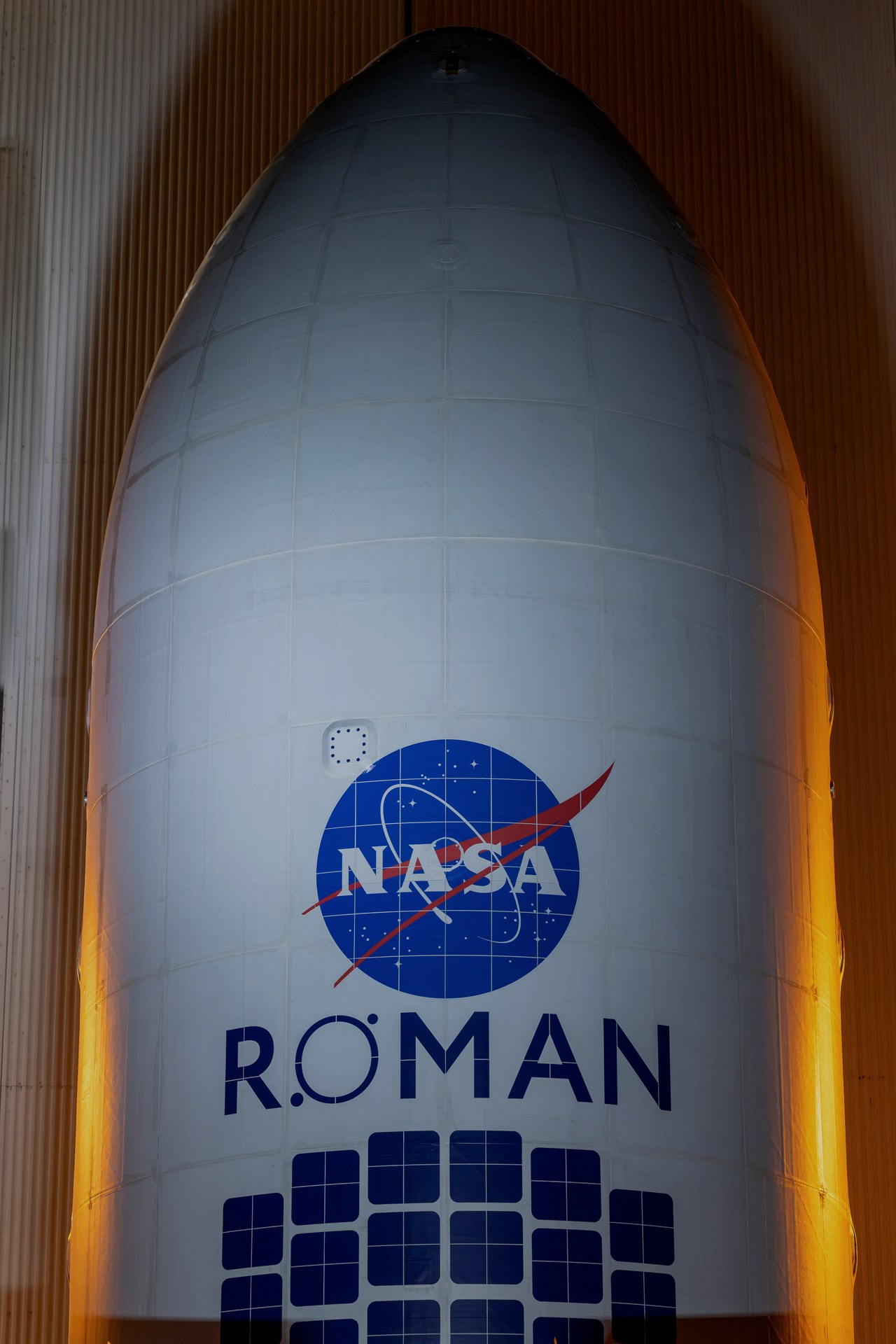
Monday, 24 August, still in the servicing facility: Rohde photographed the closed stack. KSC-20260824-PH-SER01_0005. White fairing, NASA meatball, ROMAN in blue, eighteen dark rectangles in the WFI layout, SPACE TELESCOPE under the grid. The detectors are painted on the nose because they are the argument. Eighteen 4K infrared arrays. That is the camera that surveys a thousand times faster than Hubble. Tuesday, 25 August, the encapsulated payload moved to the SpaceX hangar at 39A. Saturday, 29 August, Falcon Heavy rolled out and went vertical. Sunday, 30 August, 7:26 a.m. Eastern, it left.
Who built it, and who talks to it
Goddard manages the project. JPL in Southern California, Caltech/IPAC in Pasadena, and the Space Telescope Science Institute in Baltimore are on the release. Primary industrial partners on 30 August: BAE Systems Inc., L3Harris Technologies, Teledyne Scientific & Imaging. The FAQ, not yet rewritten for the launch, still lists Ball Aerospace and Technologies Corporation in Boulder for the same industrial slot; BAE is the name Headquarters used on the day it flew. Contributions from ESA, JAXA, CNES, and the Max Planck Institute for Astronomy. That is the list. Do not add a lab that is not on it.
Five-year primary mission, designed to support five more if the fuel lasts. Fuel is the expendable. The FAQ is the source. Commissioning is the three-month cruise plus the calibrations NASA will run after the instruments wake. First images, early 2027. Not this week. Not a preview jpeg from a clean room. Early 2027, after L2, after the wheel has turned through darks and flats and the coronagraph has been told to live.
What happens in the coming days is already on the release. High-gain antenna deploys. The aperture cover deploys. Mid-course correction one of two. Coronagraph power-on. Then, a few weeks out, the Wide Field Instrument. Eighteen saltine-sized detectors at 89.5 K, still dark, waiting for the element wheel. Goddard will keep the link. Canberra, Madrid, Goldstone, in that order, until the geometry says otherwise.
The cruise is 1.5 million kilometres and about ninety days. Halo orbit, not a parking space. L2 is a region, not a buoy. Roman will loop around it so the Sun, Earth and Moon sit in the same part of the sky and the sun shade can do one job. That geometry is why a survey telescope wants this orbit. Stable thermal. Long stares. No Earth in the way every ninety minutes.
Commissioning rides the cruise. Headquarters called it a three-month commissioning period: instruments woken, calibrated, tested, while the observatory is still on the way and after it arrives. Goddard’s separation blog treated 7:57 a.m. Eastern as the hand-off from launch operations to on-orbit commissioning. Solar array and sun shade are already done. High-gain antenna and aperture cover are next. Mid-course correction one of two. Coronagraph power-on in the coming days. Wide Field Instrument a few weeks into the voyage, which means the 300-megapixel camera comes alive while Roman is still climbing out through interplanetary space, not after it has parked. First images, early 2027. That phrase is NASA’s, not a desk guess. It sits on the far side of about 100 days of flying, cooling, focusing and proving the wheel.
The Deep Space Network hand-offs are geography. Canberra first because Australia is in view about seventy minutes after a Florida sunrise launch. Madrid about six hours later as Earth turns. Goldstone after that. ESA’s New Norcia and JAXA’s Misasa join later for science downlink, not for this morning’s launch-and-early-orbit loop. Near Space Network for the high-rate science once the surveys start. Deep Space Network for the ranging that tells Greenbelt where a 12.7-metre observatory is, 1.5 million kilometres out, to the precision a mid-course burn requires. Two networks. Different jobs.
Falcon Heavy is three cores and twenty-seven Merlin engines. NASA did not put the engine count in 26-071. SpaceX’s vehicle is the one that flew. Side boosters back at LZ-2 and LZ-40, centre core expended, second stage done after the 7:57 a.m. hand-off. Fourth NASA primary on this rocket. Launch Services Program moved the date because the payload was early, not because a weather window appeared. That is the agency’s sentence.
The science will not wait for a pretty picture to justify the ticket. Weak lensing does not need a press-kit spiral galaxy. It needs shapes, millions of them, measured well enough that a one-percent stretch in a background galaxy is a signal and not a jitter. Galaxy clustering needs positions and redshifts. The grism is how you get redshifts without a slit for every object. Microlensing needs cadence. Twelve minutes, six seasons, or the event is a point and not a curve. The coronagraph needs a dark hole, dug in software and in deformable-mirror commands, held long enough to integrate a planet that is a billion times fainter than its star. None of that is a brochure. It is why the technical sheet spends pages on persistence decay curves and LED bandpasses.
Citizen scientists will see the same pixels as the project infrastructure teams. The release says so, once you take the marketing nouns off the sentence: software classifiers and people looking at images, flagging the frames that matter. STScI has been preparing for a survey data rate that Hubble never had to swallow. 1.4 terabytes a day is a firehose with a public tap.
What this morning actually changed
Yesterday this desk could file a pad story. Targeting 7:26 a.m. Eastern, Sunday, 39A. Backup Monday 31 August at 7:22 a.m. Fairing already lettered. Formal readiness May 2027. That file still sits in the paper, as a pre-launch note, because it is what was true on Saturday. This file is Sunday’s result.
Liftoff 7:26 a.m. Eastern, 30 August 2026. In Adelaide that was 8:56 p.m. Sunday. Falcon Heavy, LC-39A, Kennedy. Goddard telemetry at seven minutes. TDRS at 7:33. Separation at 7:57. Boosters back at the Cape. Solar array and lower sun shade at one hour twenty-three minutes. Canberra on the Deep Space Network at about seventy minutes, then Madrid, then Goldstone. Three months to L2, 1.5 million kilometres. Coronagraph on in the coming days. Wide Field Instrument in a few weeks. First images early 2027. 1.4 terabytes a day after that. Nine months ahead of the May 2027 readiness date. On budget, if you take the administrator at the sentence NASA printed.
The 2.4-metre mirror that started as an NRO telescope in 2012 is now past Max-Q and past the fairing and past the second-stage burn. The 18 detectors that spent TVAC2 at 89.5 K are still off, which is correct. The coronagraph’s deformable mirrors have not been asked to hold a dark hole on the sky. They will be. The surveys the community defined in 2023 and 2024, and that ROTAC signed in April 2025, are still on paper until commissioning is over. The paper just got a lot closer to the sky.
Roman is 12.7 metres of observatory on a three-month cruise. The name on the fairing is a chief astronomer’s. The name on the release is 26-071. The time on the clock was 7:26. The rocket left. The telescope is the object that is still going.
The paper
Comments
No notes on this story yet.
Sign in to comment