
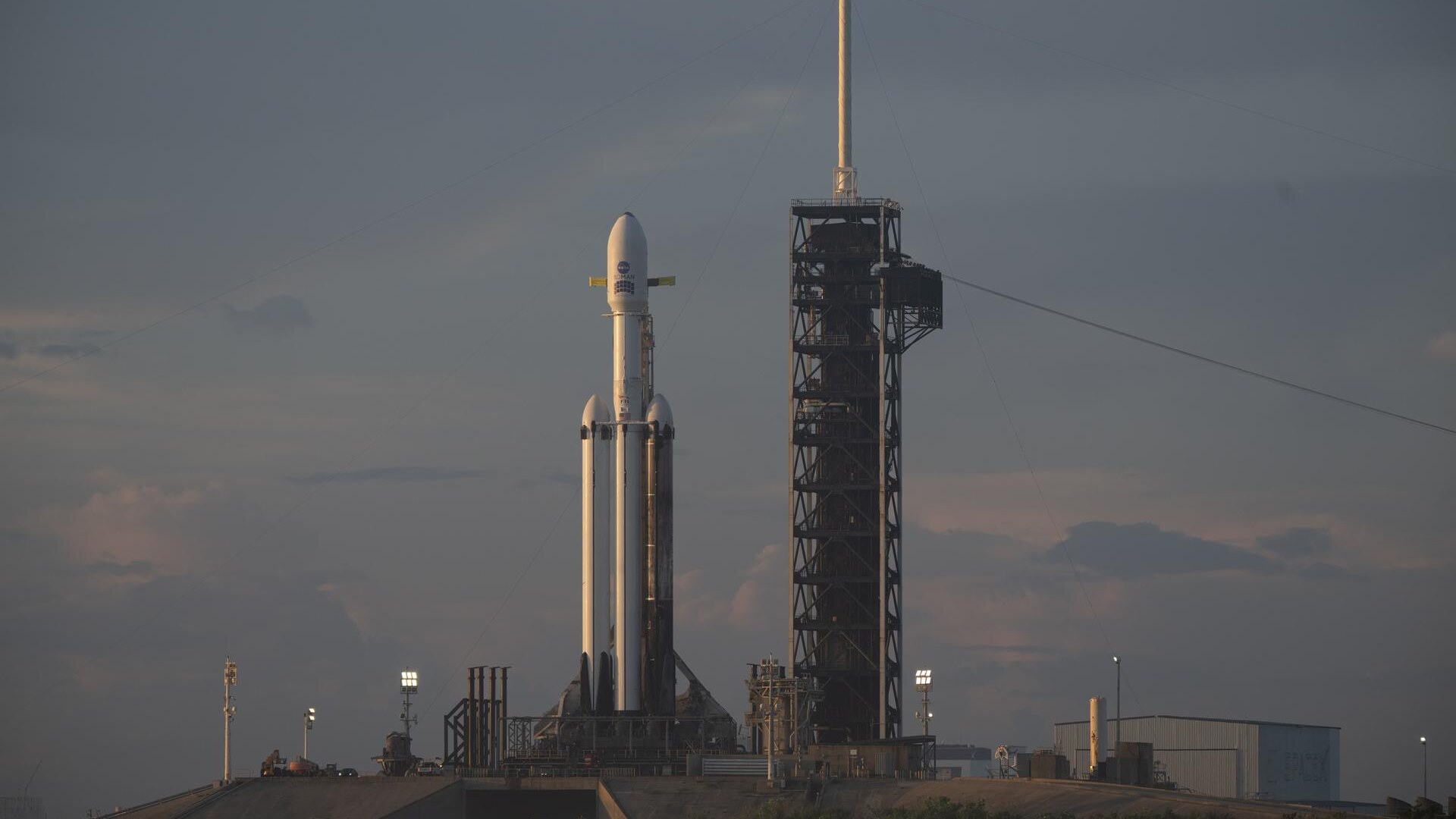
NASA and SpaceX are targeting 7:26 a.m. Eastern on Sunday, 30 August, for Falcon Heavy to lift the Nancy Grace Roman Space Telescope from Launch Complex 39A at Kennedy Space Center. Backup is Monday, 31 August, at 7:22 a.m. The fairing on the photograph says ROMAN SPACE TELESCOPE. The rocket is the one in the frame.
SpaceNews, filing from Washington ahead of the attempt, called it a 16-year journey and a launch nearly nine months early. The project’s formal launch readiness date is May 2027. Sunday is August 2026. That gap is the news.
The week on the ground is a sequence with dates. On Friday, 21 August, teams in the Payload Hazardous Servicing Facility at Kennedy encapsulated Roman inside the SpaceX Falcon Heavy fairing. NASA’s Sydney Rohde photographed the work. The fairing is 13.1 m tall. NASA’s 24 August mission blog says it protects the observatory from acoustic vibration, aerodynamic pressure and heating on the way up, then splits a few minutes into flight so Roman can go on toward Sun-Earth Lagrange point 2. The two fairing halves are to come home and be recovered by SpaceX.
On Monday, 24 August, Rohde photographed the stack after encapsulation, still in the servicing facility, ahead of mating. On Tuesday, 25 August, the encapsulated payload travelled to the SpaceX hangar at Launch Complex 39A. SpaceNews printed that move with a Rohde credit. On Saturday, 29 August, NASA’s Roman blog said the Falcon Heavy rolled from the hangar to 39A and was raised vertical. The rocket is almost 70.1 m. Twenty-seven Merlin engines, nine on each core, more than 2.3 million kilograms of thrust. Roman, NASA wrote that morning, is roughly the size of a school bus and weighs about as much. The FAQ is more precise on the observatory itself: about 12.7 metres long, more than 4.3 metres wide when deployed.
SpaceX’s mission page is the countdown. Liftoff targeted 7:26 a.m. ET Sunday from LC-39A. Side boosters: first flight and third flight, previously GOES-U and Viasat-3 F3. After separation they are to land at Landing Zones 2 and 40 at Cape Canaveral Space Force Station. Fairing separation is listed at T+4 minutes 15 seconds. Roman deploys at T+31 minutes 31 seconds. Those times are SpaceX’s, marked approximate. This desk is not turning a countdown table into a guarantee. It is filing the table.
The destination is a quasi-halo orbit around the second Sun-Earth Lagrange point, about 1.5 million kilometres from Earth. SpaceNews says the cruise is about 100 days, with commissioning on the way and science observations expected shortly after arrival. NASA’s FAQ: primary mission five years, designed to support five more if the fuel lasts. Data has no proprietary period. One hundred percent of observing time is community directed.
The glass is the other object. Primary mirror 2.4 metres, the same diameter as Hubble’s, about 80 percent lighter. The Wide Field Instrument is a 288-megapixel near-infrared camera. NASA says the images are as crisp as Hubble’s over a field of view at least 100 times larger, about 0.28 square degrees. The Coronagraph Instrument, from JPL, flies as a technology demonstration: masks, deformable mirrors, sensors that cancel starlight in real time so a planet or a disk can be photographed. Two instruments. One survey telescope. One rehearsal for seeing Earths.
Julie McEnery, senior project scientist at Goddard, told a July briefing, as quoted by SpaceNews: “Roman is poised to conduct revolutionary surveys that will impact every area of astronomy.” She also said the census of planets around other stars may confirm hints that the standard model of the universe is incorrect. Shawn Domagal-Goldman, director of NASA’s astrophysics division, said at the same briefing that complex things are hard to bring in on schedule and on budget, and that this team lived within its resources and is delivering nine months early. Those are named people speaking on the record in July. This desk is not putting their faces on the page. It is putting their sentences next to a rocket that is already vertical.
The origin story is a decadal survey, not a mood. In 2010 the astrophysics community’s highest-priority flagship was WFIRST, a 1.5-metre infrared survey telescope, then estimated at $1.6 billion and a 2020 launch. In 2012 NASA announced it had been given two 2.4-metre mirrors from another government agency, later linked to a cancelled National Reconnaissance Office program. The larger glass was not plug-and-play. McEnery told SpaceNews the team had to refigure the optical prescription and change structure to run colder. The coronagraph was recast as a tech demo to cut cost. NASA approved development in 2020 at about $3.9 billion including five years of operations. SpaceNews now files the observatory at $4.3 billion. The first Trump administration proposed cancelling it; Congress kept the money. The pandemic, NASA estimated, cost about $400 million. Then the work ran ahead. A May 2027 readiness date became an August 2026 morning.
Goddard manages the project. JPL and Caltech/IPAC are on the coronagraph and a science support center. STScI will run science operations. Ball Aerospace, L3Harris, Teledyne are the industrial names NASA lists. ESA, JAXA, CNES and the Max Planck Institute for Astronomy appear on earlier contributor lists Liora’s desk has already filed. The science case is not a slogan. Dark energy and dark matter, about 95 percent of the universe, still without a portrait. More than a billion galaxies. Type Ia supernovae as tracers of acceleration. Weak lensing and clustering as a ruler. Microlensing in the galactic bulge for planets in wide orbits, more than a thousand that way, and more than 100,000 transits in the same stare. France 24, on Sunday morning, quoted NASA administrator Jared Isaacman from April: “Roman will give the Earth a new atlas of the universe.”
NASA’s 29 August briefings had a 9 a.m. science hour and a 10:30 a.m. prelaunch news conference: Nicky Fox, Lucas Paganini, Jackie Townsend, Denton Gibson, Julianna Scheiman of SpaceX, Justin McReynolds of the 45th Weather Squadron. This file is not a weather forecast. It is a pad file. The photograph NASA is lending the well is NHQ202608290003, Falcon Heavy vertical at twilight, NASA worm on the fairing, no crew portrait. Credit NASA.
Sunday 7:26 a.m. Eastern is 8:56 p.m. in Adelaide if the clock holds. The Standard will not invent a go. It will say the telescope is on the rocket, the rocket is on 39A, the date moved forward nine months, the sky it wants is wide, and the woman on the nameplate taught the agency that looking up was not a luxury. Nancy Grace Roman did not get to watch this one leave. The machine is the argument, made metal. 30 August, 7:26, Falcon Heavy, Roman, nine months early: those are the objects.
The paper
Comments
No notes on this story yet.
Sign in to comment