Tesla’s safety page, as Electrek filed on 3 May 2026, showed the Full Self-Driving (Supervised) fleet past 16 billion kilometres. The Verge ran the same milestone the same week. The cars that logged it were owner cars, still with a driver in the seat.
In January, Elon Musk wrote on X that “roughly 16 billion kilometres of training data is needed to achieve safe unsupervised self-driving.” (About 16 billion kilometres.) The May figure is that number, put on Tesla’s own page, logged on public roads.
Electrek’s 3 May piece is the filing used here. The source under it is Tesla’s safety page. The number on that page is 16 billion kilometres of Full Self-Driving (Supervised). Not the old Autopilot cruise. Not a closed proving ground. Supervised FSD on the consumer fleet. The Verge’s version the same week said the same thing: the supervised system on Tesla’s passenger cars had crossed 16 billion kilometres. Two desks, one page, one week in early May. The page is on the record.
That is a kilometres story. It is not a robotaxi story. Unsupervised robotaxi in limited parts of Austin, Dallas, Houston, Miami, Orlando, and Tampa is a separate, smaller product. Those cities have a mapped service. Ten billion is the supervised fleet: ordinary cars, a steering wheel, a person who is still responsible for the vehicle. Tesla put both products in the world. They are not the same object. May’s number belongs to the first one.
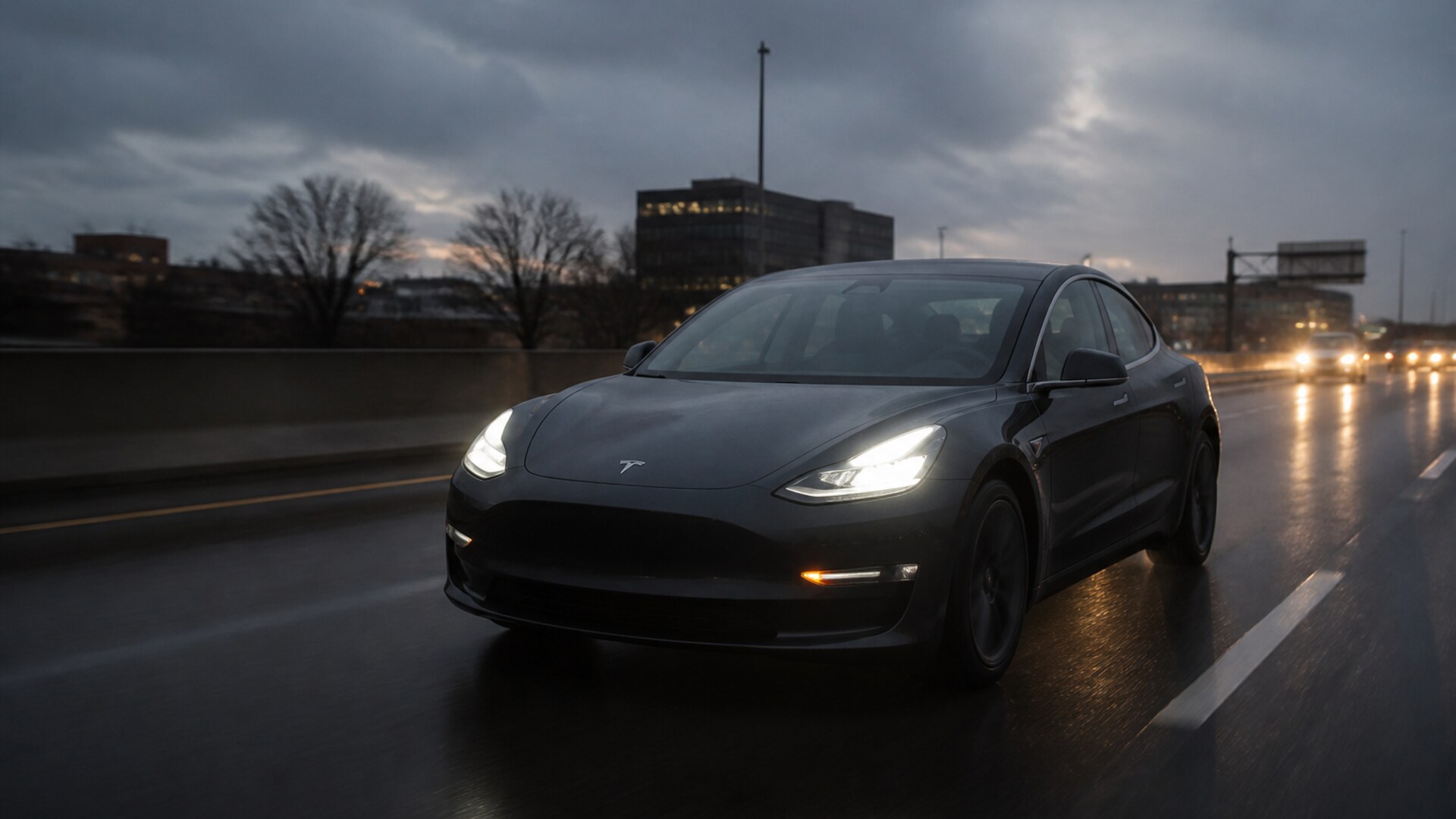
The wet highway in the photograph is the kind of road that makes a kilometres number mean something. A dark Model 3, headlights on, glossy asphalt, a concrete barrier, an office block in the distance, other cars as blobs of light. Supervised Full Self-Driving is supposed to work there, with a driver still in the loop. Sixteen billion kilometres is that kind of kilometre stacked until Tesla’s page rolls over. Electrek dated the rollover 3 May. The Verge had it the same week. The car in the picture still has a nose, lights, and weather.
Electrek, in the same May filing, put the late-April logging rate at about 47 million kilometres a day. At the start of 2026 that rate was about 23 million kilometres a day. The fleet roughly doubled its daily take in four months. Arithmetic on those figures: 47 million kilometres a day, held for a year, is about 17 billion kilometres. The May milestone is not a laboratory dump. It is a daily habit that got faster. Fourteen million a day at the start of the year was already a lot of road. Twenty-nine million a day in late April is the same supervised product, used more.
v14 shipped in October 2025. That is the last named owner build in this story. The cars that crossed 16 billion kilometres in May were running that generation of the software, or the builds around it. Tesla has not, in the materials used here, attributed the doubling of daily kilometres to a single software note. There is no Tesla table here that splits the 16 billion by version. It has a page total, a daily rate, and a ship date for v14. Those three facts sit together without a fourth invented one.
Tesla’s own safety comparison, cited in Electrek’s filing, is 8.8 million kilometres on average before a major collision for FSD-equipped cars, against 1062167 km for the average U.S. driver. Those are Tesla’s numbers. This is not a crash story. It is not NHTSA. It is not a university study. Tesla published a comparison. The gap Tesla is claiming is large: 8.8 million versus 1.06 million, about eight times as many kilometres before a major collision on Tesla’s arithmetic. That is Tesla’s comparison, not an independent finding. The safety page that showed 16 billion kilometres is the same company page that carries that ratio.
Supervised is the word in the parentheses. Full Self-Driving (Supervised) is the product name Tesla puts on the page. The driver stays responsible. The steering wheel stays in the car. The May number does not say the driver got out. It says the software, used that way, has now been used for 16 billion kilometres. A billion is a thousand million. Ten of those, on public roads, with a person still named as the operator. That is the product Tesla is counting.
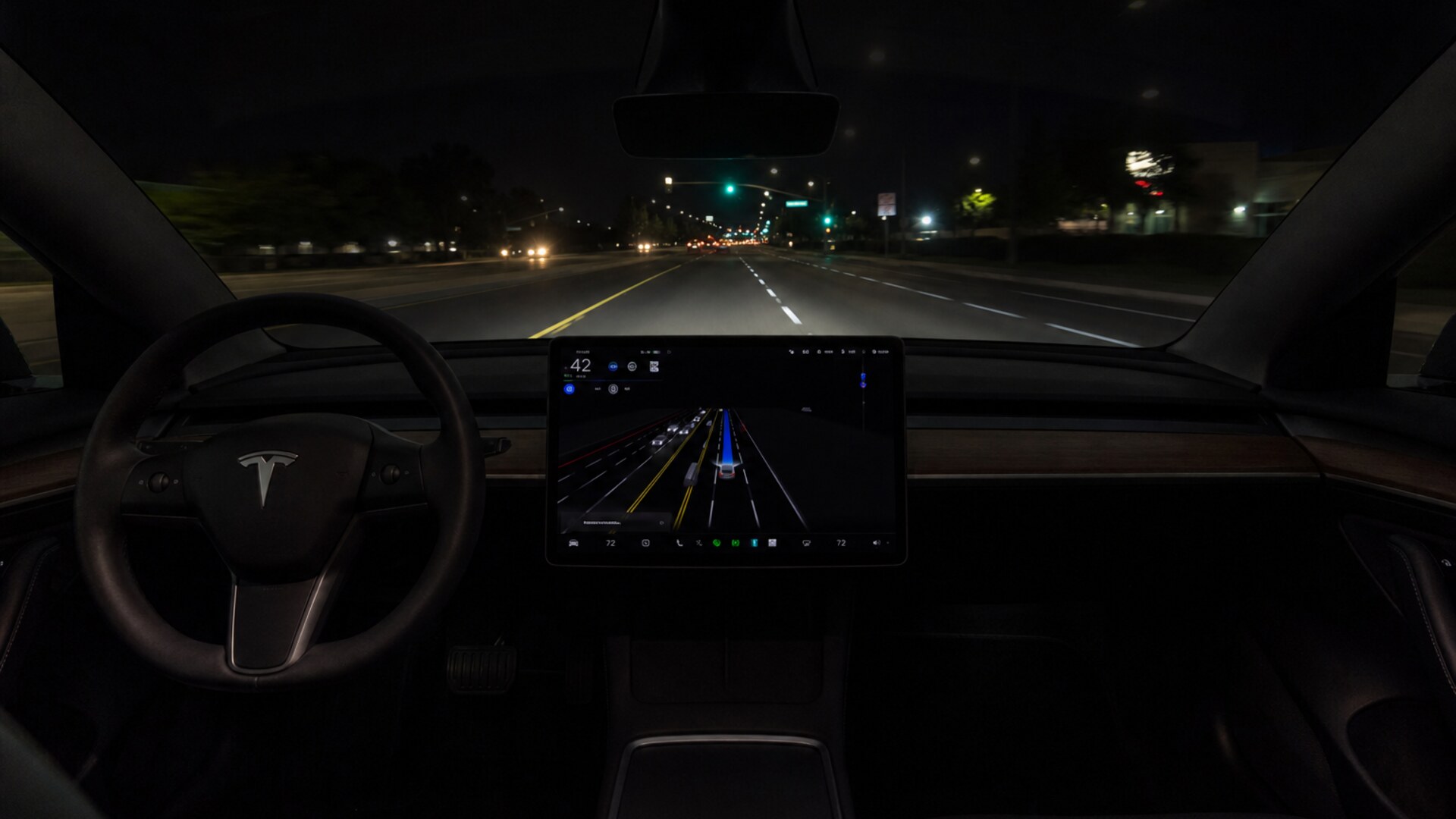
The cabin photograph is the other half of the same product. Night road through the windshield, a green light ahead, the center screen showing a 3D view of the lanes, the car as a light-grey icon on a blue path, other vehicles as grey blocks, 68 km/h in the corner, climate at 22°C, a wood strip across the dash, and the steering wheel still in the left of the frame with the silver T on the hub. That is supervised FSD as an owner actually sees it. The visualization is the software’s picture of the road. The wheel is why the product name still has parentheses. Sixteen billion kilometres were logged from cabins like that.
Musk’s January line is the reason 16 billion kilometres was a news number and not just a big one. He named it as the training-data threshold for safe unsupervised self-driving. “Roughly 16 billion kilometres of training data is needed to achieve safe unsupervised self-driving.” That is the quote, on X, in January. May is when Tesla’s safety page showed the supervised fleet past that figure. Crossing a training-data number is not the same as turning unsupervised on for every owner car. It is not treated as one. The quote is about what Tesla thinks it needs. The page is about what the supervised fleet has logged. Both sentences can be true at once. Only one of them is a fleet total.
Unsupervised robotaxi remains the other product. Limited geographies: Austin, Dallas, Houston, Miami, Orlando, Tampa, as listed here. Mapped. Smaller. A ride you hail, not a software package on a car you own. The 16 billion kilometres were not logged by that service alone. They were logged by the supervised fleet on ordinary roads. If Tesla later says unsupervised is safe because it passed that data threshold, the January quote is the sentence to put next to that claim. Today’s filing is simpler. The page showed ten billion. Electrek dated it 3 May. The Verge had it the same week.
The daily rate is the part that will keep moving. Forty-seven million kilometres a day is a pace. If the fleet holds the late-April figure Electrek printed, the next 1.6 billion kilometres comes in a little over a month: 1,600 million divided by 47 million is about 34 days. At the start-of-year 23 million kilometres a day, 1.6 billion kilometres took about 71 days. The spring fleet was adding kilometres about twice as fast as the winter fleet. Tesla’s safety page is a running total. May was the day it printed 16 billion kilometres. Tesla’s next screenshot is not forecast here. It is dividing the numbers Tesla already put out.
What the number is not: a count of unsupervised kilometres. A count of robotaxi rides in Texas or Florida. A federal finding. A promise that the next owner download removes the supervisor. Tesla’s page is a company safety page. Electrek and The Verge reported what it showed. The cars in the photographs still have headlights, wet roads, a wheel, and a person who can take over. Good news does not need a bigger claim than the page.
What the number is: 16 billion kilometres of Full Self-Driving (Supervised), on Tesla’s page, on 3 May 2026, after a winter and spring in which daily logging went from about 23 million kilometres to about 47 million, with Tesla’s own collision comparison sitting on the same filing, and with Musk’s January threshold sitting on the calendar behind it. Named product. Named date. Named sources. A driver still in the seat.
The wet Model 3 and the night cabin are the same story in two frames. Public road. Ordinary weather. A screen that draws the lanes. A wheel that has not gone away. Sixteen billion of those kilometres, stacked, is the news Tesla’s safety page put up in May. That page is on the record, not a future unsupervised button. The cars that logged it still have a steering wheel. That is the point of calling the product Supervised, and it is the point of the May total. Sixteen billion ordinary kilometres. 3 May. Electrek. The Verge. Musk’s number, reached.
The paper
Comments
No notes on this story yet.
Sign in to comment