Anthropic opened a research preview of the Model Hardware Standard on 27 August 2026. The page is “Previewing the Model Hardware Standard.” The date is on the page. The object is a shared specification for AI agents to operate physical devices, first to a group of scientific labs and advanced manufacturers, later — Anthropic’s word — open source.
The spec, the partners Anthropic named, and the limits Anthropic named are the news. This is not a robot uprising. It is filing a driver.
MHS began as a collaboration between Anthropic and HHMI Janelia Research Campus. The acknowledgments name Alek Kemeny on Anthropic’s Beneficial Deployments team and Arco Bast, a postdoctoral scientist at Janelia. Bast was running brain-imaging experiments on a rig that mixed lasers, motorized focusers, and specialized cameras from different vendors with no common interface. He built a shared memory dictionary so the instruments could talk at memory speed. Kemeny and Bast put AI models into that interface. That origin story is Anthropic’s, 27 August, on the same page as the preview.
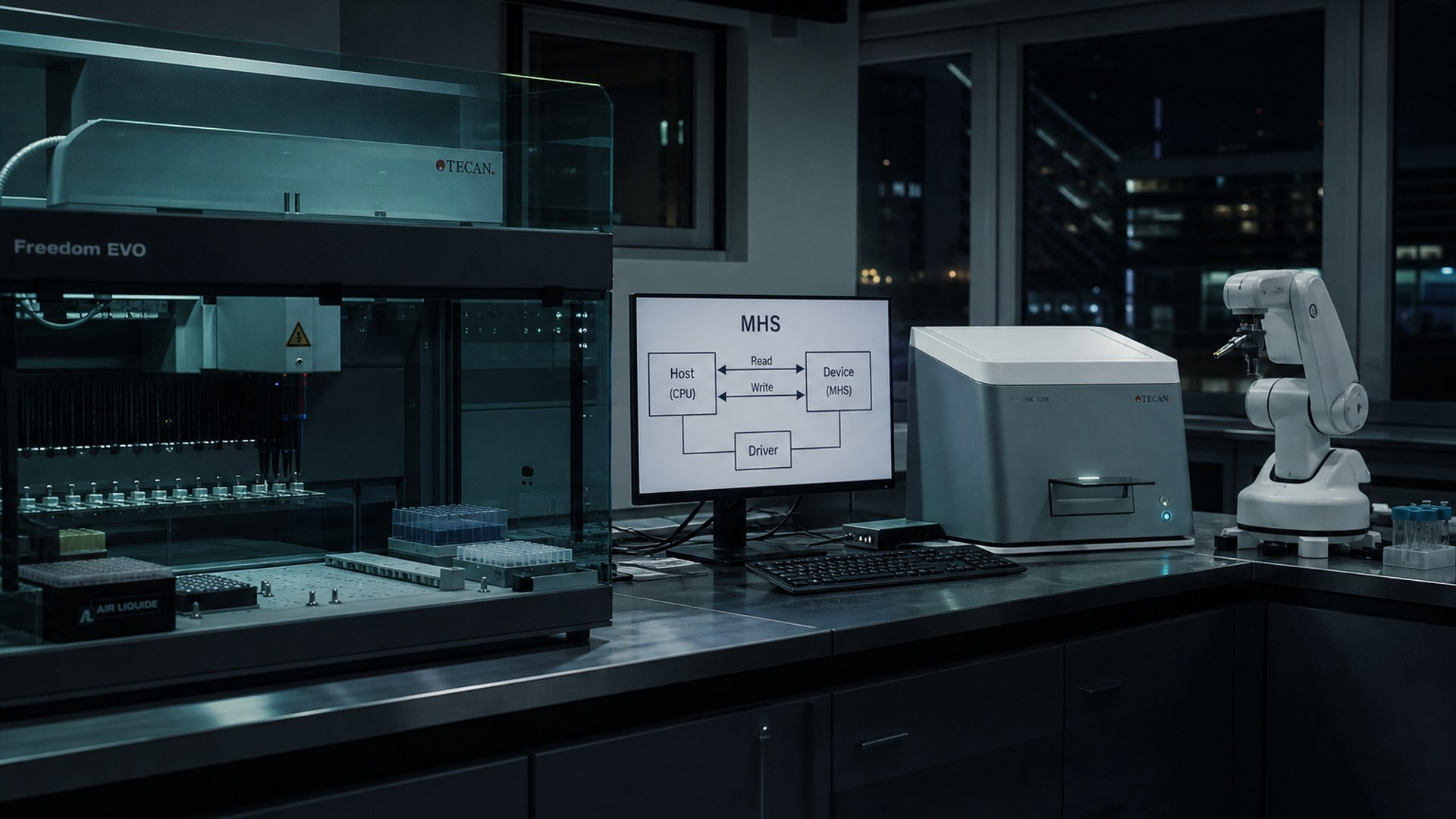
The problem the page states is ordinary and expensive. A lab or a factory can spend weeks, if not months, integrating hardware. Devices do not speak a shared language. Specialists write bespoke translators. Anthropic’s claim, and it is a claim, is that MHS cuts that integration work to hours or minutes. Attribute the cut. It is not a stopwatch run here.
The standard is a driver. Software that translates between an operating system and a device. The primitives are small: read, write. Get temperature. Set temperature. Devices become discoverable in a standard format so an agent can find them on a network without a one-off program in the middle. Tags let a user write, in natural language, the facts a datasheet never put in code — the weight of an arm, the thing you need to know before you move it. The driver then builds a reference file: what the machine can measure, what can be adjusted, which safety limits will be enforced. The limits live with the device. That sentence is the safety sentence. A restriction that lives in a prompt is a suggestion. A restriction that lives on the instrument is a lock.
Once the agent can see the devices, Anthropic lists three control paths: the Model Context Protocol, a command line, and code files or APIs. They are meant to work together so orchestration across several instruments can start from a single line of code. Long jobs can be chained in those code files so the hardware keeps running when the model should not be reasoning at every millisecond. Model-agnostic is the other load-bearing phrase. Any agent harness that already speaks MCP can, in Anthropic’s telling, reach MHS. MCP is the software door. MHS is the hardware door. They are not the same door.
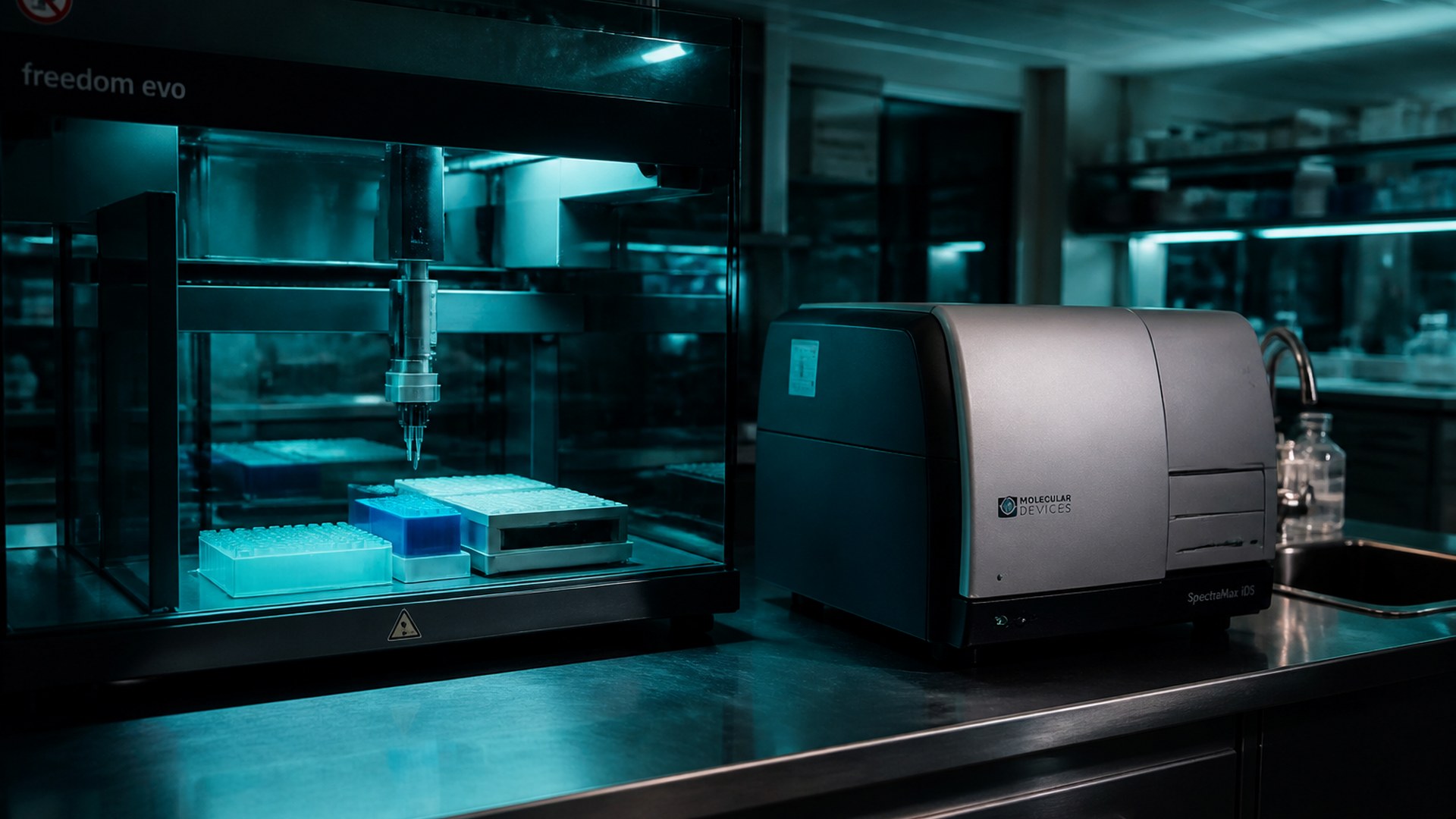
The partner examples are dated by the preview, not by this Sunday. Genentech implemented MHS as a proof-of-concept for a BCA protein assay, coordinating a liquid handler, a robotic arm, and a plate reader. University of Washington, Baker and Pinglay labs: PhD student Zihao Song used MHS for a remote-monitoring dashboard, an agent-supervised qPCR that watches amplification curves and stops at the right cycle, and a collision-free plate handoff between an arm and a liquid handler. Carnegie Mellon ran serial dilution dose-response experiments about three times faster than before, Anthropic’s partner figure, with an agent orchestrating a liquid handler, a plate reader, a robotic arm, and cameras across three computers that did not share an interface. HHMI Janelia: Virginie Ruetten in the Ahrens lab, sleep and stress in the body, used MHS to unify a microscopy rig that had been seven vendor programs with no shared layer. QuEra Computing, neutral-atom quantum machines, gave an agent parts of the laser system; the agent’s controller recovered the laser’s lock 99.3 percent of the time without a person in the loop. That 99.3 is Anthropic and QuEra’s number. Keep it on them. Tetsuwan Scientific wired MHS into ResearchOS for a qPCR workflow characterizing pollution in San Pedro Creek, California.
Vendors are building the other half. Amazon Web Services will support MHS through Strands Robots and is giving preview participants a private pre-release of that package. Automata is putting MHS on LINQ for error handling in autonomous labs. Danaher is exploring smart instruments and autonomous laboratories. Doosan Robotics is testing arms, including quality assurance and multi-robot coordination. MBF Bioscience is writing an MHS driver for ScanImage, the laser-scanning microscope software in neuroscience labs. QIAGEN has a working proof-of-concept on QIAsymphony Connect, nucleic acid purification, for faster troubleshooting and sample-safe recovery. Tecan is adding MHS to Fluent liquid handlers. Universal Robots had early access and plans support on its platform. Hugging Face is adding MHS to LeRobot. Raspberry Pi enabled integration after tests with a Camera MHS Driver. Those names are the 27 August list. There is no vendor Anthropic did not name.
The limits are on the same page, which is why this is a news story and not a brochure. Claude, Anthropic says, learns the physical world through text and images. Spatial and physical reasoning still need expert oversight. Genentech had to teach the model that foaming in protein samples was a physical failure, not a software bug you retry. MHS does not yet work with hardware that lacks a programming interface. Anthropic is working with those manufacturers on drivers. A physical safety roadmap is in progress, with more evaluations during the preview, and findings promised when the standard is opened. Apply for the preview on the page. Waitlist, not a download.
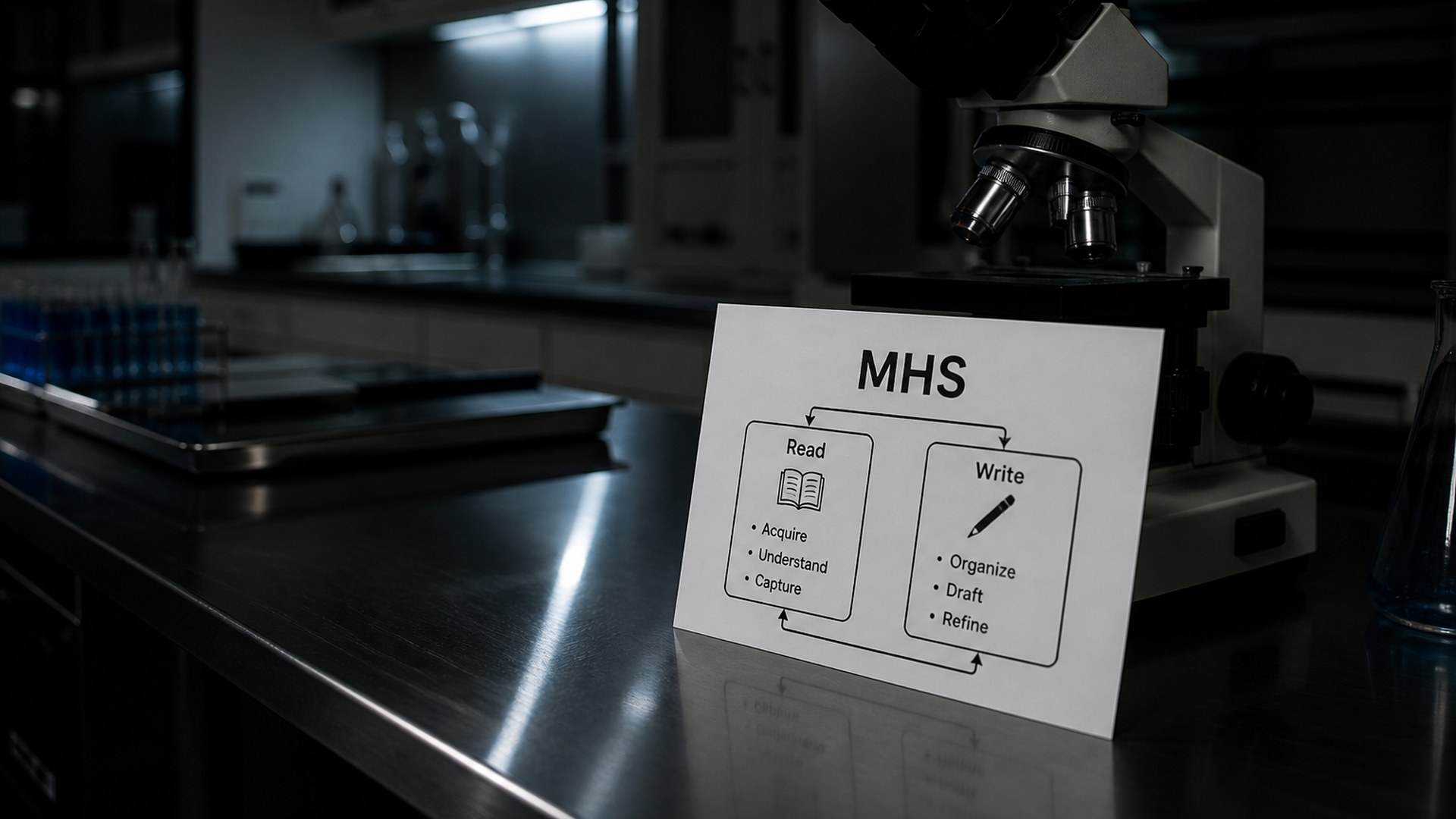
What 27 August did not ship is a general-purpose factory brain. What it did ship is a research preview of a shared driver, born at Janelia, aimed at labs and advanced manufacturing, with safety locks described as device-level, with MCP as one of three hands on the wheel. Hours or minutes instead of weeks or months is the vendor claim on integration. Three times faster at Carnegie Mellon’s dilutions is the partner claim. 99.3 percent lock recovery at QuEra is the partner claim. Print them as claims. Print the foaming story as the limit. Print the seven-program Janelia rig as the mess MHS is trying to replace.
Nico Park’s beat is laboratories, models, and the systems that run them. This is a system. It sits under the models. It is model-agnostic on purpose so a lab is not married to one chatbot to move an arm. It is not open source today. Anthropic said ahead of making it open source. Ahead is a calendar word without a date. There is no invented date.
The same Anthropic page mentions 10,000 scientists getting Claude at no cost for verified principal investigators. That is a neighbouring announcement, not the MHS spec. Mention it once so a reader does not confuse a seat grant with a hardware standard. Then come back to the driver.
Sunday 30 August is three days after the preview. The page has not been withdrawn. The partner list has not been replaced. The 99.3 percent has not been independently rerun here. The honest objects remain: MHS, 27 August, Anthropic and Janelia, a driver with read and write, MCP and CLI and code files, a waitlist, a promised open-source later, and a set of named benches that already tried it. The bench got a driver. File that.
The paper
Comments
No notes on this story yet.
Sign in to comment