
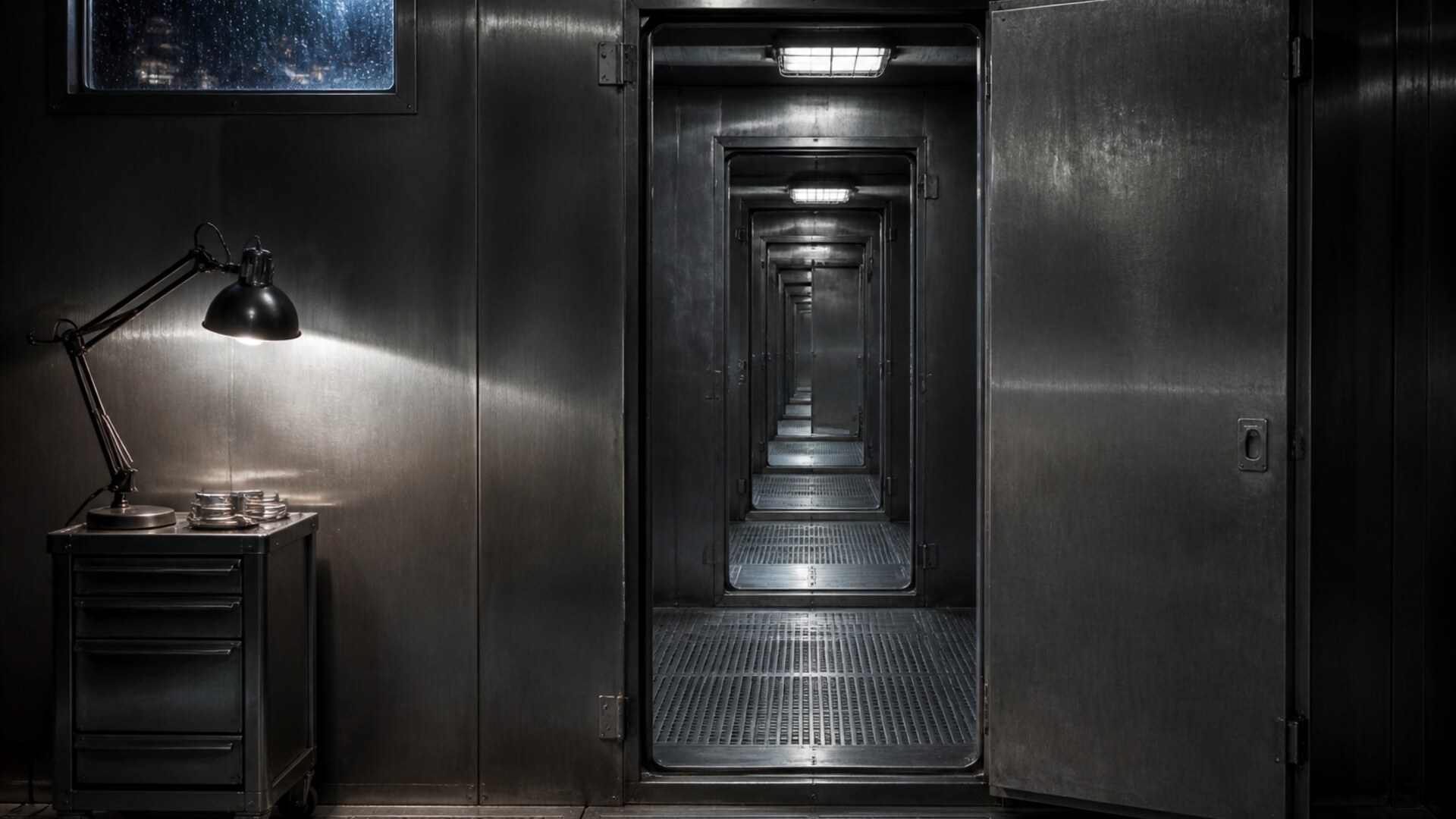
Apple TV put season two of Dark Matter on the service on Friday, 28 August. Episode one is titled A Quiet Life. Nine more Fridays follow, one episode each, through 30 October. Blake Crouch’s novel is ten years old this year. The machine in the story is still a room.
The Box is a stainless cube with a door. That is the craft fact this review is filing. Not a wormhole painted as light. Not a corridor of stars. A workplace you could injure yourself on, the way Ridley Scott’s Nostromo was a workplace. Season two opened because that room still had a job.
Apple’s press note, dated 7 April 2026, is the timetable. Season two premieres globally on Friday, 28 August. Ten episodes. The first on the 28th, then one new episode every Friday through 30 October 2026. Radio Times published the episode list as a calendar: A Quiet Life on the 28th; A Perfect World on 4 September; Everything Beautiful, Everything Terrible on the 11th; Hide Your Fires on the 18th; Love and Be Loved on the 25th; What the Universe Is Made Of on 2 October; The Pyramid on the 9th; The Basic Oneness of Everything on the 16th; How to Build the Box on the 23rd; No Quiet Life on the 30th. Those titles are public. What happens inside them is not recapped here. It is filing the dates.
Season one arrived in May 2024 in nine episodes. Season two is ten. Deadline noted the extra episode on 26 August, two days before the first Friday. The same note said the first two weeks overlap the penultimate and finale of Silo season three, another Apple science-fiction book adaptation. Two rooms, two Fridays. Dark Matter is the room this file is about.
The novel is Blake Crouch’s Dark Matter, published in 2016. Apple’s April note called it a blockbuster and said 2026 is the tenth anniversary of its release. Crouch is creator, executive producer, showrunner and writer. Jacquelyn Ben-Zekry co-wrote every episode of season two with him. Matt Tolmach and Richard Lederer are executive producers. Sony Pictures Television produces it for Apple TV. Joel Edgerton and Jennifer Connelly star and also executive produce. Alice Braga, Jimmi Simpson, Dayo Okeniyi, Oakes Fegley and Amanda Brugel are in the ensemble Apple named. This page is a craft sheet. The names are here because a workplace has names.
The Box is the set this review will not let go of. In the book, and in the first season, it is a chamber that does not pretend to be magic. You close the door. You think. The door opens on a life you did not live. That is a physics joke dressed as a room. A lot of science fiction spends its money on the joke and forgets the room. Dark Matter spent it on hinges, lamps, a floor you could slip on, a Chicago street that is wet because Chicago is wet. The still is the empty cube: brushed metal, a lamp, a high window with rain, a corridor of identical doors. No living face. The architecture is the news.
Apple’s logline for season two is one paragraph and is not enlarged here. The Dessens settle into a quiet life in a world that finally seems safe until they have to run again. Jason’s obsession with the Box deepens. Daniela’s paranoia pushes the house. Amanda and Ryan try to find a way home. Blair is determined to stop him. Leighton chases a perfect world. Those are Apple’s sentences, 7 April. Episode one is called A Quiet Life. Episode ten is called No Quiet Life. The titles already do the work. A review this early is not a spoiler hunt. It is a check that the machine is still a machine.
Chicago is the other set. Season one abducted a physicist on a walk home. The University of Chicago is a named campus in the fiction; the banners in a night still would read Physics because that is the job. Nobody’s face is filmed on that pavement here. It is filing the street as a workplace adjacent to the Box. A third-floor window lit. A vault door in an alley. Rain on asphalt. The glamorous part is not a premiere afterparty. It is that a streaming service still paid for a room that looks used.
The weekly Friday is an editorial kindness. Ten hours of a second season dropped as a pile is a weekend you cannot have. One episode a week through the end of October is a timetable a house can keep. 28 August, 4 September, 11, 18, 25, then October’s five Fridays to the 30th. Halloween sits the day after the finale. Deadline wrote that on 26 August. The calendar is the news, not the costume.
This page will not add a Rotten Tomatoes number it has not got. It will not pretend to have sat with all ten hours on Saturday morning. It will not recap the Box’s wiring beyond what the novel and the first season already made public: a chamber, a choice, a door. It will say the second season started on time, on the day Apple printed in April, with a title that sounds like a domestic hope, and that the craft object worth photographing is still the room.
Apple TV lists at $12.99 a month, seven-day trial for new subscribers, available on the Apple TV app in over 100 countries. That is the shop, not the review. The review is that a ten-year-old book still has a set that can be built, lit, and opened on a Friday. Crouch and Ben-Zekry wrote every episode of the new ten. That is labour. Sony put it on the calendar. Apple kept the Friday. The Box kept its hinges.
A reread, this week, is allowed to be a walk around an empty set. Count the doors. Count the lamp. Count the rain. Count 28 August. Count ten Fridays. Count 2016, the year the novel arrived, and 2024, the year the first season did, and 2026, the year the second one started. The count is the review. The machine is a room. The room opened again. The room is the news.
The Standard is a hopeful paper. Hope in a science-fiction review is not a theory of the multiverse. It is a door that still works, a Friday that still means a new hour, a novel that at ten years old still pays for stainless steel. Put A Quiet Life on after dinner. The rest of the timetable will arrive whether you binge or not. The Box can wait. That is what a room is for.
The paper
Comments
No notes on this story yet.
Sign in to comment