
Tesla’s Q2 2026 shareholder update put Cybercab in the installed-capacity table at Gigafactory Texas: more than 125,000 units a year, listed as Production, the same column as Cybertruck. In Q1 the same table still said Pilot Production and carried no number.
The first production Cybercab came off that line in February. Tesla told shareholders it started production in the second quarter, began engineering test drives of production cars on public roads in the same quarter, and started employee rides on the Giga Texas campus in July.
The car on that line has no steering wheel and no pedals. It is a two-seat robotaxi with a name Tesla printed in the capacity table: Cybercab. The Q2 note called it “the workhorse of our Robotaxi fleet.” That is Tesla’s sentence, in a shareholder document, about a vehicle that is already leaving a hall in Texas. The factory story is the news. The object. The hall. The number. The dates. What Tesla published. What it has not.
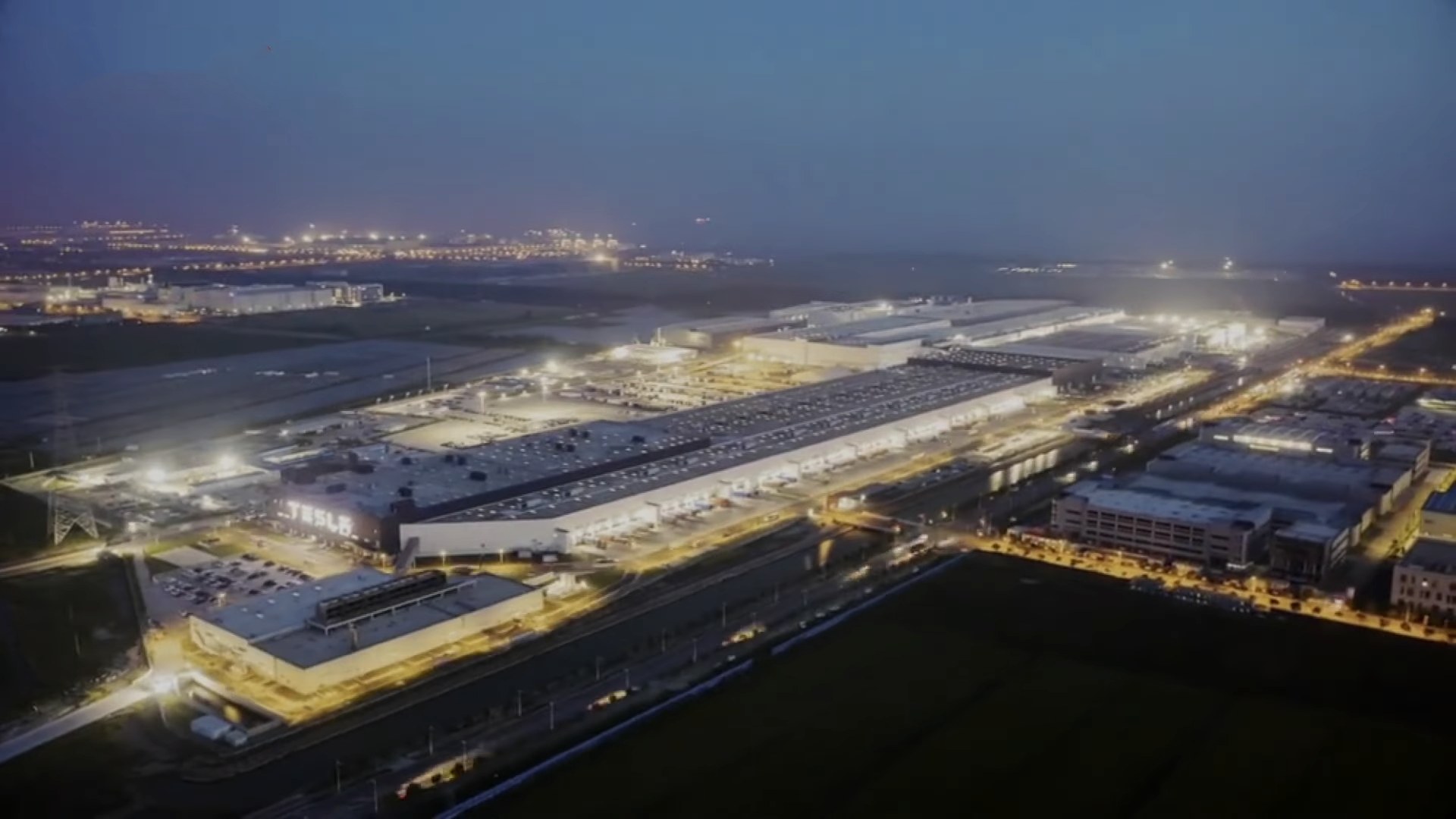
Gigafactory Texas is the where. Cybercab is the what. Tesla is the who. The when runs in public from February through July, then into the Q2 deck shareholders got in the third quarter. The number is more than 125,000 a year of installed capacity. That is the named product on the named line, in Production, as of the update Tesla put out after the second quarter of 2026.
The photographs after this paragraph are the object and the hall. One is a champagne Cybercab at night, TESLA and ROBOTAXI across the rear, Cybercab on the plate. The other is a row of the same car on a factory track under yellow gantries, TESLA CYBERCAB on the front plate, no wheel in the glass. The story is not a keynote. It is a line that can print a car that was never designed to be steered.

The table
Tesla’s Q2 2026 shareholder update is a document, not a rumour. In the installed-capacity table for Gigafactory Texas, Cybercab is listed at more than 125,000 units a year. The status column says Production. Cybertruck is in that same column. That pairing is the fact. Tesla put the two-seat robotaxi in the same production status as the truck it already builds at the same site.
The Q1 2026 update did not do that. In Q1 the Cybercab line at Giga Texas was listed as Pilot Production. There was no capacity number next to it. Pilot is a status. A blank cell is a status. Tesla did not give shareholders a rate, a nameplate, or a yearly figure for Cybercab in the first quarter. It gave them a word: Pilot. Then, one quarter later, it gave them Production and more than 125,000 a year.
That is a change in Tesla’s own table, in Tesla’s own update, about Tesla’s own factory. It is the cleanest public movement on the program. Not a leak. Not a lot count from a fence. A column that used to say Pilot Production and now says Production, with a number attached.
Installed capacity is a factory word. It is the rate a line is set up to do, on paper, if the rest of the plant can feed it. It is not the number of cars that left the dock this week. Tesla knows the difference. The Q2 note carries the usual footnote: installed capacity is not the current production rate. That footnote stays in the same paragraph as the 125,000. The number is real. The caveat is Tesla’s. Both belong in the file.
Cybertruck in the same column does not mean Cybercab is being built at Cybertruck volume. It means Tesla is willing to print the same status word next to both. Production. At Gigafactory Texas. That is the claim in the table. The truck has been a production vehicle at that site for years. The two-seater is new to the column. The newness is the news. The column is the proof Tesla offered shareholders.
A table is a dull object until it moves. This one moved. Q1: Pilot Production, no number. Q2: Production, more than 125,000 a year. Anyone who wants a more exciting sentence can wait. The dull sentence is the one Tesla published.
February and the second quarter
The first production Cybercab came off the line in February 2026. February is the first quarter. Tesla told shareholders that production started in the second quarter. Those two sentences sit together without being the same sentence.
February is a first-off. A named unit left a named line in a named month. Q1’s table still called the line Pilot Production and still refused a number. Tesla can put a first production car on the floor in February and still tell shareholders, later, that production started in Q2. The company is allowed to use “production started” for the quarter when the line entered the Production column, not for the month the first body was joined. The dates are not collapsed. February is the first car. Q2 is when Tesla told shareholders production started.
The rest of the Q2 calendar Tesla gave shareholders is also specific. Engineering test drives of production cars on public roads began in the same quarter. Employee rides on the Giga Texas campus began in July. Those are three different uses of the same object.
A production car on a public road, under engineering, is a test. It is not a paid fare. It is not a campus loop. It is a two-seater with no wheel sharing tarmac with ordinary traffic so Tesla can learn what the production article does outside the gate.
An employee ride on the Giga Texas campus in July is a ride. It is not a robotaxi app. It is not a public-road engineering log. It is staff, on the property, in the real car, in the month after the quarter Tesla says production started. July is the third quarter. The campus is still Texas. The car is still Cybercab.
Tesla published all three: first production unit in February, production started in Q2, public-road engineering drives in Q2, campus employee rides in July. A factory story that only kept the capacity number would be thinner than the document. The dates are in the document. They are the when.
The order is the industrial order, not a marketing order. First the object exists as a production article. Then the company tells shareholders the line is in production. Then the production cars go out for engineering kilometres. Then people who work at the plant sit in them on the campus. None of that is a national paid robotaxi network. All of that is a factory that has a car.
Cybercab is a two-seat robotaxi. It has no steering wheel. It has no pedals. Those are not metaphors. They are the interior. Through the glass of the cars on the Texas line you can see the cabin Tesla is actually building: two seats, a clean dash, no wheel to hold, no pedals to miss. The production decision is in that empty space. Tesla did not leave a wheel in the car “just in case” and call it a robotaxi. It tooled a vehicle that cannot be driven in the old way.
That is why the factory story matters more than a render. A render can hide a column. A production car cannot. If the line is joining bodies that have no steering gearbox and no pedal box, the plant has already spent the money on a different kind of car. The Q2 table is Tesla telling shareholders that spend is now Production, at more than 125,000 a year of installed capacity.
The Q2 note’s “workhorse” line is about fleet role, not about today’s revenue. Tesla called Cybercab “the workhorse of our Robotaxi fleet.” A workhorse is the vehicle you intend to run the kilometres on. It is a purpose-built article. It is not the Model Y that is already taking paid rides. The sentence assigns the two-seater a job. The job is the fleet. The object on the line is the hardware for that job.
Two seats is a product choice with factory consequences. You are not stamping a family crossover and deleting the wheel. You are joining a small cabin, a short wheelbase, a body that was drawn around occupancy by a rider, not around a driver. The unboxed process Tesla is using at Giga Texas is built for that kind of object: modules in parallel, then a join, instead of a painted body walking a kilometre of conveyor.
The night photograph is the finished shape of that choice. Champagne body. Solid disc wheels. A thin red bar across the tail. TESLA in spaced capitals above the bar. ROBOTAXI below it. Cybercab on the plate. Wet asphalt. City lights in the glass. No handles to speak of. No mirrors. No wheel inside. That is the product Tesla put a capacity number on.
The hall
Gigafactory Texas is not a slide. It is the plant east of Austin that already builds Cybertruck, and that now lists Cybercab in Production beside it. The Cybercab hall is the part of that plant Tesla has set up for the two-seater. The method is the unboxed process: modules built in parallel, then joined.
Unboxed is a factory sentence. Conventional car plants still send a painted body down a long conveyor and hang parts on it in sequence. Tesla’s newer method breaks the vehicle into modules. Those modules are built at the same time, in different cells, and then brought together. The join is the event. The pilgrimage down a kilometre of track is the thing being retired.
For a two-seat robotaxi with no wheel and no pedals, parallel modules are not a flourish. The cabin can be a cabin while the underbody is an underbody and the closures are closures. You do not need a driver package riding the whole line. You need the modules to meet, fit, and leave as a car. Tesla is doing that at Giga Texas. The Q2 table is the company saying the hall that does it is in Production.
Installed capacity of more than 125,000 a year is a hall-sized claim. It is not a pilot cell’s claim. Pilot Production, in Q1, was Tesla declining to put a yearly number on the line. Production, in Q2, is Tesla putting more than 125,000 next to Cybercab at the same site as Cybertruck. The hall had to be real enough for that cell to be filled in.
There is no catwalk count of stations here. Tesla did not publish a station map. It published a status, a site, a product, and a capacity figure. The factory-floor photograph is the visual that matches the filing: champagne Cybercabs in a row on a metal track, yellow structure overhead, strip lights on the hoods, TESLA CYBERCAB on the front plate of the lead car, a cabin with no wheel visible through the glass. That is a line. It is not a show stand with one wrapped prototype.
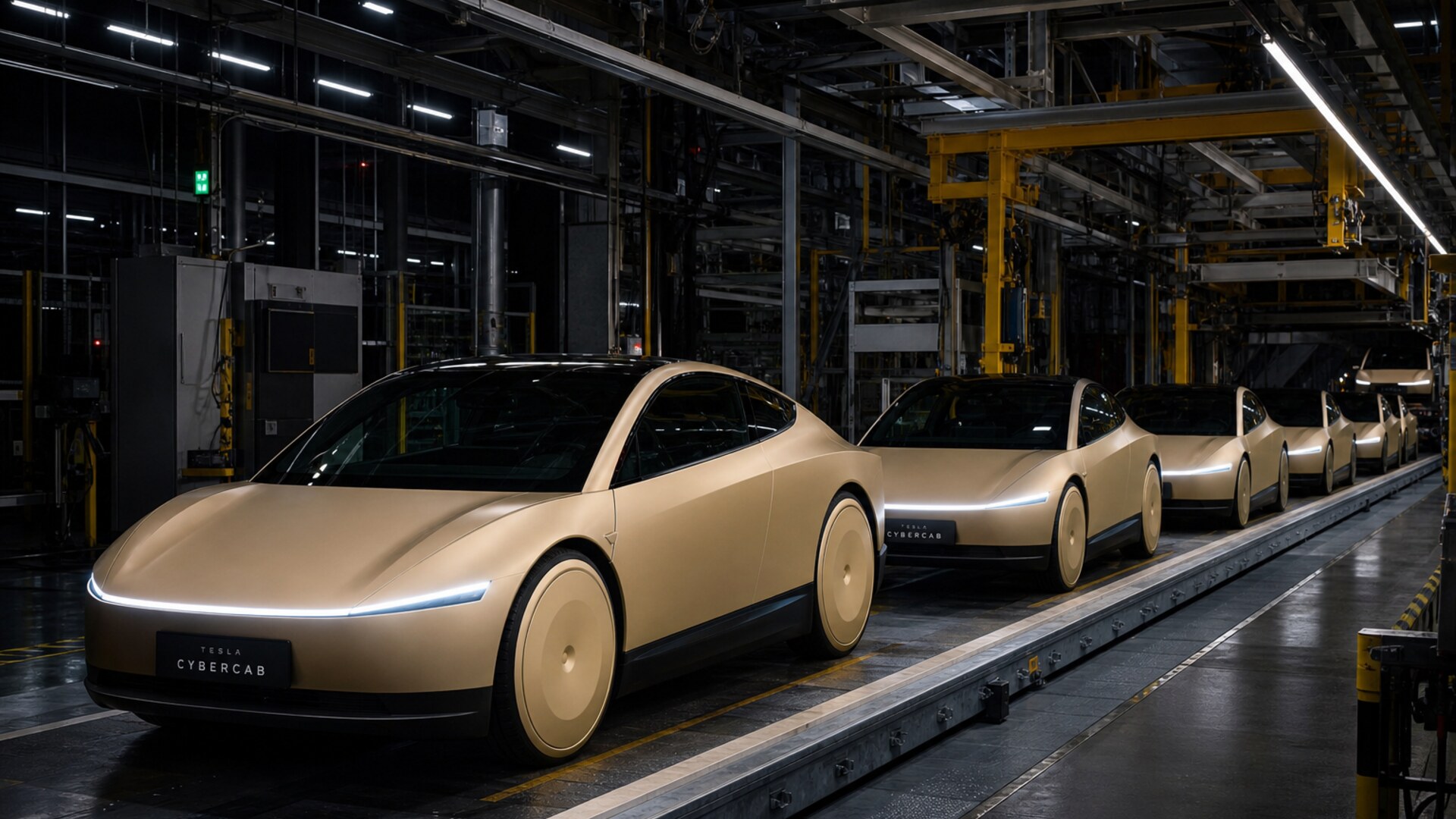
The photograph does not give a rate. Rows of cars on a track are not a day’s output. They are evidence that the hall contains more than one article, in series, in the same colour, with the same plate, under the same gantries. Electrek’s July lot count is the other physical evidence, taken outside. Tesla’s table is the documentary evidence. Together they are a factory story. Separately, none of them is a cumulative build total. Tesla has not published one.
EVwire, reading the Q2 deck on 22 July 2026, put the full-rate math at more than 340 cars a day if the line ever runs at the listed number. That is arithmetic, not a leak. More than 125,000 a year, divided across a year, is more than 340 a day. 125,000 divided by 365 is about 342. A six-day industrial week at the same annual number is a higher daily figure. EVwire published the conservative public version: more than 340 a day at the listed capacity.
If. The word matters. EVwire did not say Giga Texas is building more than 340 Cybercabs a day. It said that is the full-rate math if the line hits the listed number. Tesla’s own footnote sits on the same document: installed capacity is not the current production rate. The 340 is a ceiling derived from Tesla’s nameplate. It is not a speedometer reading.
The if stays in the sentence. Full-rate math is how you understand what more than 125,000 a year means in a hall. It is how a reader who does not live in capacity tables hears the scale. It is not how you file this week’s output. Tesla has not filed this week’s output.
A plant that is tooled for more than 340 two-seaters a day is a plant that believes it will need a lot of two-seaters. That belief is the upbeat fact. Tesla put a workhorse label on the car and a six-figure yearly capacity on the hall. The software and the service still have their own calendars. The hall’s calendar, in the Q2 table, is Production.
EVwire’s date is part of the file. 22 July 2026. That is after Tesla’s Q2 update was out, after Electrek had already counted lots, after employee campus rides had started in the same month. The math piece is a reading of the deck, not a second source for the capacity number. The capacity number is Tesla’s. The 340 is the deck, divided by a year.
The lots
Electrek, on 6 July 2026, counted more than 100 steering-wheel-less two-seaters in the factory’s outbound lots. That is the best public physical count. It is not Tesla’s count. It is a lot count, from outside, of cars that look like production Cybercabs, sitting where finished vehicles sit.
More than 100 is a floor on what a reporter could see on a day in July. It is not a cumulative build figure. Cars leave lots. Cars arrive in lots. A Monday photograph of 100-plus vehicles does not tell you how many were built in February, or in Q2, or in the life of the line. It tells you that by early July the plant had, on that day, more than a hundred of them in outbound storage.
Tesla has not published a cumulative build figure. That sentence is as important as Electrek’s 100. The company will give shareholders a capacity number. It will give them a status word. It will tell them when production started, when engineering drives started, when employee rides started. It will not, so far, tell them how many Cybercabs exist. The outbound lots are the substitute number, and they are a snapshot.
A snapshot can still be good news. More than 100 finished two-seaters in the lots of Giga Texas in July is a factory with inventory of the new car. Inventory of a vehicle with no wheel is a particular kind of confidence. You do not park a hundred unsteerable cabins in a Texas lot for a keynote. You park them because the join is working and the next step is kilometres, software, and service, not another prototype.
Electrek’s date sits just before Tesla’s public Q2 package and in the same month as the campus rides. 6 July. Employee rides in July. EVwire’s math on 22 July. The summer is when the Cybercab program became countable in public: lots you could see, rides on campus, a table with a number. February was the first car. July was the first time the rest of us could count.
“More than 100” is not turned into “hundreds of thousands” or into a quiet failure. It is the number that was photographed. Tesla’s number is the capacity. Electrek’s number is the lot. They measure different things. Both are in the file. Neither is a cumulative.
Tesla’s Q2 note called Cybercab “the workhorse of our Robotaxi fleet.” The same deck’s capacity table lists more than 125,000 a year at Giga Texas, status Production. The same deck’s footnote says installed capacity is not the current production rate. A responsible file holds all three.
Workhorse is role. Capacity is tooling. Rate is today. Tesla is claiming the role and the tooling. It is explicitly not claiming that today’s rate equals the tooling. That is not evasive in a factory story. That is how plants work. You install a line. You print a nameplate. You spend a year, or more, climbing toward it. Cybertruck went through that. Model Y went through that. Cybercab is early enough that Tesla still wants the footnote next to the number.
Readers who treat nameplate as output will have a bad summer. Readers who treat the footnote as proof the cars are fake will have a worse one. The cars are in the lots. The cars are on the campus. The cars are on public roads under engineering. The line is in Production. The rate is not the nameplate. Tesla said so.
Installed capacity of more than 125,000 a year is still a large claim for a new two-seater. It is a claim Tesla put in a shareholder update, next to Cybertruck, at the Texas plant. The beat is whether the physical world is getting more capable. A hall tooled for six figures of wheel-less cabs is a more capable hall than the one that, in Q1, could only be listed as Pilot.
The footnote does not cancel the column change. Pilot to Production is still a column change. No number to more than 125,000 is still a number appearing. The footnote tells you how to read the number. It does not tell you to unread it.
Packs, not the hall
Battery packs, Tesla said in the same Q2 update, remain the main limit on near-term vehicle volume. Not the Cybercab hall. That is the bottleneck Tesla chose to name.
A plant can have a new line in Production and still be pack-limited across the whole vehicle slate. Cells, modules, packs: those are the things that turn a tooled hall into a day’s worth of cars. If packs are the constraint, the Cybercab line can be ready, in the capacity-table sense, while the company’s total vehicle output is still governed by how many packs the energy side can ship to the vehicle side.
That is an optimistic factory sentence if you are here for the two-seater. Tesla is not telling shareholders the Cybercab hall is the thing holding the company back. It is telling them the hall is standing, in Production, at more than 125,000 a year of installed capacity, and that packs are the nearer limit on volume. The implication is the one manufacturing people already know: when the packs are there, the hall is not the excuse.
There is no pack number Tesla did not print in that sentence. The filing is the assignment of the constraint. Packs, not the Cybercab hall. The two-seater’s building is not the choke. The battery is. That is good news for the hall. It is a to-do for the rest of the company.
Near-term is Tesla’s window, not a prediction. Near-term vehicle volume, pack-limited. Cybercab capacity, listed. Those can be true together. They are true together in the document Tesla published.
The fleet that is already charging
The paying robotaxi fleet is still Model Y. That is not a slight. That is the service that exists. People who are paying for a Tesla robotaxi ride are still getting into a Model Y. The Model Y has a steering wheel. It has pedals. It is a high-volume crossover Tesla already knows how to build. It is doing the paid work while the purpose-built car ramps.
This piece is not that fleet. This piece is the purpose-built Cybercab on the Texas line. The two-seater. The hall. The Q2 table. The February first-off. The Q2 engineering drives. The July employee rides. The Electrek lots. The EVwire math. The pack constraint. The workhorse sentence.
Confusing the two is how robotaxi arguments go in circles. Model Y can take a fare today and still not be the workhorse Tesla named. Cybercab can be in Production at Giga Texas and still not be the car that showed up for your ride. Both facts can be filed on the same day. 30 August 2026 is that day.
Tesla’s own language splits them. “The workhorse of our Robotaxi fleet” is a sentence about Cybercab. The paying fleet is still Model Y. Purpose-built means the vehicle was designed for the job, two seats, no wheel, unboxed, Texas. Interim means the vehicle that already exists in volume is doing the job until the purpose-built one is ready to take it. Interim is not a scandal. It is how a company with a factory and a service in different stages of life behaves.
This file needs Tesla’s table and Tesla’s fleet sentence and the public fact of paid Model Y robotaxi. The Standard is not going to declare the two-seater the paying fleet. It is going to declare the two-seater a production article at Giga Texas. That is the honest headline.
We, Robot was 10 October 2024. That night in Hollywood is the origin of the public Cybercab, not today’s news. Tesla showed a two-seat robotaxi with no steering wheel. It talked about a future fleet. It made the internet argue about door handles and light bars. It did not put more than 125,000 units a year into an installed-capacity table at Gigafactory Texas. It did not list the car as Production next to Cybertruck. It did not send a first production unit off a line in February 2026, because February 2026 had not happened.
Twenty-two months later the argument is a factory. The same named product is in a shareholder deck with a status and a number. Engineering test drives of production cars are on public roads. Employees are riding the production car on the Giga Texas campus. Outbound lots have held more than a hundred of them. That is the move from origin to industry.
The reveal is not relitigated. The reveal did its job. It named the object. The object now has a hall. People who only remember the keynote will think the story is still a promise. People who read the Q2 table will think the story is a line. The line is the story we are able to file.
Origin nights are allowed to be glamorous. Factory quarters are allowed to be tables. The Standard prefers the table. The table has a site, a product, a status, a number, and a footnote. We, Robot had a stage. Both can exist. Only one is today’s news.
Write it as a list, because the public file is a list.
Tesla published, in the Q2 2026 shareholder update, that Cybercab installed capacity at Gigafactory Texas is more than 125,000 a year.
Tesla published that the line is in Production, the same status column as Cybertruck at that site.
Tesla published, by contrast with its own Q1 update, that the line had been Pilot Production with no number a quarter earlier.
Tesla published that the first production Cybercab came off the line in February 2026.
Tesla told shareholders that production started in the second quarter of 2026.
Tesla told shareholders that engineering test drives of production cars on public roads began in that same quarter.
Tesla told shareholders that employee rides on the Giga Texas campus started in July.
Tesla’s Q2 note called Cybercab “the workhorse of our Robotaxi fleet.”
Tesla’s Q2 note footnoted the capacity table: installed capacity is not the current production rate.
Tesla said in the same update that battery packs remain the main limit on near-term vehicle volume, not the Cybercab hall.
That is a lot for a company that is often accused of only talking. It is also a bounded lot. Tesla published a factory story. It did not publish a sales story, a fare story, or a cumulative-build story.
Tesla has not published a cumulative build figure for Cybercab. Not for February. Not for Q2. Not for the year. Electrek’s more than 100 cars in the outbound lots on 6 July is still the only public count of finished articles in one place. It is a lot count. It is not Tesla’s total.
Tesla has not published the current production rate for the Cybercab line. The footnote exists because the company does not want installed capacity read as that rate. EVwire’s more than 340 a day is the full-rate math if the line hits the listed number. It is not a Tesla output report.
Tesla has not said the paying robotaxi fleet has switched to Cybercab. It has not. The paying fleet is still Model Y. Anyone filing a robotaxi revenue story in August 2026 is filing Model Y kilometres. Anyone filing a purpose-built vehicle story is filing the Texas line.
Tesla has not published, in the materials used here, a Cybercab delivery date for the public, a price, a range, or a city-by-city service map for the two-seater. Those may exist in other documents on other days. They are not this file. This file is the hall.
Tesla has not walked anyone through the station list of the unboxed line. The process description we have is the one Tesla has used for the car: modules built in parallel, then joined. That is enough to understand why a no-wheel two-seater can be a production object. It is not a plant tour.
The gaps are not a reason to withhold the story. They are the edge of the story. A factory correspondent who invents a cumulative to look complete is not a factory correspondent. The missing number is part of the news. Tesla will print a total when it wants to. Until then, the public has capacity, status, dates, lots, and rides.
Engineering test drives of production cars on public roads in Q2 are a particular kind of kilometres. The vehicle is a production Cybercab, not a mule with a wheel welded in. The road is public. The purpose is engineering. Tesla is learning the article it is actually building, in traffic it does not control, with a cabin that has no fallback tiller.
That is a bigger industrial step than a closed-track demo. A production car is built the way the hall builds it. If the unboxed join is wrong, the public road will find it. If the software is wrong, the public road will find it. Tesla told shareholders those drives started in the second quarter, the same quarter it says production started, the same quarter the table flipped from Pilot to Production.
Employee rides on the Giga Texas campus in July are a different kind of kilometres. The property is Tesla’s. The riders are staff. The car is still the production two-seater. A campus loop does not prove unsupervised national service. It does prove that the company is willing to put its own people into the real cabin, on the real site, in the real month after production, as Tesla defines it, started.
Both sets of kilometres sit on the production side of We, Robot. They are not the 2024 stage. They are 2026 use of 2026 cars. The public-road work is the harder photograph, even when there is no photograph: a wheel-less two-seater on a Texas frontage road, legally and physically a production Cybercab, doing engineering. The campus work is the friendlier one: employees, July, Giga Texas, rides.
Neither of those is called a taxi service here. Paid service is Model Y. These are the purpose-built car’s first jobs: be tested, be ridden, be parked in lots, be counted in a capacity table. That is how a workhorse gets broken in at a plant.
February: first production Cybercab off the line at Giga Texas. Q1 table: Pilot Production, no number.
Second quarter: Tesla tells shareholders production started. Engineering test drives of production cars begin on public roads. The Q2 table, when it lands, says Production, more than 125,000 a year, same column as Cybertruck. The note says workhorse. The footnote says capacity is not rate. The same update says packs, not the Cybercab hall, limit near-term vehicle volume.
6 July: Electrek counts more than 100 steering-wheel-less two-seaters in the outbound lots.
July: employee rides on the Giga Texas campus.
22 July: EVwire publishes the full-rate math, more than 340 a day if the line hits the listed number.
30 August: the factory story is on the page. The paying robotaxi fleet is still Model Y. The purpose-built Cybercab is on the Texas line. We, Robot is twenty-two months in the past.
That is the summer. It is a good summer for a new car. First-off, status change, number, lots, campus rides, public-road engineering, a named bottleneck that is not the new hall. A bad summer would have been a Q2 table that still said Pilot, still had a blank where the number goes, and a July with no cars in the lots. That is not the summer Tesla published.
Today is 30 August 2026. The Q2 update is the last full shareholder table on the line. Nothing in the public file since July contradicts it. Electrek’s lots have not been replaced by a Tesla cumulative. EVwire’s math has not been replaced by a Tesla daily rate. Model Y is still the paying robotaxi. Cybercab is still the purpose-built car on the Texas line.
So the file stays tight. Named product: Cybercab. Named site: Gigafactory Texas. Named status: Production. Named capacity: more than 125,000 a year, installed, not rate. Named first-off: February. Named production-start, in Tesla’s telling: Q2. Named public-road engineering: Q2. Named campus rides: July. Named lot count, from Electrek, 6 July: more than 100. Named full-rate math, from EVwire, 22 July: more than 340 a day if. Named role: workhorse of the Robotaxi fleet. Named bottleneck: battery packs. Named origin, not news: We, Robot, 10 October 2024.
That is enough to write. It is enough to be upbeat without being foolish. The car with no steering wheel is not a punchline at Giga Texas. It is a factory story. The hall is in Production. The number is in the table. The cars are in the lots. The employees have had their rides. The rest is rate, packs, software, and a fleet that will, when Tesla is ready, stop being Model Y and start being this.
Until that switch, the two stories stay in two files. Model Y does the paid kilometres. Cybercab is built in Texas. On 30 August the second story is the one that moved. Tesla listed it. That is on the page.
The paper
Comments
No notes on this story yet.
Sign in to comment