
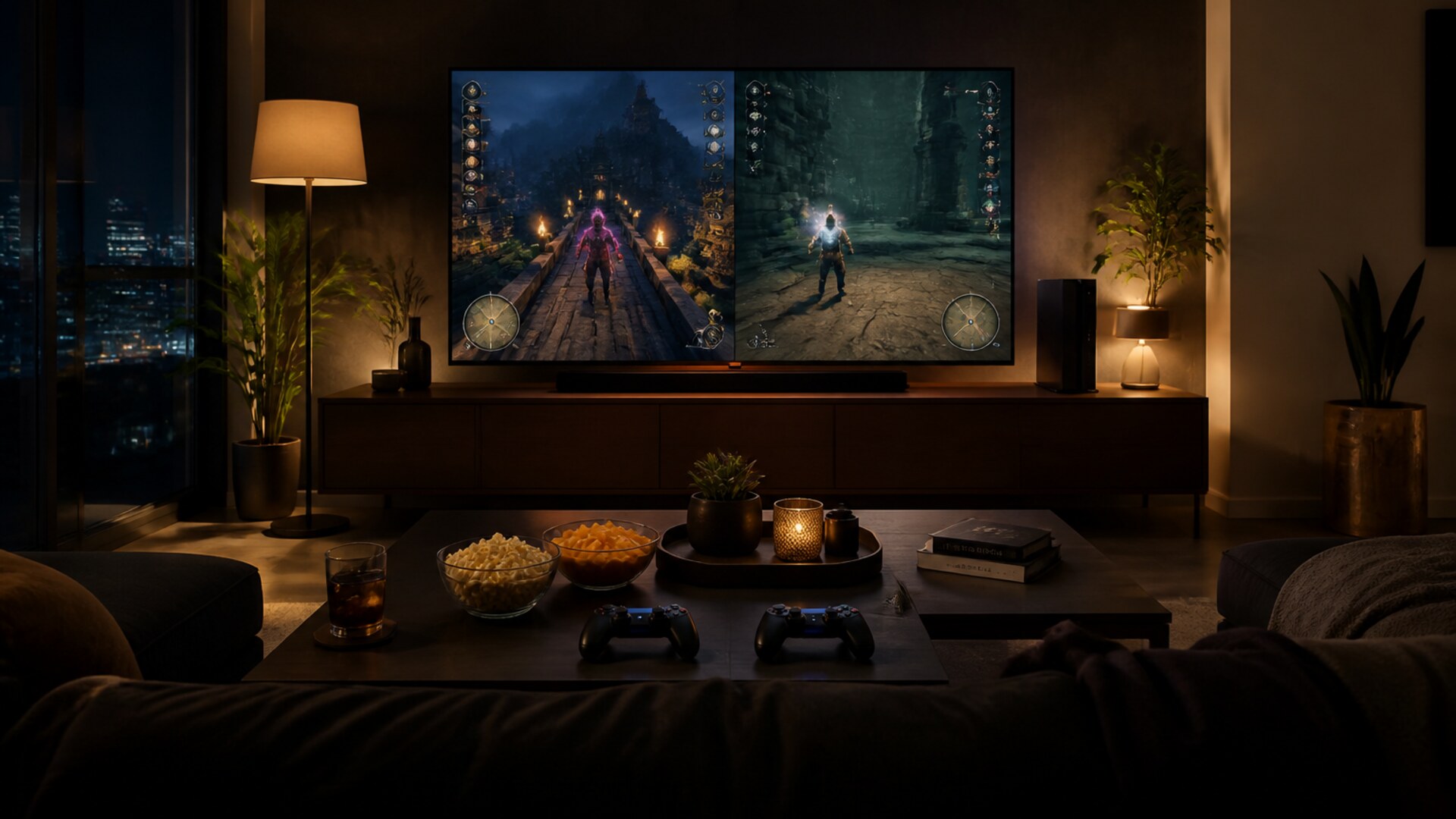
Wild Ice, from Journey Bound Games, went live on Steam on 19 August. Steam lists it as action, indie, and strategy, native split-screen, $16.99 against a $19.99 list. You play Max and Finley, small-town hockey players, holding furnaces against frost zombies.
Lost in Tandem, from Tempete Studio in Poitiers, launched on Steam on 22 July at $14.99 with a one-week 10 percent discount. It is a 2D adventure-puzzle about a girl and a Mech-ute robot, built for one or two players on a couch. The studio says every frame was hand-painted.
The most luxurious hardware in games is still a second controller on the same sofa. These two carts treated that as a shipping brief, not a mood.
Hazelight’s Split Fiction, the loud proof that a two-player campaign is a genre, has been out since 6 March 2025 and, by April 2026, had sold more than seven million copies. These July and August carts are smaller. They are also finished objects with a date and a price. There is no theory about friendship on the page. It is filing two named games that shipped this summer, both designed so a second pad on the same sofa is the point.
Online play is a marvel. It is also a logistics problem dressed as company: accounts, latency, a teenager in a headset, a friend who is on in a minute for forty of them. Local co-op is older than all of that. For a stretch the industry treated it like a dusty cabinet. Why split a screen when you can sell two copies. Why sit next to someone when the cloud will seat you in adjacent emptiness. Then a run of games remembered that joy has a geography, and the geography is a room.
Wild Ice is the colder of the two temperatures. Journey Bound Games is a two-person studio in British Columbia. In February 2020 the same room shipped Path of Giants, a serene puzzle about three explorers on an icy mountain, and Steam has kept it at 97 percent positive through more than a thousand reviews. The next object from that marriage of tastes is zombie hockey. Nobody on a four-hundred-person committee would greenlight that sentence. Two people who live together might, on a Tuesday, and then they might finish it. They finished it. 19 August is the date.
The loop is honest about its two halves. Before the wave you place hockey-themed traps: puck launchers, barricades, the furniture of a rink that has been asked to become a fort. Then the furnace comes on and the frost dead arrive, and you are no longer a manager. You are Max the scavenger or Finley the tank, slapshots and body checks, holding heat in a town the store page calls Coldwater. Difficulty runs from Rookie to Veteran. You can play it alone. The design is polite about the empty cushion and happier about the full one. Native split-screen is on the feature list the way a second plate is on a table. Remote Play Together, the Valve courtesy from October 2019, lets the second licence stay off the bill if the other person is a city away. IGN ran the gameplay trailer on 11 August and named the 19 August PC date in the caption. A free demo sat on the store page before the 1.0. That is how a small room talks: here is the thing, here is the day, here is a slice you can run tonight.
The price is a civility. $16.99 against a $19.99 list is less than two cinema tickets and less than a single night of a live-service battle pass that will ask you to come back on Thursday. Steam tagged it action, indie, and strategy, which is a filing cabinet, not a mood. Nine achievements. Windows. No Mac, no Linux, no console street date on the page being read. PC and a sofa is the brief. The sofa is doing the expensive work.
Lost in Tandem is the other weather. Tempete Studio sits in Poitiers, not Paris, a French independent room founded in 2016 that spent years on Dixit World with Libellud, the digital cousin of a board game about pictures. Lost in Tandem is the first original game. Juicebox Studios published it. The store opened on 22 July at $14.99 with a one-week 10 percent welcome. You can play it solo by swapping between the girl and the Mech-ute, the way you can eat a meal alone, but the game is honest about its preference. Two people, one story about being lost together, puzzles that need both sets of hands.
The studio’s artist-forward line is not a slogan on a pitch deck. The press note on launch day said everything was hand-painted and animated with traditional techniques, by people, with no generated texture in the pile. In a year drowning in generated texture, that is not a footnote. It is a lighting choice. Five chapters, five biomes, a walk of three or four hours if you do not stop to put stickers on the robot, longer if you do. Relics, news clippings, leftover bread in a world that looks emptied of humans and somehow still tender. Upgrades on the Mech-ute that open the next door. Remote Play Together is on this cart too, so the second person can be a time zone away and still sit, in the old sense, on the same glass. The game costs less than a couple of cinema tickets and looks like a picture book you could hang.
The market around them did not shrug. It multiplied. Sheepherds!, from November 2025, is a one-to-four-player game about dogs, sheep, and wool, with no timer and no mechanic for ruining a friend’s afternoon. Hotwing Hellions, out in March, is a split-screen shmup in a space-western: two bounty hunters, one screen, the sort of game that makes you lean. North Peak Studio’s The Doi is due on Steam in September in the Pico Park tradition, which is to say the puzzle is your friends. Those titles have their own desks. This one is about the two that put a summer date on a store page and hit it.
What is the hardware story, if you insist on one. Televisions got bigger and better. Cloud saves made it painless to pick up the same file. Remote Play Together let a split-screen game commute. Steam Deck made a sofa portable. None of that matters if the design does not want you in the same room. The design, suddenly, wants you in the same room. Wild Ice splits the glass because Max and Finley are a pair. Lost in Tandem splits the verbs because a girl and a defective robot cannot finish the walk alone. Split Fiction, still selling, still at 97 percent on Steam with more than a hundred thousand reviews, taught the expensive version of the same grammar. These two carts taught the affordable version.
There is a culture scene if you want the living-room report rather than the feature list. A Saturday in late August does not require a raid calendar. Someone puts the second pad on the table before anyone asks. Someone else takes the scavenger because they like to run. The tank stays near the furnace. In another house the robot gets the stickers and the girl gets the ledges. Pizza arrives in the window that used to be a loading screen. A child who does not “game” will still pick up a pad if the job is to hold a furnace or walk a painted hill. A grandparent will stay if the art looks like a book. The industry spent a decade training living rooms to behave like offices. These two objects train them back into rooms.
Finishing is a form of glamour. An indie studio that ships a beautiful co-op game has done something a lot of richer rooms have forgotten how to do. They have made a complete object that requires another person in the air. They have bet against the lonely engagement loop. They have, in a very old-fashioned way, trusted the house. Journey Bound trusted a hockey stick and a trap grid. Tempete trusted paint and a robot that does not work properly. Both trusts have a receipt: 19 August, 22 July, $16.99, $14.99.
That receipt stays on the page. Not a theory of friendship. Not a think-piece about the death of the living room, which was always a lazy obituary. Two named games, two prices, two dates, two sofas that now have something to do. Put the second controller on the table. That is an editorial position. It is also, in the last weeks of summer 2026, a reasonable reading of the carts that actually shipped.
The paper
Comments
No notes on this story yet.
Sign in to comment