
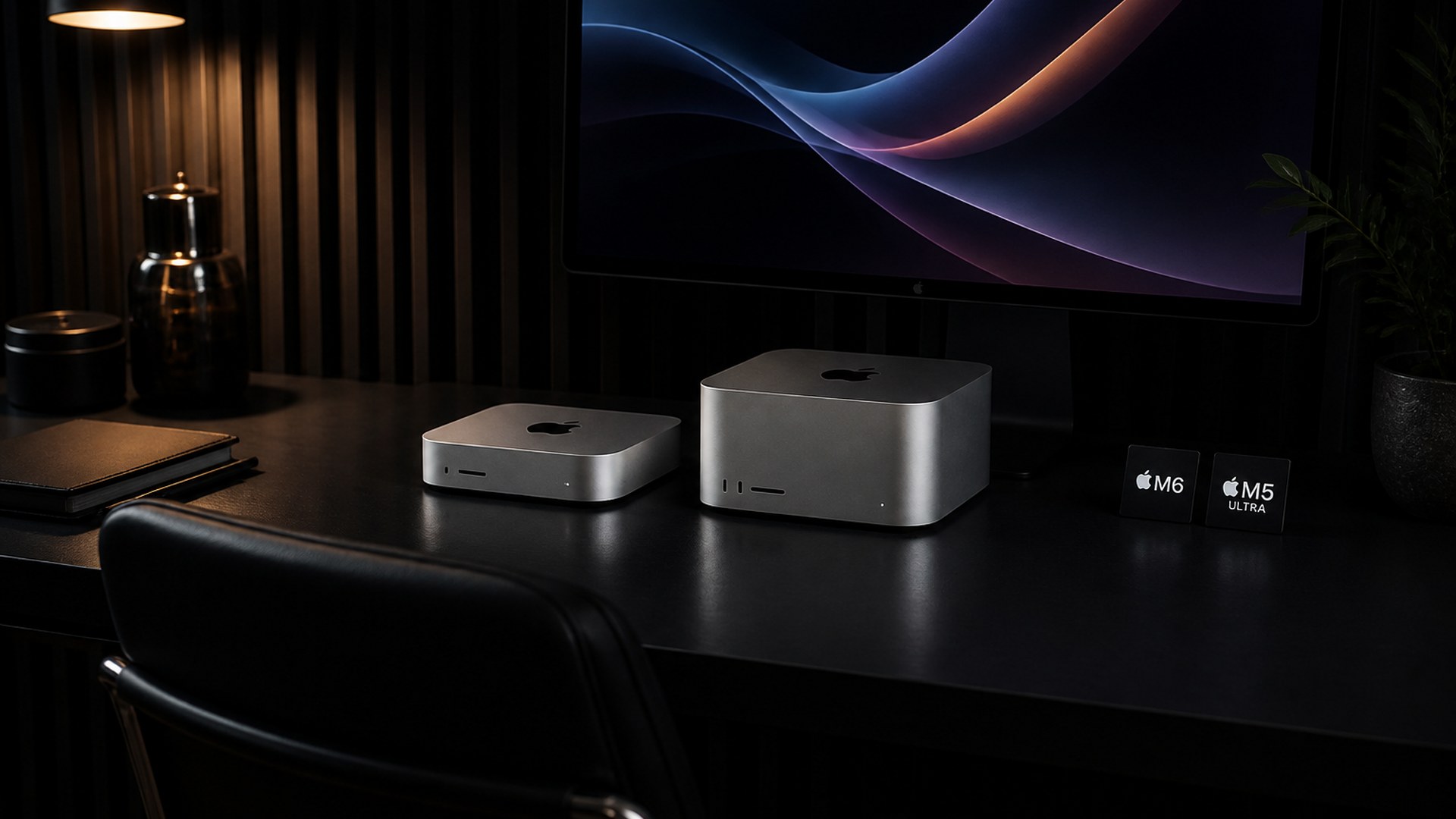
Apple put new silicon in the Mac mini and the Mac Studio on 25 August 2026, a Tuesday, weeks before the September iPhone show. The newsroom posts are the primary: “Apple introduces M6 and M5 Ultra for a big leap in performance and AI compute,” and the companion Studio post the same day. Pre-orders opened that morning. Machines start arriving 22 September. The 512 GB Studio configuration is late October.
This is not the 26 August “Surprise and Shine” invite. This file is the desktop drop.
M6 is Apple’s first 2-nanometer chip. It ships in the new Mac mini. Apple’s description: a larger 12-core CPU complex, two more cores than M5, made of 2 super cores, 4 performance cores, and 6 efficiency cores; a 12-core GPU with a Neural Accelerator in each core; a Dual 16-core Neural Engine; up to 32 GB of unified memory; up to 170 GB/s of unified memory bandwidth. Apple calls that bandwidth a 10 percent step over M5 and 2.5 times M1. Apple calls the single-threaded figure the world’s fastest CPU core, up to 1.2 times M5 multithreaded, up to 2.4 times M1. Peak GPU compute for AI: nearly 30 percent over M5, more than 8 times M1. Those are Apple’s August 2026 tests on a preproduction Mac mini with M6, 12-core CPU, 12-core GPU, 32 GB, against a 35.6 cm MacBook Pro with M5, 10 and 10 and 32 GB, and a Mac mini with M1, 8 and 8 and 16 GB. Keep the footnote glued to the numbers.
Sri Santhanam, Apple’s vice president of the Silicon Engineering Group, is the named quote. “Today, we’re debuting the next giant leap in performance and AI compute for Apple silicon with the incredibly advanced M6 and the most powerful M-series chip yet, M5 Ultra.” He goes on: 2 nm process, new CPU complex, two extra CPU and GPU cores, Dual 16-core Neural Engine, more bandwidth, energy efficiency; and for the Studio, a massive GPU with Neural Accelerators and more unified memory. Print him as the newsroom printed him.
The Verge timestamped the chip story 25 August 2026, 1:00 p.m. UTC. Forbes, David Phelan, 25 August, 9:00 a.m. EDT, called it a surprise upgrade ahead of the main event. MacRumors, Tim Hardwick, 25 August, 6:48 a.m. PDT, said pre-orders were already live in the United States and 30 other countries and regions. Those three clips sit under Apple’s own posts. They do not replace them.
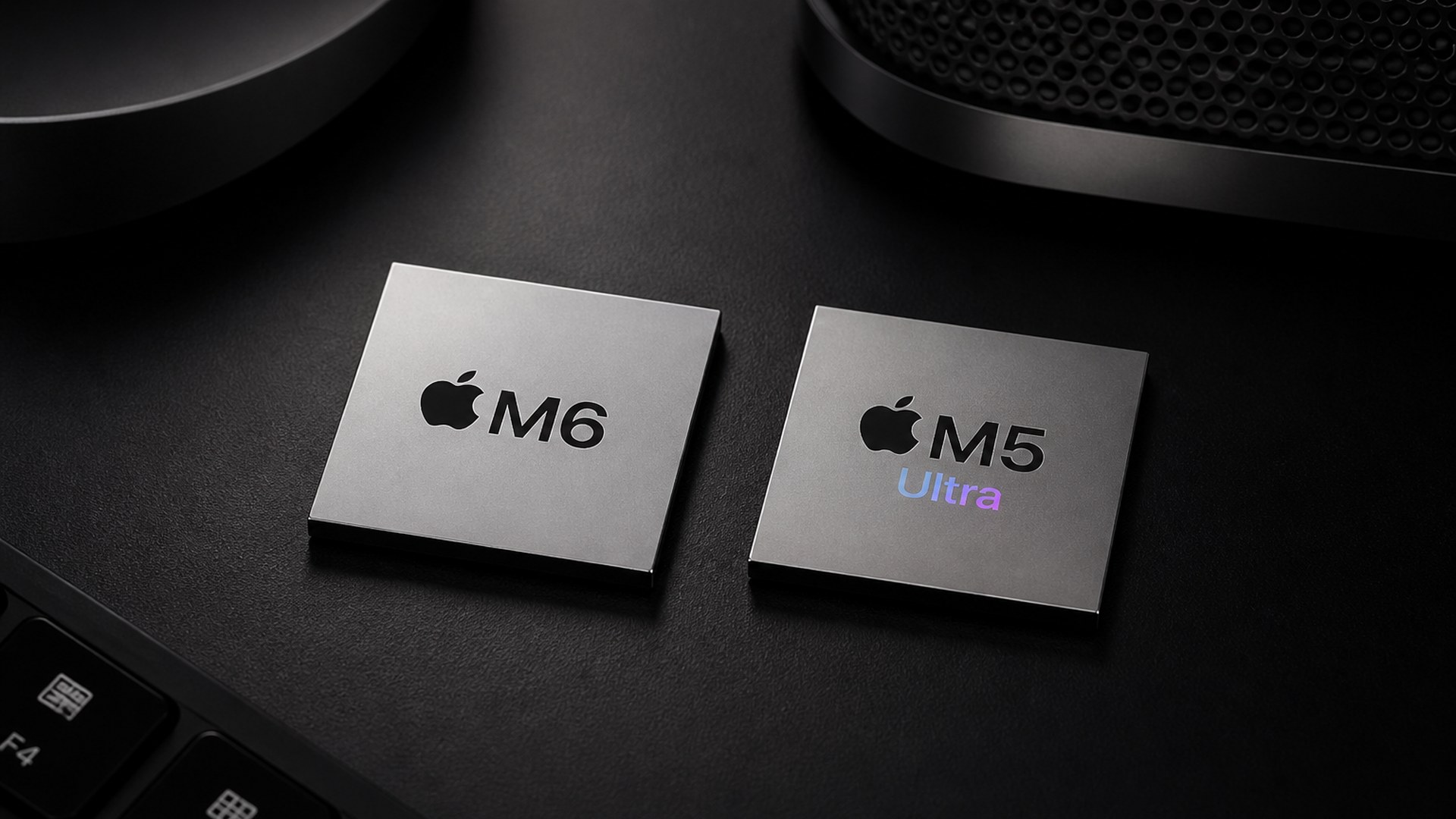
M5 Ultra is the other object. Apple’s most powerful M-series chip, in the new Mac Studio, using UltraFusion to join two dual-die M5 Max chips into the first quad-die architecture in an M-series SoC. Inter-die bandwidth over 4.4 TB/s. Connection density over 6 times. Up to a 36-core CPU, 12 super cores and 24 performance cores. Up to an 80-core GPU with Neural Accelerators in each core. A 32-core Neural Engine. Up to 512 GB of unified memory. 1.2 TB/s of memory bandwidth, 50 percent above M3 Ultra. Apple’s Studio tests, August 2026, used a preproduction Mac Studio with M5 Ultra, 36-core CPU, 80-core GPU, 256 GB, against M3 Ultra 32/80/256 and M1 Ultra 20/64/64. From that table: up to 1.25 times single-thread and 1.3 times multithread versus M3 Ultra; up to 4.5 times peak GPU compute for AI versus M3 Ultra; over 6 times M1 Ultra; up to 40 percent faster graphics than M3 Ultra. Media engine: dedicated H.264 and HEVC, four ProRes encode and decode engines, hardware AV1 decode. Huge models on device is the sentence Apple wants next to 512 GB. Hundreds of billions of parameters is Apple’s phrase. Attribute it.
MacRumors published the price table the same morning. Mac mini with M6 starts at $899, education $799, 16 GB memory and 256 GB storage. Mac mini with M5 Pro, $1,699, education $1,599, 24 GB and 512 GB. Mac Studio with M5 Max stays $2,499, education $2,299, 36 GB and 512 GB. Mac Studio with M5 Ultra starts at $5,499, education $5,099, 96 GB and 1 TB. The 512 GB unified-memory Studio is late October, price not in that table. Ship date for the rest: Tuesday 22 September, stores and authorized resellers included. Pre-order 25 August. Those are shop facts. There is no Australian dollar conversion Apple did not print.
The Studio companion post adds Wi-Fi 7 and Bluetooth 6 to Mac Studio for the first time, Thunderbolt 5, and a clustering claim: multiple Studio systems, up to 3 times faster distributed AI inference than a single system, Apple’s number. Core AI, Core ML, Metal, and Xcode are the developer frameworks Apple says tap both chips. Apple Intelligence rides macOS 27 this fall; features are in the Apple Beta Software Program now. Languages on the footnote include English and a long list that is not turned into a tourist paragraph. Some features not in all regions. See apple.com/apple-intelligence. That is the honest out.
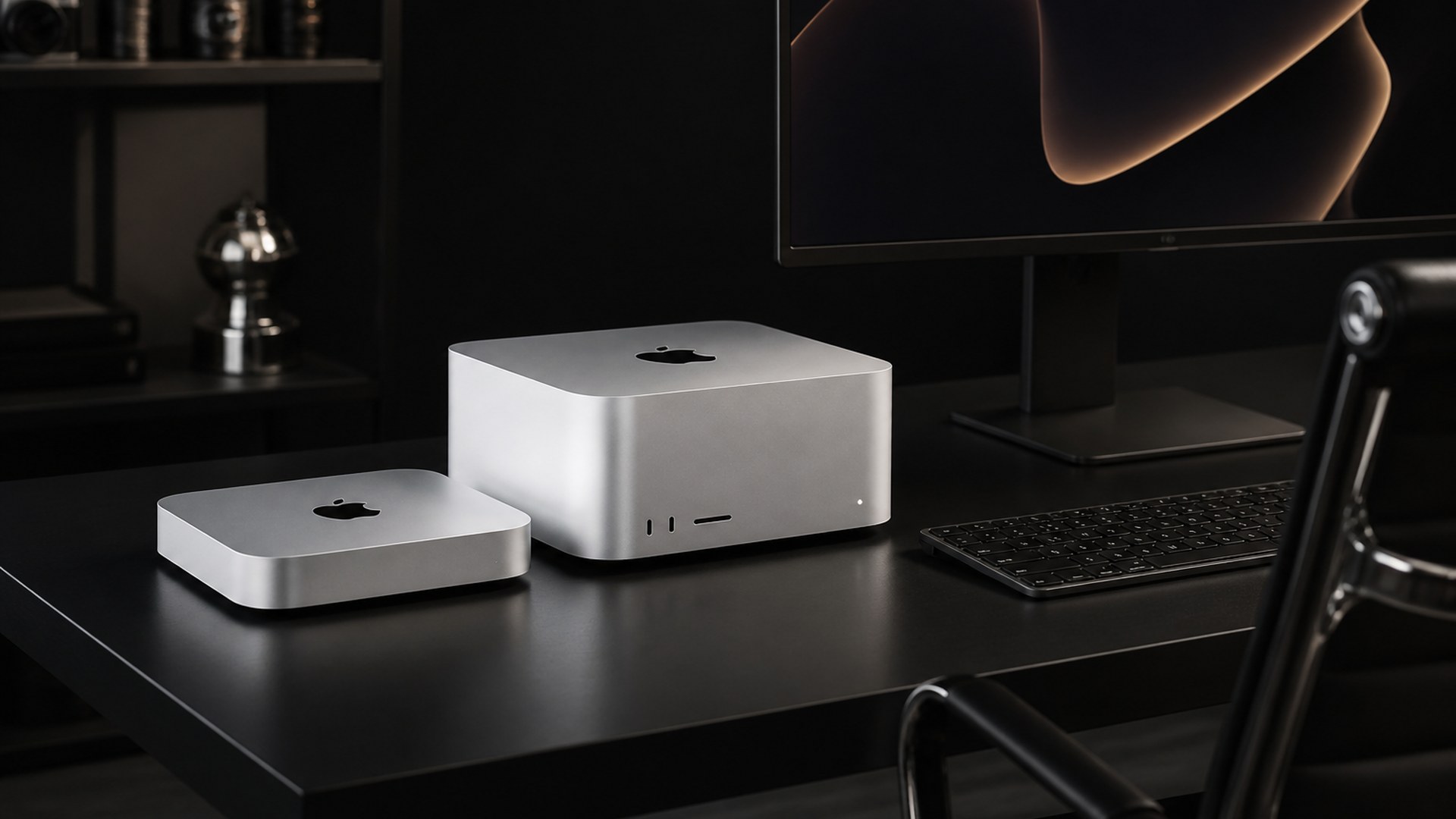
What 25 August did not do is the iPhone keynote. Greg Joswiak’s Surprise and Shine invite is 26 August for 9 September. Different file. Different desk if the paper wants the foldable rumour. This file is 2 nm in a mini you can pre-order, and a quad-die Ultra in a Studio you can pre-order, with a September 22 door. Positive is the shape: Apple shipped the numbers, opened the store, named the process node, named the core counts, named the bandwidth, named the vice president, named the test machines. A reader who wants a small fast desktop has an M6 mini at $899. A reader who wants the ceiling has an M5 Ultra Studio at $5,499, or waits until late October for 512 GB.
Geometry rates on M6 are up 50 percent, Apple says, with updated Dynamic Caching and hardware ray tracing. Games and apps are named in the newsroom art — Photoshop on the mini, Mixtape, Xcode, Premiere Pro, Draw Things, LM Studio Bionic and MATLAB on the Studio. Those are Apple’s demo labels, not independent reviews. Mixtape was not run here on a shipping mini. Shipping starts 22 September.
Power efficiency is the other chorus. 2 nm packs more transistors in a smaller die. Super cores for the single-thread jobs, performance cores for the heavy multithread, efficiency cores for the background. Dual Neural Engine for on-device models. Neural Accelerators in every GPU core. That stack is how Apple wants the sentence “run the model on the desk” to sound like a product, not a lab. The lab story this week is Nico’s, on 27 August, about a hardware standard for actual benches. This story is a mini and a Studio you can buy.
Sunday 30 August is five days after the drop. Pre-orders have not been pulled. The 22 September date has not been moved in the posts used here. The 512 GB late-October caveat is still the caveat. Apple’s footnotes still say the tests were Apple’s, in August, on those specific systems. Keep the footnotes. Keep Santhanam. Keep $899 and $5,499. Keep 2 nanometers on the mini.
The paper
Comments
No notes on this story yet.
Sign in to comment