
SpaceX rebranded Direct to Cell as Starlink Mobile at Mobile World Congress. Michael Nicolls, SVP of Starlink, said the first-generation system already spans about 650 satellites and has connected more than 16 million unique users, with 10 million monthly active users through partner carriers.
The service is live in 22 countries. In the United States it is T-Mobile’s T-Satellite, commercial since 23 July 2025. Nicolls called it the largest 4G coverage by geographic area in the world. He said monthly actives should exceed 25 million by the end of 2026.
The stage was Barcelona, the first Monday of the congress. PCMag dated the keynote 2 March. Broadband Breakfast filed it 3 March. Nicolls’s line on the first-generation system was a count, not a slogan: about 650 satellites, more than 16 million unique users, 10 million monthly actives through partner carriers including T-Mobile, Rogers, and KDDI. Fierce Network had him saying the first-generation constellation was fully deployed after 18 months, operating across five continents. The named product on the stage was Starlink Mobile. The old name was Direct to Cell. SpaceX had filed to trademark the new one last year.
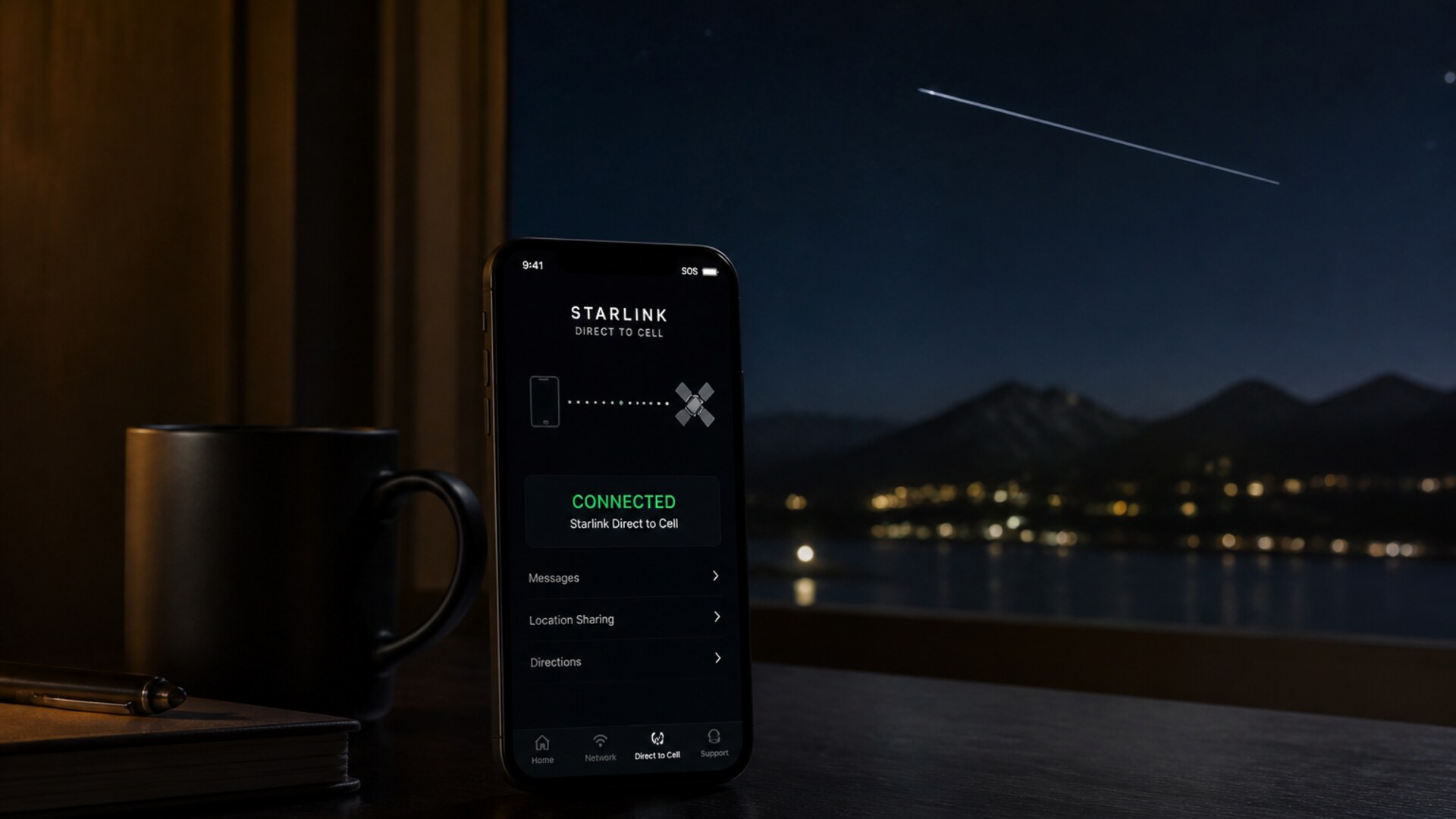
The phone is unmodified LTE. There is no pizza on the roof. Messaging came first; limited data followed. T-Mobile’s T-Satellite left beta on 23 July 2025. The Verge filed Mike Sievert’s announcement the same day: text and location-sharing first, $10 a month as a standalone for a limited time before $15, included on Experience Beyond and older Go5G plans. More than 60 phones on T-Mobile’s eligible list, The Verge said, including iPhone 13 and up, Pixel 9, Galaxy S21 and newer. KeepTrack later put data on the service from October 2025 and, in its 2026 status note, still had the live footprint at 22 countries, more than 650 direct-to-cell satellites, and access for over 400 million people. TechTimes, in August 2026, repeated the July 2025 commercial start, the 650-satellite class, and the 22-country count. Those three numbers — 650, 22, 16 million unique — are the ones SpaceX put on a stage in Barcelona. Those are the figures SpaceX put on a stage in Barcelona.
Nicolls said the next constellation, launched on Starship from mid-2027, is aimed at about 1,200 satellites and full voice and data. “We’ll be able to launch more than 50 satellites on every [Starship] launch, and we’ll begin launching in mid-2027,” PCMag quoted. “With Starship, we’ll be able to deploy the constellation very quickly. Our goal is to deploy a constellation capable of providing global and continuous coverage within six months. And that’s roughly 1,200 satellites.” Fierce Network had Deutsche Telekom signing as the first European operator for that V2 system on the same Monday. Broadband Breakfast had the first-generation birds at roughly 350 kilometres, and the broader Starlink network at nearly 10,000 satellites in low Earth orbit. The pocket is the terminal. The dish still carries the household.
Gwynne Shotwell has said the current system uses about 5 MHz of spectrum. That line is the physics under the 4 megabit-class speeds PCMag put on the first-generation service. On the August earnings call she said the EchoStar purchase — 65 MHz, with FCC approval of the licence transfer already in the Q2 release — is a massive increase in capability, and that the next-generation satellites would start flying in 2027 with service by the end of that year. Ars Technica and TelecomTV both carried the 5 MHz current-system figure from that call. PCMag had the EchoStar deal closing 30 November 2027, and last autumn’s Musk line of a two-year timeframe for phone manufacturers to adopt the chips for that spectrum. Nicolls, in Barcelona, said that when the mid-2027 launch arrives, “we will be on most devices in the US.” The Barcelona keynote and the August call are the same product at two dates. Mid-2027 is the Starship launch line Nicolls put on the stage. End of 2027 is the service line Shotwell put on the call.
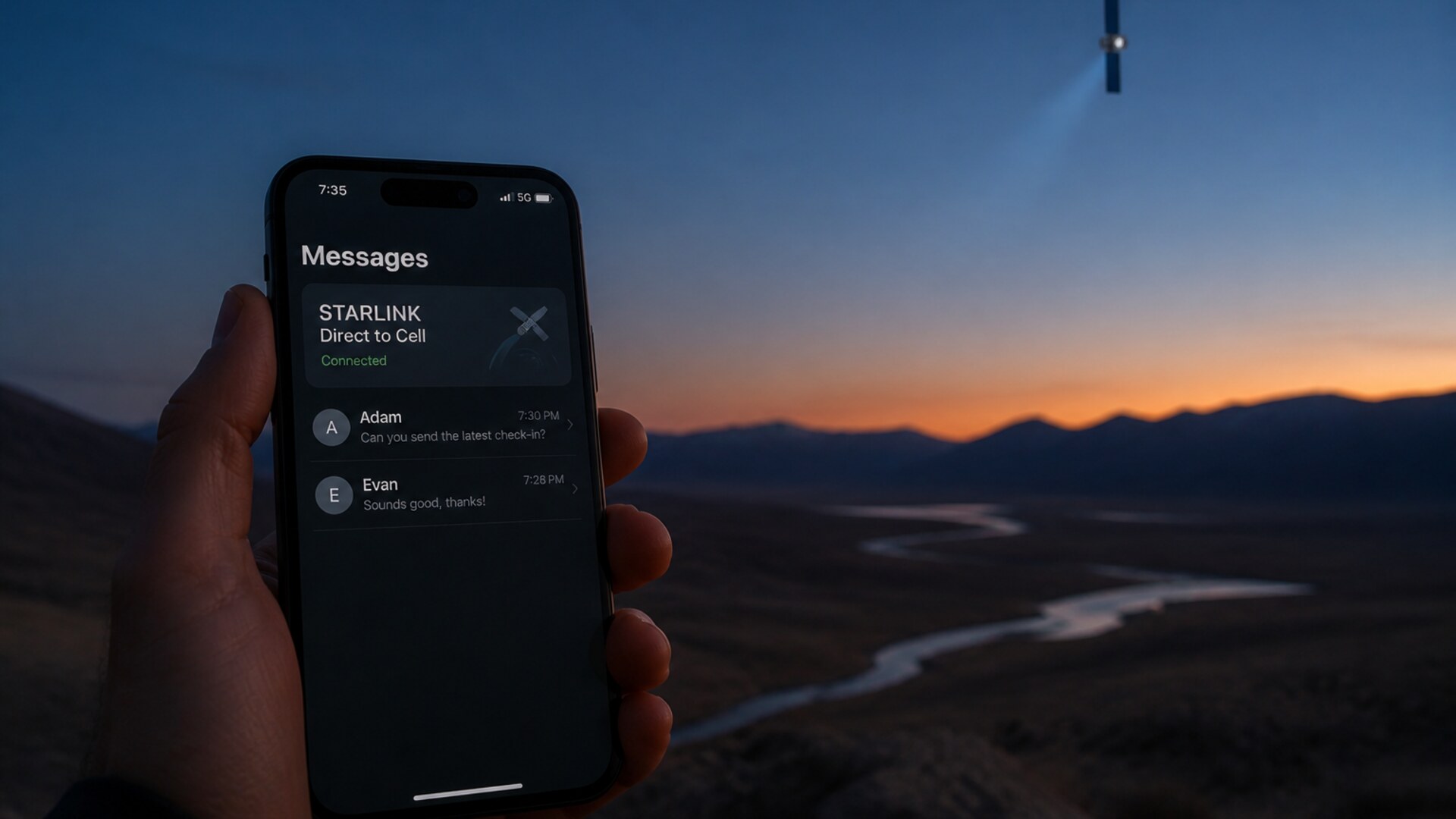
The photograph of the night desk is the product as a user sees it: a phone, a green Connected box, Direct to Cell still on the screen because that is the name the hardware still prints, a window onto dark mountains. The dusk valley shot is the same claim from the other side of the glass: Messages, a Starlink banner, no tower in the frame. Neither picture is a named person. Both are the unmodified handset Nicolls described. The pocket finds the sky. The dish is a different SKU.
Nicolls’s vision sentence on the stage was a hybrid, not a replacement. “Satellite is complementary to terrestrial networks; it cannot provide the data density that terrestrial networks have. But it can augment terrestrial networks in the places where terrestrial networks cannot reach. Or when terrestrial networks need additional capacity.” PCMag printed that. He also said the second-generation satellite will have a phased array five times larger than the first generation, four times the bandwidth per beam, nearly 100 times the data density of a V1 bird, and 16 times the beams per satellite. A SpaceX policy manager, the week before the keynote, had put the peak-speed aim at 150 Mbps per user. Nicolls repeated the figure. Current V1, on the same filing, sits around 4 Mbps. Fierce Network had Shotwell on the same Barcelona dais talking first-generation progress; the August call is where she put 5 MHz on the current system and 65 MHz on what comes next. Those are two products on a timetable, not one product with a speech.
The U.S. retail name remains T-Satellite. Rogers Satellite is the Canadian name. KDDI is the Japanese partner named on the stage. SoftBank, NTT Docomo and Spark NZ appeared later on SpaceX’s 30 June connectivity highlights as new Starlink Mobile partnerships. The wholesale method is the method Nicolls spent the keynote defending: SpaceX sells to carriers; carriers put their own brand on the bar. Twenty-two countries is how you know the wholesale is real. Ten million monthly actives is how you know someone is using it. Twenty-five million by the end of 2026 is the number Nicolls put on a clock. The year-end figure will be reported when a carrier or SpaceX prints it, not before.
T-Satellite still needs sky. T-Mobile’s own support language, as The Verge had it in July 2025, is outdoor, with trees and heavy cloud as the usual limits, and indoor and in-vehicle use unreliable. TechTimes, this August, had satellite at 0.002 percent of T-Mobile’s traffic in a live week of telemetry — one-fiftieth of one percent — which is what a dead-zone product looks like on a national carrier’s graph. That is not a failure of 650 satellites. It is the design: parks, maritime corridors, backcountry, the kilometres of highway the towers skipped. V1 speeds of 2 to 4 Mbps sit on that same filing. V2’s 150 Mbps is the mid-2027 claim. Both numbers stand. The second is a claim, not a launch that has happened.
650 satellites, 22 countries, 16 million unique users, 10 million monthly actives. T-Satellite since 23 July 2025. Next constellation on Starship from mid-2027, about 1,200 satellites, full voice and data. Shotwell: about 5 MHz on the current system. Those are the numbers SpaceX put on a stage in Barcelona, and the spectrum line the president put on the call. The pocket is the terminal. The dish still carries the household. Both stay on the page.
The paper
Comments
No notes on this story yet.
Sign in to comment