
Starlink V3 satellites are built for Starship’s cargo bay. SpaceX’s second-quarter 2026 results, and the PCMag filing of them, said the next Starship test flight is meant to put those satellites into an operational orbit, not a twenty-minute rehearsal.
A recent Starship flight lofted a V3 batch for about twenty minutes — long enough to talk to the satellites over radio and laser and pull telemetry. Musk has said a critical mass, probably around a thousand of them, is needed before customer speed upgrades show, and pointed at the second quarter of 2027.
The shopping list starts with a bay. Starlink V3 is cut to Starship’s cargo volume, not to a Falcon 9 fairing. That is a product decision. You do not tool a satellite for a rocket unless you intend to fly the rocket often. SpaceX’s Q2 2026 results put the next Starship test on an operational-orbit sentence. PCMag filed that sentence: the next test is meant to deploy V3 satellites into operational orbit. SpaceNews took the same line from the 4 August earnings call, the first since the June IPO. Musk’s words on that call: “Flight 14 will be our first flight to fly our version three Starlink satellites, our communication satellites, to operational orbit.” Named flight. Named version. Named orbit class. Not a twenty-minute demo.

The twenty-minute demo already flew. Flight 13, 24 July 2026. SpaceX’s Q2 letter, published after the quarter closed, said that subsequent-to-quarter flight deployed 20 production V3 satellites, demonstrated an in-space Raptor relight, and executed what the company called the softest splashdown of Starship to date. Twenty birds. About twenty minutes of talk: radio, laser, telemetry. Then they came down. That is a rehearsal with real hardware. The shopping list for cheap orbit is not a rehearsal. It is an operational slot. The next test is supposed to leave the next batch up.
Musk put a quantity on the speed upgrade. A critical mass, “on the order of about 1,000” V3 satellites, before customer speed upgrades show. He pointed at approximately the second quarter of 2027 for that mass. SpaceNews has the quote from the 4 August call. A thousand is a production number. Twenty on a test is a checkout number. The gap between 20 and 1,000 is the reason the bay matters. Falcon cannot carry this bird the way Starship’s bay can. V3 is the named product. Starship is the named bay. Q2 2026 is when SpaceX put the operational-orbit sentence in an earnings report.
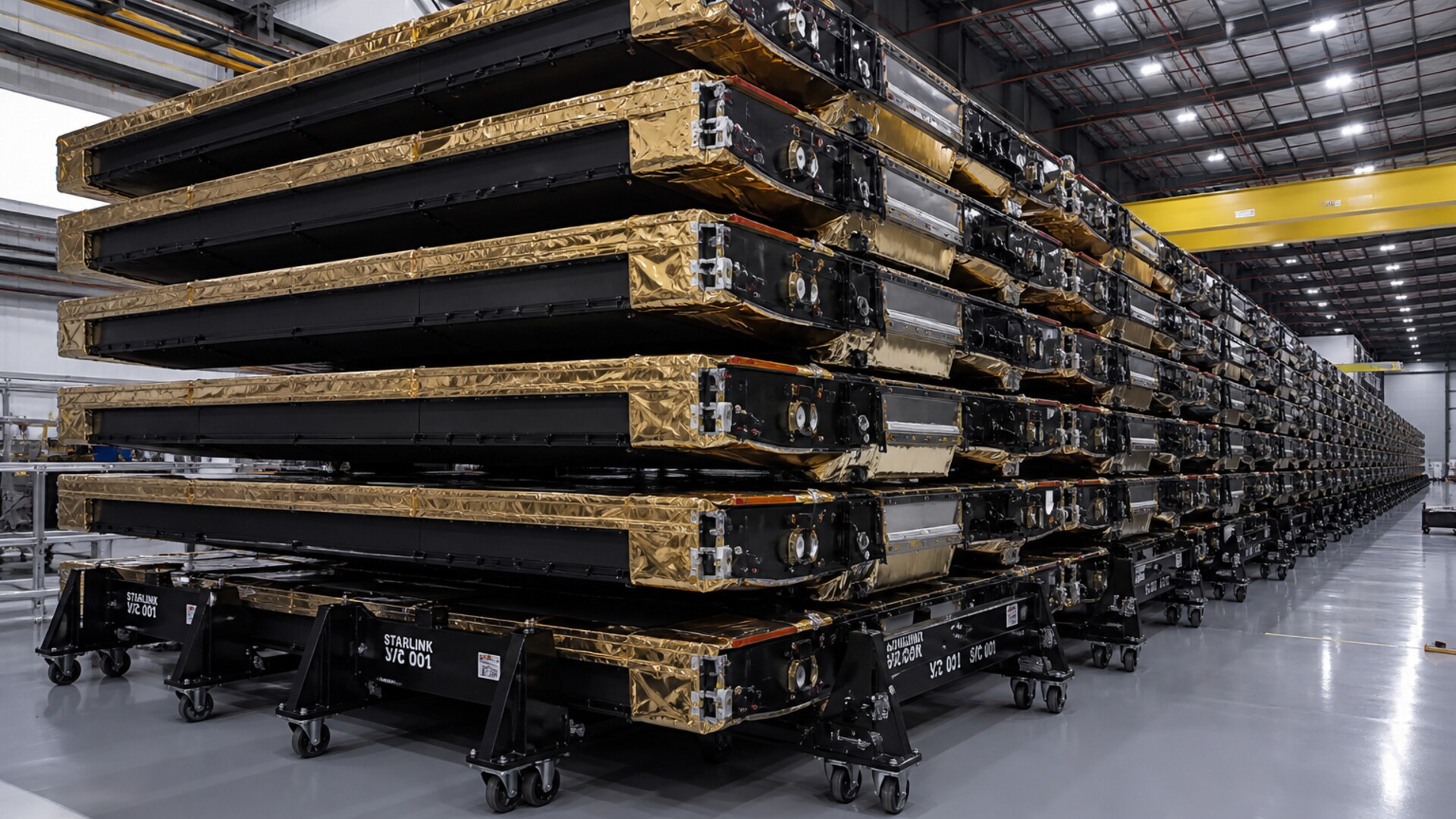
The factory floor is the inventory. Rows of flat, rectangular spacecraft on black wheeled frames, gold multi-layer insulation on the edges, dark faces, stacks of four, a polished grey floor, industrial lights, a yellow gantry at upper right. The nearest base is lettered STARLINK S/C 001 in white. That is a satellite built as a slab, which is how you pack a bay. S/C 001 is not called a Flight 14 serial here. It is calling the object what the stencil says: a Starlink spacecraft, sized as a wide flat, waiting in a hall. V3 is the generation SpaceX says belongs in Starship’s maw. The photograph is the shopping list in hardware: many units, same shape, gold edges, a crane.
Q2’s other numbers sit on the same filing because they are why the list exists. SpaceX reported $7.8 billion in second-quarter revenue. Connectivity, which is Starlink, was about $4.3 billion. Paid subscriptions: 12 million at the end of June, up 1.7 million in the quarter, doubled year on year. SpaceX’s overall quarter was its first stretch of public earnings after the IPO. Under the launch noise, the dish is the business. V3 is the next dish-in-the-sky, fatter. Company materials have put V3 on the order of a terabit per second each, an order of magnitude beyond the V2 birds. That is SpaceX’s product claim, not a speed test this morning. The claim is why the bay was the design constraint.
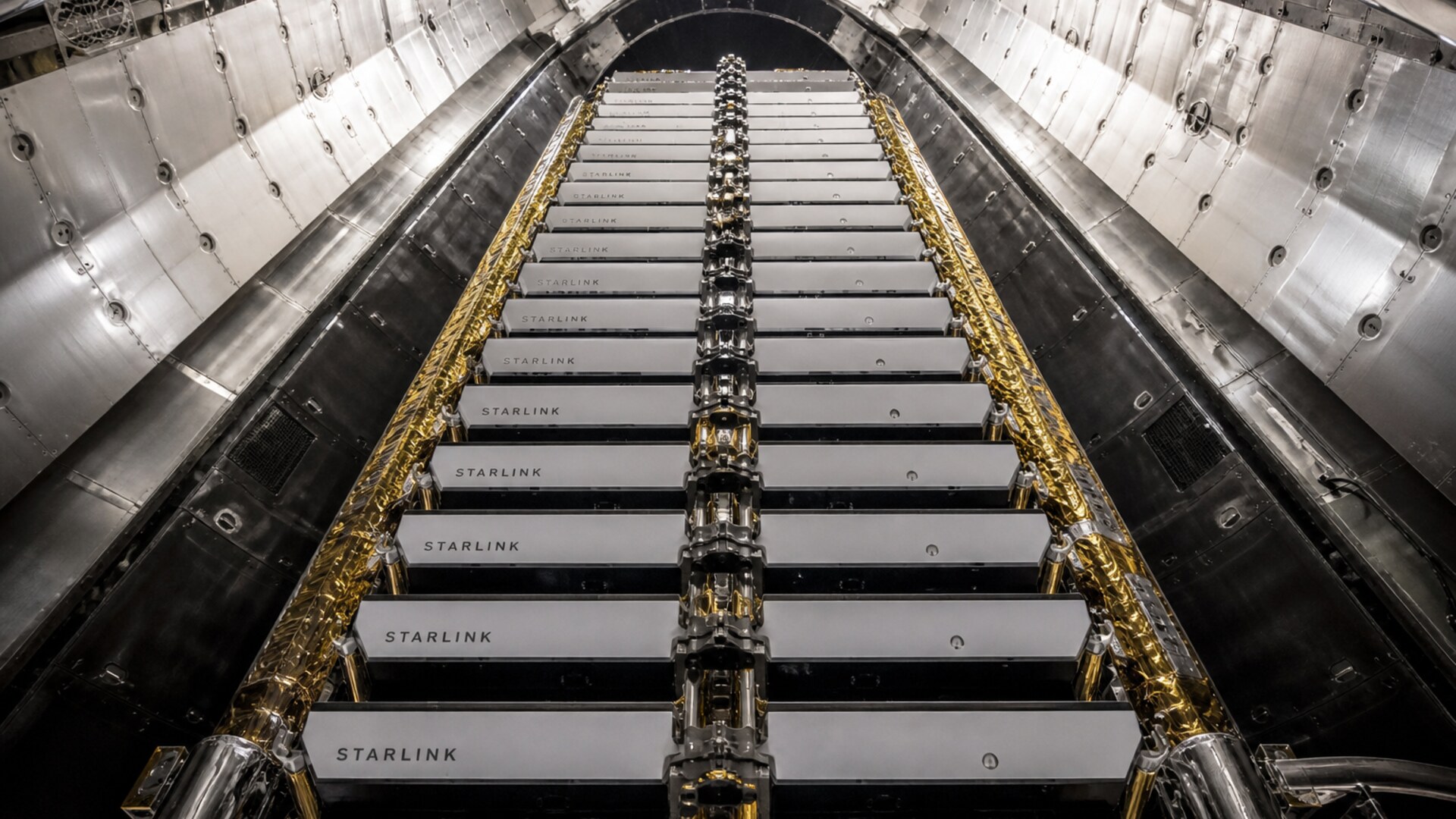
The bay photograph is the packing diagram. A vertical stack of flat satellites, STARLINK in black caps on the left of each panel, a central mounting rail, gold insulation on the side supports, curved metallic walls, a dark circular opening at the top. That is how you shop for cheap orbit: fill the volume. V3 is cut for that volume. A Falcon fairing is a different volume. The next Starship test is meant to put a V3 batch into an operational orbit rather than into a twenty-minute radio check. Flight 13 already proved the dispenser could talk to 20 of them. Flight 14, on the 4 August call, was the flight Musk named for operational orbit. Launch dates move. The product-to-bay match does not.
Prices change architectures. That is the rest of the list, still as logistics, not as a mood. A telescope that was too heavy last decade becomes a proposal if the kilogram price falls. A depot of methane and oxygen stops being a slide if tanker flights are cheap enough to schedule. NASA’s Artemis lander still needs tanker flights before it can think about the Moon. Those are line items. They are not this quarter’s payload. This quarter’s payload, on the earnings call, is SpaceX’s own constellation. Starlink pays for Starship. Starship is supposed to make Starlink fat enough to keep the 12 million figure moving. The first freight on the new vehicle is the company’s own birds. That is vertical integration as a shopping list.
The rest of the Q2 connectivity filing is why a fatter bird is even a shopping-list item. Gwynne Shotwell, SpaceX president and chief operating officer, said on the call that Starlink “had a standout quarter” and added net more than 1.7 million subscribers globally, the best quarter to date. ARPU held at $66, in line with Q1. Enterprise, maritime, aviation, and government — the unromantic customers — were already the faster-growing slice of connectivity in the company’s own split, about $1.8 billion in the quarter against a $4.3 billion connectivity total. Direct-to-Cell, with more than 650 satellites of that flavour on orbit and service live in 22 countries, is a different SKU: phone to sky, no dish. V3 is the dish-network upgrade, sized for the new bay. Two products. One company. The earnings call put both on the same hour.
Space, as a segment, is still the smaller P&L line and the whole logistics argument. Q2 space revenue was $962 million, up 55 percent sequentially and 29 percent year-over-year. Across the six months ended 30 June the company said it flew 78 launches and put 1,041 tonnes of mass on orbit, primarily for its own constellation. Those tonnes are still mostly Falcon-class birds. V3 is the tonne that is supposed to move onto Starship. Company language on the call still has Starship reducing cost to orbit by 99 percent or more relative to the historical average. That is SpaceX’s percentage. There is no independent kilogram price here. It is writing down the reason the shopping list changed shape: a satellite too wide for the old fairing, a rocket with a bay that fits it, a test that is meant to leave the satellite up.
What the Q2 sentence is not: a completed operational-orbit deployment. A thousand V3s on station. A customer speed upgrade already in the app. A Falcon 9 fairing suddenly able to swallow this slab. A Louisiana launch of the bay. PCMag and the earnings call are the filings. 24 July is the twenty-minute rehearsal with 20 production units. Q2 2027 is Musk’s pointed date for critical mass. An operational V3 constellation waits until the birds stay up and the company counts them.
What the Q2 sentence is: Starlink V3, sized for Starship’s cargo bay, named as the payload for the next test’s operational orbit, after a July checkout of 20 units for about twenty minutes, with a thousand-satellite critical mass pointed at the second quarter of 2027. Named product. Named bay. Named quarter. The factory slabs and the stacked rail are the same list in two rooms. You do not stencil STARLINK on a slab that wide unless the rocket in the next room is the one you intend to fly.
The paper
Comments
No notes on this story yet.
Sign in to comment