
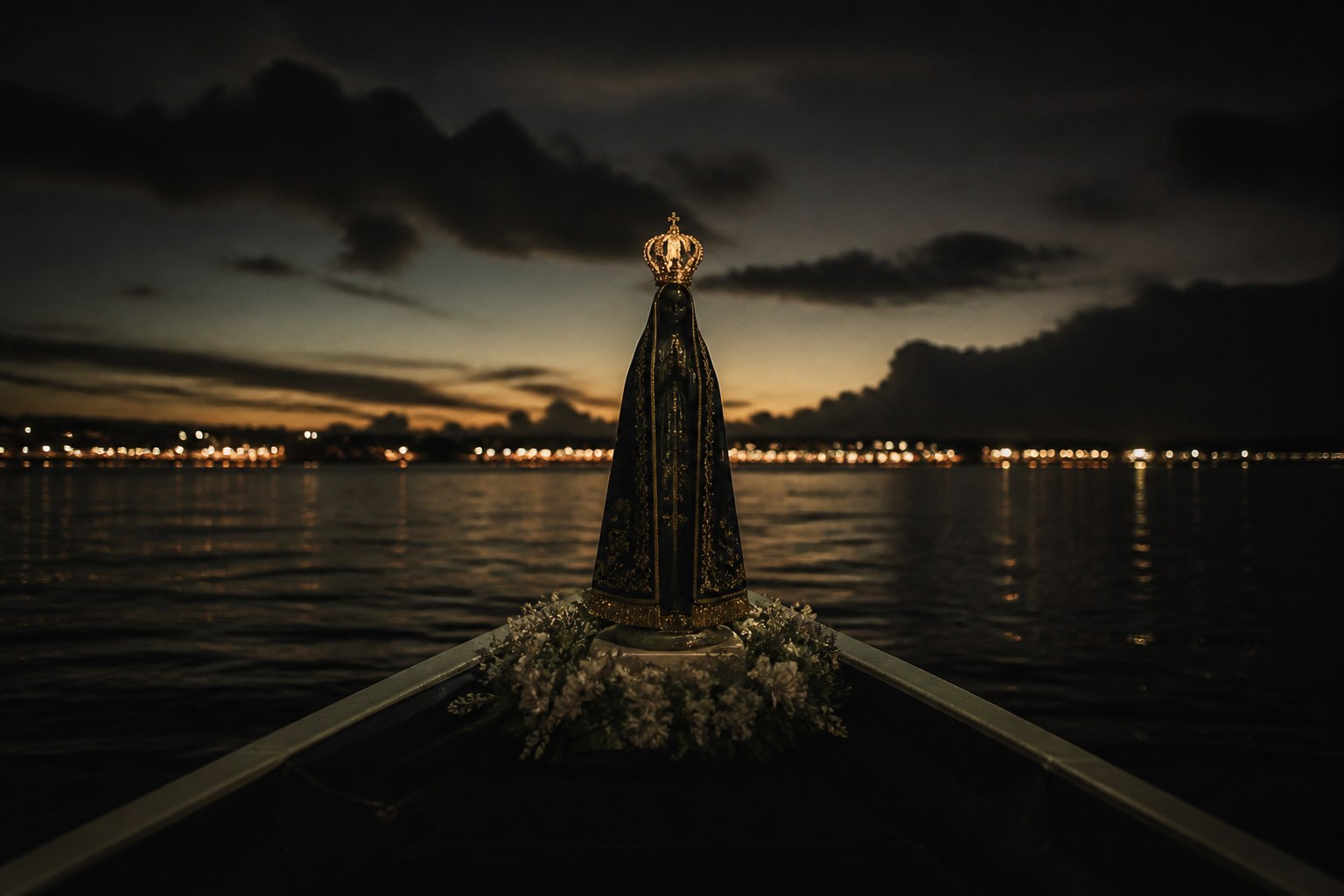
The lake at Castel Gandolfo has sat under the papal palace for four hundred years. On Saturday evening, 29 August 2026, it finally carried a pope.
Pope Leo XIV said Mass at 6 p.m. in the Church of Maria Santissima del Lago. Pope Saint Paul VI consecrated that church on 15 August 1977. After Mass the Holy Father walked the statue of Our Lady of the Lake down to the shore. The Vatican had said he would be the first pope to take the water section of the Feast of Our Lady of the Lake. EWTN’s photographs, credited to Zofia Czubak, confirm he boarded.
Vatican News filed the plan at 11:28 on 29 August, from Michele Raviart in Castel Gandolfo. The small church belongs to the Pontifical Parish of Saint Thomas of Villanova. At the end of the celebration the pope and the faithful left it and carried the statue along the road to the Tropicana beach resort. On the shoreline the statue went onto a boat provided by the Castelli Romani Regional Park Authority. The pope boarded with it. The run was to Giorgio’s Beach, at the foot of the Apostolic Palace, billed at about twenty-five minutes.
The hull had a name. Vatican News’s evening file, by Benedetta Capelli at 20:36, puts the pope aboard the Falco, decorated with yellow and white flowers. The Mass file at 18:35, by Edoardo Giribaldi, names the Falco as a boat of the Lungolago Castel Gandolfo Association. About ten civilian boats, two of them canoes, and the usual law-enforcement hulls made the escort. Canoes carried young people who had taken part in the Castel Gandolfo championships. Dragon boats came too. The objects on the water were the story: a parish statue, a named boat, a crater lake, a palace wall.
Castel Gandolfo has been the papal summer house since the early seventeenth century. Vatican News marks this year’s thanksgiving at four hundred years of papal presence, beginning with Urban VIII in 1626. The National Catholic Register, using EWTN News photographs from 29 August, describes Lake Albano as a roughly 5.2-square-kilometre lake in a volcanic crater. The Apostolic Palace looks down on it. Giorgio’s Beach sits at the foot of that wall. The water is not a backdrop. It is the parish’s floor.
The feast is younger than the palace. Father Dino Sella started it in the Marian Year of 1954 so the people who work the lake would have a place in the year. The church came twenty-three years later. Vatican News records that Pope Saint John Paul II visited it in 1979. Paul VI and John Paul II both walked the land procession. Neither took the boat. That is the first-on-the-water fact the Vatican stated, and the fact EWTN’s cameras recorded on Saturday night.
Father Adriano Gibellini, liturgical director and the person responsible for pontifical celebrations in the Diocese of Albano, presented the evening at Castel Gandolfo town hall on Friday, 28 August. “Usually, some of the faithful also follow the procession by swimming, but this year that has not been possible for safety reasons,” he told Vatican Media. The water section is old parish work. The pope on it is new.
Father Tadeusz Rozmus, parish priest of Saint Thomas of Villanova, told Vatican Media the pope’s presence was giving thanks for creation as it looks from that shoreline. Vatican News prints his words. “With the Pope’s presence, this thanksgiving takes on a particularly powerful meaning.” Then: “His presence, in my view, is also an appreciation of the gift of creation. Here in Castel Gandolfo, creation is represented by this beautiful lake, surrounded by these mountains, by the beauty of nature. It is a way of giving thanks, of savoring and breathing in that beauty.” He added Paul VI’s intention at the consecration: that the church should be a church that “breathes the lake,” because the Church represents the boat of Saint Peter and invites thanksgiving for what is actually there. In Castel Gandolfo that object is the lake.
Mayor Alberto De Angelis said the invitation began a year ago, from the parish, because the town wanted him there as one of them. Vatican News’s 11:28 file is the source. The idea came from Father Rozmus, answering a desire of local residents. The municipal administration, the diocese, law-enforcement agencies, the local tourism association and the Castelli Romani Regional Park all had to work the same shoreline. The town’s thanks, in that file, is that the pope placed the small town in Lazio “at the center of the world” and took part “as one of them” in a parish feast.
The church itself is an object. Vatican News’s Mass file describes a fan-shaped structure that resembles the planks of a boat. At the point corresponding to its ideal bow, the planks converge toward the cross rising above the stretch of water among the Alban Hills. From that altar, on 29 August, the pope preached the Gospel of Jesus walking on the water. He named the “contrary winds” of a world marked by suffering, violence and division. The procession, he said, recalls the miracle: the Lord reaching frightened disciples and bringing them safely back to shore.
He lingered on “simple gestures” of devotion, repeated from generation to generation. The small local community, gathered solemnly, represented the whole Church: “one body, in prayer, in sentiments, in intentions, in the orderly and unanimous development of our being together.” Then the line that belongs on a lake at dusk: “Let us therefore draw close tonight to Jesus and Mary, to the Son and the mother, so that, united, we may be, not only on the lake but during all the nights of the world, a reassuring reflection of God's presence and an irresistible echo of His love that invites us to love.”
The tradition, the same file notes, has been repeated since the post-war period, when no more than six or seven families lived in the small town of Lazio. Saturday night was not a state pageant. It was that parish, with a pope in the boat.
On the far shore, before the Falco arrived, Salesian novices led prayer and song. They sang hymns, including Eccomi, and read Gospel passages. People waited on beach loungers and pedal boats. Vatican News says the atmosphere stayed quiet and prayerful despite the crowd. The pope stepped ashore to applause. Tenor Aurelio Grimaldi and his wife, Elena Kovalova, performed La Vergine degli angeli from Verdi’s La forza del destino, then César Franck’s Panis Angelicus, with Maestro Massimiliano Franchina at the piano. Local authorities and mayors wearing the Italian tricolor sash listened in silence.
The Holy Father described Mary as “a woman of listening and service.” He entrusted the Church and the peoples of the world to her. Addressing her “with a filial heart,” he prayed for a Church “courageous in proclaiming the Gospel, humble in service and persevering in charity.” Then the sentence Vatican News put in the hed: “To your loving protection, we entrust all the peoples of the earth: look with kindness upon your children wounded by war and encourage in everyone the desire for peace.” He asked her to look with particular care upon “children, the elderly, the sick, families, young people and all those who live in loneliness.” He remembered those who live and work around the lake, and those who come there in search of peace. “Long live the Pope!” pilgrims called. The Castel Gandolfo marching band played. The band is celebrating the tenth anniversary of its foundation this year. As evening fell he left the lakeshore for a waiting car. The statue stayed with the people.
Sunday, 30 August, keeps the feast going. Father Rozmus says Mass in the same church for the motorcyclists who ride the Castelli Romani on weekends. A group of them were due at the Angelus with the pope. The land procession is old. The water section is old. The pope in the boat is the new object. Paul VI walked. John Paul II walked. Leo XIV boarded.
The NKJV has Mary on the first page of this kind of news: “My soul magnifies the Lord, and my spirit has rejoiced in God my Savior.” A statue on a boat is not a metaphor. It is a parish that asked, and a pope who said yes.
NKJV: “The earth was without form, and void; and darkness was on the face of the deep. And the Spirit of God was hovering over the face of the waters.” (Genesis 1:2)
The paper
Comments
No notes on this story yet.
Sign in to comment