Split Fiction launched on PlayStation 5, Windows, and Xbox Series X/S on 6 March 2025, and on Nintendo Switch 2 on 5 June. Hazelight Studios developed it. Electronic Arts published it under EA Originals. Josef Fares directed.
By April 2026 the game had sold more than seven million copies. SteamPulse, reading Steam, lists about 119,000 reviews at 97 percent positive and a $49.99 price. It is co-op only. A Friend’s Pass lets an owner invite a second player for free, including across platforms.
The design is two bodies, one story: authors Mio Hudson and Zoe Foster stuck inside a machine that steals stories. Puzzles are built so one person cannot finish them.
It Takes Two, Hazelight’s 2021 game, taught the same grammar. Split Fiction is the 2025 product. Seven million is a number a two-player game earned after a dated launch. The cart, the date, and the director stay on the page.
The sales tape is a timetable, not a vibe. One million copies in the first forty-eight hours. Two million in the first week. Four million by 6 May 2025, which is two months after the 6 March street date. Seven million by April 2026, which is a year and a month. Hazelight, on 8 April, put the studio total next to it: A Way Out at thirteen million since 2018, It Takes Two at thirty million since 2021, Split Fiction at seven, fifty million across the three. Electronic Arts had already called the launch hugely successful in the 2025 fiscal report, and had said the early numbers nearly doubled what the publisher had modelled. Those are company numbers. Keep the label on. They are still numbers a co-op-only campaign put on a board.
The Switch 2 port on 5 June 2025 was not a souvenir. It was a second living-room. The hybrid Nintendo machine is a sofa that also leaves the house. A game that requires two people now had a machine that could sit on a train table and still find the other person online. Steam Deck had already been verified at launch. Cross-play, a studio first for Hazelight, meant a PlayStation 5 and a Windows box could share the same story. The Friend’s Pass, which the studio has used since A Way Out, stopped being a same-platform courtesy and became a cross-platform one. One owner. One invite. The second licence stays off the bill. You can run the opening for free, as far as Mr. Hammer on Neon Revenge, if neither of you has bought it yet. That is not a demo in the old apologetic sense. That is a porch.
$49.99 is the list. Steam, through the months after launch, has put the cart on sale; the April 2026 filing still names the $49.99 envelope. Reviews on Steam have kept the 97 percent. By August 2026 the pile had grown past 125,000, still overwhelmingly positive. OpenCritic had 98 percent of critics recommending it. Metacritic called the reception universal acclaim. Famitsu’s four-person card in Japan added to 34 out of 40. It was the nineteenth best-selling game of 2025 in the United States. None of those scores is the news. The news is that a game you cannot finish alone sold like a game you can.
Hazelight is a Stockholm room founded in 2014. A Way Out, in 2018, was the first EA Originals experiment that treated two-player as the whole product, not a playlist. It Takes Two, in 2021, won the big awards and then kept selling: one million, two, three, five, seven, ten, sixteen, twenty, twenty-three, twenty-seven, thirty, the studio’s own posts marking the kilometres. Split Fiction is the third object in that line. Unreal Engine 5. Mio writes science fiction. Zoe writes fantasy. A machine built to steal their work drops them into both genres at once. You jump between those worlds the way you jump between cushions. The puzzles are not optional social layers. They are doors that will not open for a lone hero. That is the genre. Josef Fares directed. The desk files the name because the name is on the box.
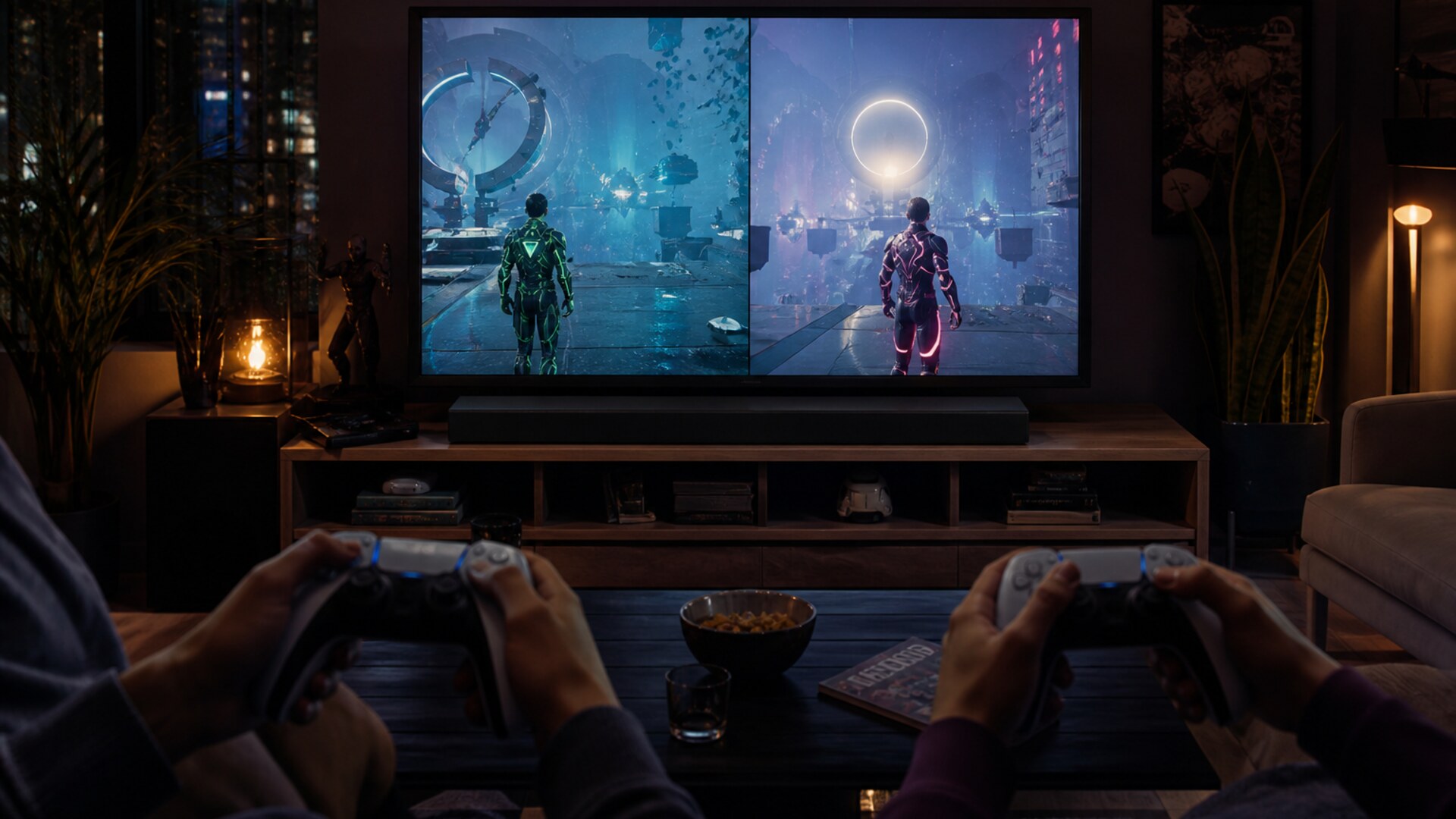
The culture scene is a living room that has been told it can be a machine again. Online play remains a marvel. It is also a treaty: accounts, latency, a friend who is dressing a digital character while you wait. Local split-screen is ruder and older. You sit next to the person. The glass divides because the friendship does not have to. Split Fiction supports both geographies. Some houses will run it on one television with two pads. Some will run it from two cities with the Friend’s Pass holding the cable. Both houses are playing the same campaign. Both houses are doing something the last decade of games kept forgetting how to price: they are buying one story for two bodies.
There is an industry lesson if you insist on one, and it is not a sermon about friendship. It is a shipping lesson. A two-player campaign can be a tentpole. It can clear a million in a weekend. It can still be on the chart a year later. It can land on a new Nintendo machine ninety-one days after the first street date and keep the same grammar. Publishers who spent the 2010s asking why they should split a screen when they could sell two copies have an answer in the April 2026 total. The second copy is a toll on the night. Take the toll down and the night gets larger. Seven million people paid for a game their friend could enter free. That is not charity. That is a market.
The design details are the fun half of the filing. Levels change their verb every twenty minutes. One room is a platform. The next is a rail. The next is a joke that only works if both of you are looking at the same gag. Critics reached for the same sentence they always reach for when a co-op game works: they did not want it to end. That is not a review score. That is a living-room report. A weekend is the right unit of time. You can finish it if the right person is on the other cushion, or on the other end of the Friend’s Pass, and if nobody has a raid calendar in the way.
Around this cart the smaller rooms have been shipping their own two-player objects. Tempete Studio put Lost in Tandem on Steam on 22 July for $14.99, hand-painted, a girl and a Mech-ute. Journey Bound Games put Wild Ice up on 19 August for $16.99, native split-screen, hockey against frost zombies. Firevolt’s WheelMates is due on 1 September with its own Friends Pass and no solo mode. Those are not Hazelight. They are weather. When the weather is good you get a dozen small gifts and one giant proof. Split Fiction is the proof. Seven million is the number on the proof.
This page will not offer a theory of the medium. It will report a dated object. 6 March 2025. 5 June for the Switch 2. $49.99. Co-op only. Friend’s Pass. Mio and Zoe. Josef Fares. EA Originals. More than seven million by April 2026. 97 percent on Steam. Two bodies, one story, puzzles that refuse a lone hero. Put the second controller on the table before anyone asks. If the second person is a city away, send the Pass. Civilisation, for one evening, is a split in the glass and a person who cannot finish this without you. That is an editorial position. It is also a reasonable reading of a year-old cart that is still selling.
The paper
Comments
No notes on this story yet.
Sign in to comment