Neuralink’s VOICE study is on ClinicalTrials.gov as NCT07224256, an early feasibility trial of a robotically implanted brain-computer interface for communication restoration. The page lists the site as The University of Texas Southwestern Medical Center in Dallas. Status: recruiting. Estimated enrollment: six. Start date: 3 October 2025. Primary completion: October 2028. Completion: October 2031. Those are the registry numbers. They are not a product launch.
The N1 implant, in that record, is meant to give an ability to communicate to adults with severe and irreversible speech production impairment and impaired upper limb function. Eligible diagnoses on the trial row are ALS, primary lateral sclerosis, stroke, or spinal cord injury. The R1 robot inserts the electrode threads. The implant is skull-mounted, wireless, and rechargeable. This is a speech stack. It is not Telepathy’s cursor.
The efficacy metric the registry actually names is CWPM: monthly maximum correct words per minute, followed for up to 48 months after implant. That is the number VOICE will be judged on if the study reports. Neuralink’s 28 January 2026 Telepathy post had already put two other speech numbers on the board, as company statements: participants on a ten-finger mental keyboard had reached typing speeds of up to 40 words per minute, and the aim through VOICE was conversational speed of 140 words per minute, reading signals from brain regions involved in speech production. Forty is typed. One hundred and forty is spoken, if the trial ever shows it. Keep the labels on.
The FDA Breakthrough Device designation for the speech indication is 1 May 2025. Neuralink’s own update that day: designation to help restore communication for people with severe speech impairment, including those affected by ALS, stroke, spinal cord injury, cerebral palsy, multiple sclerosis, and other neurological conditions. Reuters filed the tag the same Thursday. Breakthrough speeds review. It is not approval. It is not a finding that VOICE works.
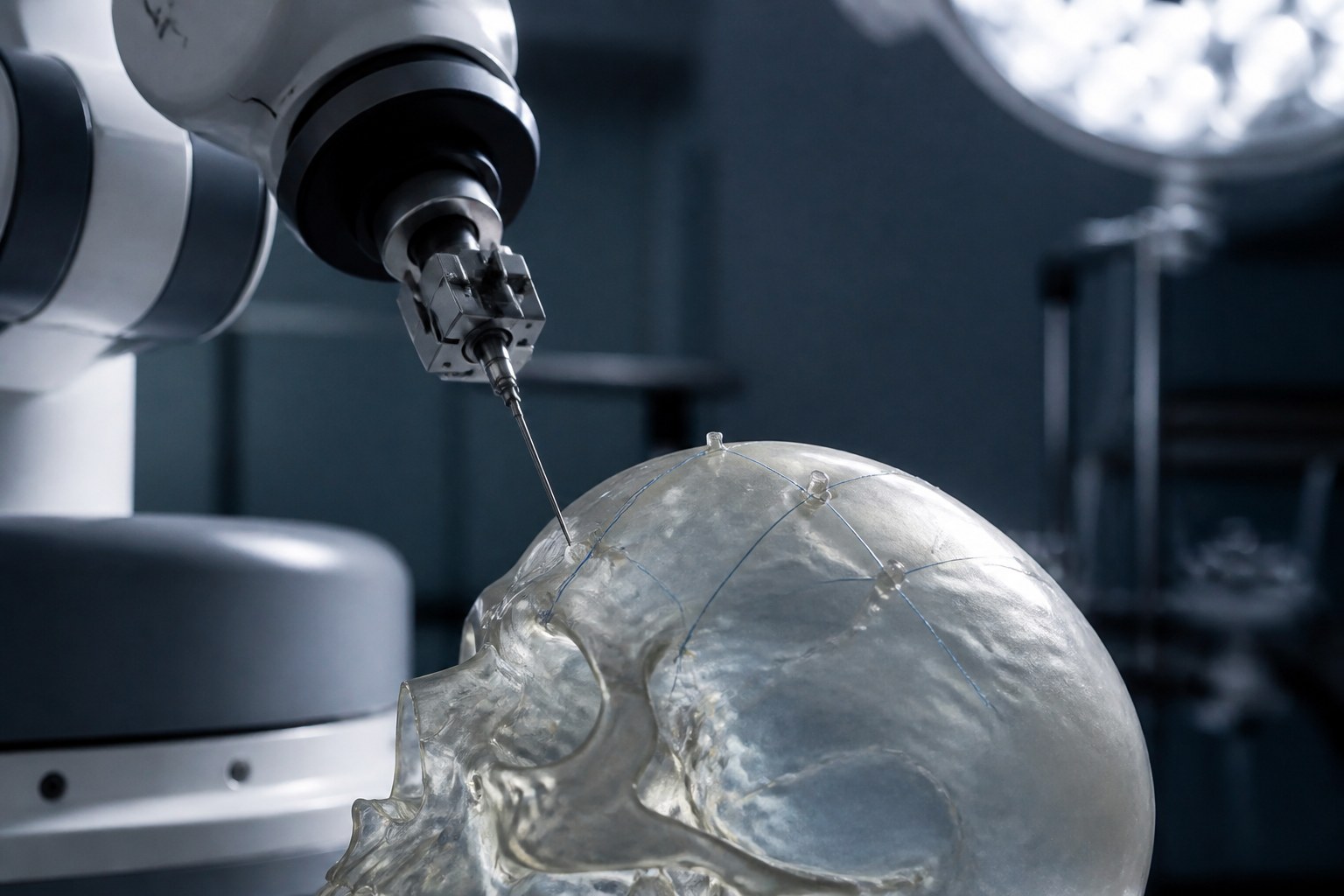
ClinicalTrials.gov is the primary source for the protocol shape. Study type: interventional. Phase: not applicable. Allocation: not applicable. Intervention model: single group. Masking: none. Six participants in one arm, estimated. The arm is implantation of the N1 by the R1. Sponsor: Neuralink Corp. Official title: VOICE: An Early Feasibility Study of a Precise Robotically Implanted Brain-Computer Interface for Communication Restoration. Early feasibility is a regulatory category. It means a small first look at safety and a preliminary look at whether the device does anything useful, not a pivotal trial and not a commercial roll-out.
Primary outcomes are safety, not poetry. The proportion of subjects with device-related adverse events at the 12-month follow-up. The proportion with procedure-related adverse events at the same visit. Secondary outcomes stretch to 48 months for those same adverse-event proportions, add a surgical metric (percent of electrodes inserted, of the total), and add the CWPM line. Twelve months is the primary safety clock. Forty-eight months is the long follow-up. October 2028 is when the registry says the primary completion should land. October 2031 is the study completion date on the same page. Six people. One site. Dallas.
Eligibility is narrow, as early feasibility usually is. Sex: all. Age: 22 to 75. No healthy volunteers. Inclusion, as written: adults with ALS, PLS, stroke, or spinal cord injury who have severe speech impairment and impaired upper limb function; life expectancy of at least 12 months; ability to communicate in English; a stable caregiver. Exclusion is a list of reasons not to put someone under an investigational robot this early: moderate to high risk for serious perioperative events, BMI over 40, poorly controlled seizures or epilepsy, poorly controlled diabetes, an ongoing need for MRI, immunosuppression, a psychiatric or psychological disorder, brain MRI showing haemorrhage, tumour, or adverse anatomy, or any condition the investigator thinks would make the implant unsafe. The registry is a filter. It is not a waiting room for a consumer gadget.
How speech BCI differs from cursor Telepathy is the whole point of a separate study. Telepathy, on Neuralink’s January post, records from the regions that would have driven the hands and arms. Participants imagine moving a hand, then a cursor, then, in Jake’s case, ten fingers on a mental keyboard, and the output is clicks and typed words. Forty words a minute is that pathway. VOICE, on the same post and on the registry, is supposed to read speech-production cortex and restore an ability to communicate for people whose problem is not only a missing hand but a missing voice. The output is words, scored as correct words per minute, not bits per second on a grid. Different cortex. Different indication. Different trial number. PRIME is the motor protocol. VOICE is NCT07224256. Do not collapse them.
Neuralink’s public trials board currently splits the work the same way. Control devices with your mind: active, for quadriplegia from spinal cord injury or ALS. Communicate with your thoughts: active, for severe speech impairment from ALS, stroke, spinal cord injury, or other conditions. See without your eyes: upcoming. VOICE is the middle tile. Recruiting, Dallas, n=6, start 3 October 2025. The Breakthrough letter in May 2025 is why the speech tile exists as a designated indication. The registry row in autumn 2025 is why it exists as a study. One does not replace the other.
Reuters, 1 May 2025, had Neuralink saying the designation covers ALS, stroke, spinal cord injury, cerebral palsy, multiple sclerosis, and other neurological conditions. The ClinicalTrials.gov inclusion list is tighter: ALS, PLS, stroke, or spinal cord injury, plus the speech and upper-limb requirements. File both. The Breakthrough sentence is broader than the six-person protocol. A designation is not an enrollment criterion. UT Southwestern is the site that is actually recruiting, according to the registry this desk fetched. If other sites later appear on that page, they will be later news.
What this page will not do is invent a first VOICE recipient, a spoken sentence, a reconstructed voice, or a words-per-minute result from a video this newspaper has not made a primary source. The January Telepathy post said the trial had launched and named the 140-word aim. The registry says recruiting, six, Dallas, 3 October 2025, primary completion October 2028. Those are the sourced lines. Secondary blogs that name a particular patient are not this file. The wrap still is a cortical texture, concept, not a patient. No living face.
The hardware nouns are the same family as Telepathy and a different job. N1 implant. R1 robot. Threads in the brain, a coin of device in the skull, a wireless, rechargeable link. ClinicalTrials.gov describes that stack in the VOICE summary. Neuralink’s January post described the scientific bet: even with an implant on one side, they were still getting strong signals from both hands in some motor participants, which is how the ten-finger keyboard appeared as a typing trick. Speech is not that trick. Speech is a different decoder, aimed at production cortex, scored in correct words per minute. If 40 words a minute was the typed ceiling they put on the motor path, 140 is the spoken target they put on VOICE. Target is not result. CWPM is how the result, if any, will be written down.
A six-person early feasibility study with a 2028 primary completion is a long corridor. Safety at 12 months is the first gate. Adverse events, device-related and procedure-related, are the primary endpoints. Words per minute is secondary. That order is the honest one. Breakthrough designation on 1 May 2025 got the indication into a faster FDA inbox. It did not skip the inbox. Neuralink devices in this program remain investigational. They are not on a shop shelf. The Patient Registry on the company’s site is how people ask to be considered. Asking is not enrolling. Enrolling six people in Dallas is the study.
File the speech trial. NCT07224256. UT Southwestern, Dallas, recruiting. Enrollment listed as six. Start 3 October 2025. Primary completion October 2028. Completion October 2031. CWPM as the speech metric. Breakthrough Device designation 1 May 2025, Neuralink and Reuters. Forty words a minute on the motor typing path, 140 as the conversational aim, both as Neuralink stated them in the 28 January Telepathy post. The cursor is Telepathy. The voice is VOICE. Different product. Different number. This newspaper will wait for the CWPM table before it prints a conversation.
The paper
Comments
No notes on this story yet.
Sign in to comment